ASML’s Power Comes From Making the Almost Impossible Repeatable
Lithography links Dutch engineering to global chip investment. Its technology, service income, cash flows and expansion plans reveal the industrial demands behind a unique market position.
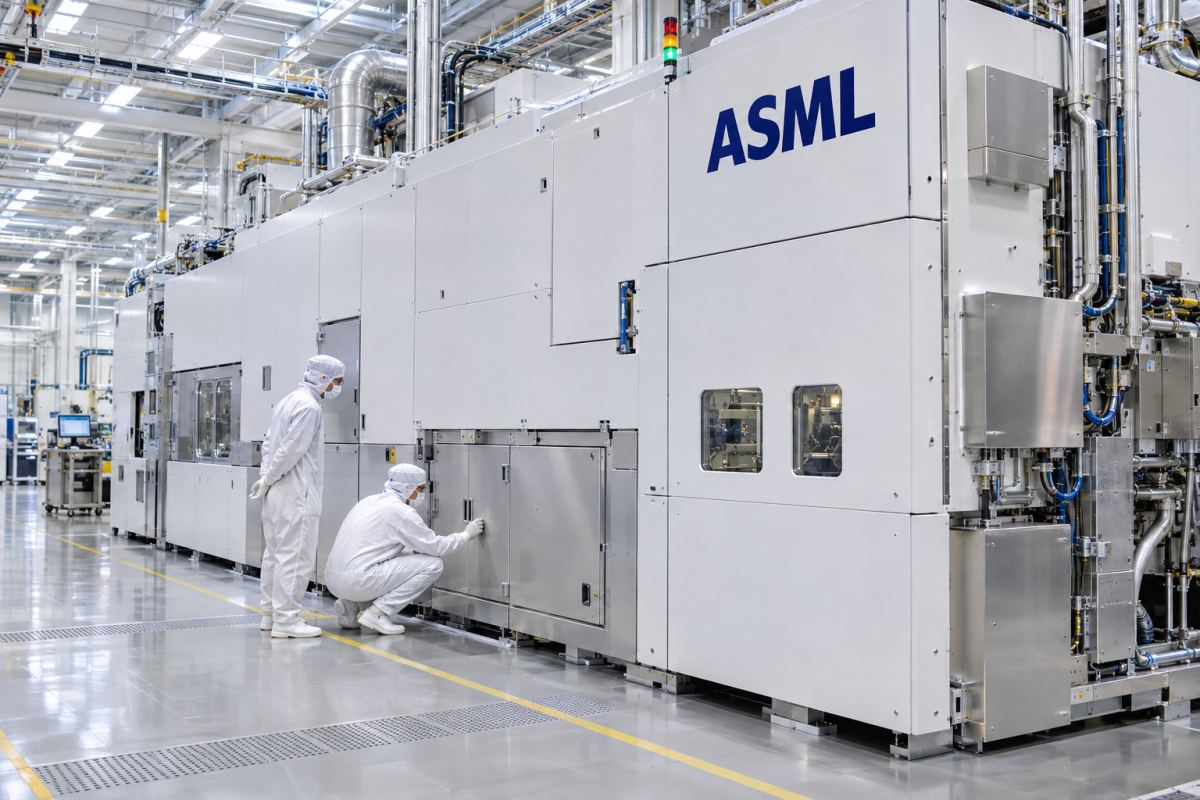
Before an advanced chip can power a computer, its patterns must be reproduced on silicon with extraordinary precision. ASML builds the systems that make a crucial part of that process possible. Its position in lithography gives a Dutch industrial company influence across a semiconductor economy often associated with American chip designers and Asian factories. The products are physical machines, but their value lies in the manufacturing capability they enable.
At approximately $522.87 billion in the November 5, 2026 stock-market snapshot, ASML's equity valuation reflected far more than the accounting value of its equipment and buildings. It reflected expectations about future chipmaking investment and the difficulty of reproducing its technology. The business remains exposed to industrial execution, customer spending and political decisions, even when demand for its most sophisticated systems appears exceptionally strong.
An industrial position built over decades
ASML began in 1984 as a joint venture between Philips and ASM International. The early operation worked from a modest building in Eindhoven before moving to Veldhoven in 1985. That origin matters because its eventual position was not created by one invention appearing fully formed. Lithography required repeated advances in optics, mechanics, light sources, software and manufacturing, supported by customers and specialist suppliers over many years.
The company became independently listed in Amsterdam and New York in 1995. Access to capital supported a business whose development costs arrived well before the full commercial payoff from its most ambitious technologies. Its history illustrates an unusual kind of industrial compounding: progress in one machine generation creates knowledge, customer relationships and a service base that can support the next, provided the new technology eventually meets factory requirements.
ASML now supplies extreme ultraviolet, or EUV, lithography systems commercially on a unique basis. That position should be described precisely. It does not make every machine used to manufacture semiconductors, and older lithography technologies still have important applications. Its deep ultraviolet systems, inspection and measurement capabilities, software and customer support contribute to a wider product offering than the flagship EUV scanners alone.
Why light creates a business advantage
Lithography transfers patterns onto a light-sensitive layer on a wafer. Success depends on resolving extremely small features and repeatedly aligning patterns with those already formed. In EUV systems, light with a wavelength of 13.5 nanometers travels through an optical system using highly specialized mirrors. Conventional glass lenses would not perform the same role at that wavelength. The precision of the entire system matters as much as the headline description of its light source.
ASML's relationship with ZEISS, which supplies the critical optics, illustrates why this is an ecosystem rather than a self-contained factory. Specialized components must perform together inside a machine that customers can use reliably in production. Competitors would need more than a laboratory demonstration of EUV light to reproduce that capability. They would need an economically useful manufacturing system, a supply chain and a support organization that customers could trust.
The next generation, known as High NA, increases numerical aperture, a measure related to the optical system's ability to resolve detail. It aims to support further advances in chipmaking, but adoption depends on customers' process choices, productivity and cost. A technically impressive tool is commercially valuable when its use improves the economics of manufacturing. Faster development does not eliminate the need for careful qualification inside customers' factories.
The installed machines keep producing revenue
Selling a new system is only one part of the relationship. Machines need service, spare parts, software and upgrades that improve their performance. ASML calls the relevant revenue installed base management, comprising net service and field option sales. This gives the company an ongoing commercial connection to customers after a machine is delivered, while placing continuing demands on its own engineering and support resources.
In calendar 2025, total net sales were €32.667 billion. Systems contributed €24.474 billion and service and field options €8.193 billion. The service category grew 26.2%, faster than systems sales at 12.4%. The mix helps explain why counting shipments alone cannot fully describe the business. Upgrading an existing machine can create revenue and improve a customer's output without adding another system to its factory floor.
ASML's US GAAP net income for 2025 was €9.609 billion, with basic earnings of €24.73 per ordinary share. Total assets at year-end were €50.567 billion. Keeping the accounting basis consistent matters: the company also reports under European-adopted IFRS, which can produce a different profit figure. Combining one set of earnings with another set of comparatives would create an apparent trend that does not faithfully represent either presentation.
Cash generation supports expensive development
Research and development expense reached €4.699 billion in 2025. Operating cash flow was €12.659 billion, while purchases of property, plant and equipment and intangible assets totaled €1.631 billion. The company's free-cash-flow measure, after those purchases, was €11.027 billion. Development costs, factory investment and working capital each play a different role in turning technical leadership into a sustainable business.
The third quarter of 2026, ending September 27, showed how quickly the financial scale can change. Net sales reached €11.662 billion, including €3.289 billion from service and field options. Operating income was €5.173 billion and net income €4.960 billion, with a gross margin of 57.5%. The result included a €510 million gain on an equity investment outside operating income; the entire bottom line should not be attributed to manufacturing profit alone.
Operating cash inflow for the quarter was €11.798 billion. Working-capital movements were a major contributor, highlighting the importance of customer payments and advances in this business. Cash received before a machine's revenue is recognized can strengthen liquidity, but it also comes with future delivery obligations. A large quarterly inflow is therefore not a recurring profit measure to multiply by four and label as annual earnings.
At quarter-end, assets stood at €58.981 billion. Cash and equivalents were €8.031 billion, with a further €4.704 billion in short-term investments. Property, plant and equipment was €8.077 billion. Non-current contract liabilities had risen to €9.301 billion from €3.366 billion at the previous year-end. Those balances help explain why cash generation, recognized revenue and obligations to customers need to be read together.
Demand visibility meets the limits of supply
Chief executive Christophe Fouquet said customers were increasing equipment-demand forecasts, driven mainly by their expectations for AI investment. ASML's October outlook called for full-year 2026 sales of €44 billion to €45 billion and a gross margin around 56%. These were management forecasts, not completed annual results. Their realization depends on production, shipment, acceptance and the broader conditions affecting customers' spending plans.
The company planned to increase capacity for conventional EUV and DUV immersion systems by 30% in 2027 and was investigating further expansion for 2028. Such plans require suppliers, trained people, facilities and disciplined coordination. A bottleneck can protect a supplier's commercial position while also limiting revenue it can recognize. Promised capacity is not the same as fully qualified machines already operating at customers' sites.
Export restrictions add another dimension. The ability to ship particular systems or supply services can depend on licenses and changing national-security rules. This is an economic risk as well as a political issue: restrictions can alter geographic sales, customer investment and the value of service relationships. Technological importance gives ASML strategic relevance, but it does not place the company outside the jurisdiction of governments or remove its dependence on international trade.
The shareholder owns an industrial commitment
ASML's ordinary shares trade in Amsterdam and on Nasdaq under ASML. During the third quarter, the company bought approximately 2.8 million shares for about €4.1 billion and paid an interim dividend of €1.88 per share. Those distributions coexist with research and capacity commitments. Their sustainability depends on cash generation across the equipment cycle, while the value created by repurchases depends partly on the price paid.
Its stock-market valuation is quoted here in dollars, whereas its financial accounts are presented in euros. Dividing those numbers without a consistent exchange-rate basis would produce a misleading valuation multiple. The more durable question is whether future demand, technical progress and service income justify the expectations embedded in the shares. Even a uniquely positioned supplier must earn the return that its stock price assumes.
ASML has built a business around making an extraordinarily difficult industrial task repeatable. Its advantage comes from decades of integration, specialized partners and experience inside semiconductor factories. The next test is to expand that capability while keeping machines productive, customers supplied and investment disciplined. The importance of advanced chips supports its opportunity; delivering the tools economically determines how much of that opportunity ultimately belongs to shareholders.