Berkshire Hathaway’s Capital Machine Enters a New Leadership Era
Insurance, railways and operating companies support a distinctive system for allocating money. Berkshire’s history, balance sheet and succession explain what shareholders own beyond Buffett’s reputation.
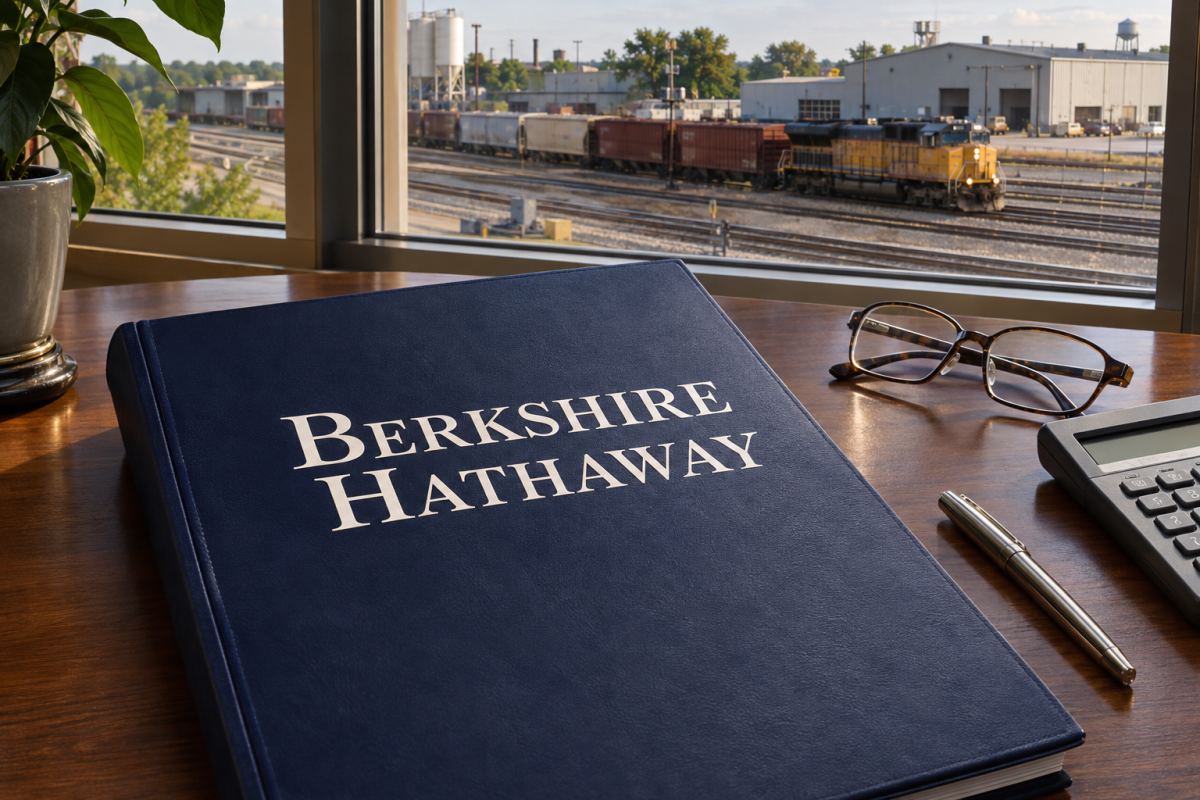
A railway, an insurance policy and a box of chocolates would usually belong in separate business stories. At Berkshire Hathaway, they belong in the same financial system. Money generated by one operation can help finance another, buy a listed investment or remain available for a future opportunity. The group's defining product is, in a sense, the allocation of capital among businesses with very different needs.
That system had a market capitalization of approximately $1.225 trillion in the November 5, 2026 snapshot. It is often described through Warren Buffett's investment record, but understanding Berkshire today also requires looking at its operating companies, insurance obligations and new leadership. The challenge is to see how the organization works beyond the reputation of the person who built it.
How a textile company became something else
Buffett took control of Berkshire in 1965 when it was a New England textile business. The subsequent transformation depended on moving capital toward more attractive activities. The purchase of National Indemnity and its companion insurer in 1967 was a decisive step. Insurance introduced a source of investable funds with economics very different from manufacturing textiles.
The crucial mechanism is insurance float: funds associated with insurance obligations that remain available before claims and other amounts must be paid. An insurer can invest those funds, but it must be able to meet its promises. Float therefore belongs in a discussion of financing and risk, rather than being treated as free shareholder money. Its value depends on underwriting discipline, investment returns and the timing of payments.
Berkshire expanded into a collection of businesses, including GEICO, manufacturing operations, retailers and energy utilities. The acquisition of BNSF in 2010 added one of North America's major freight railway systems. These operations brought different customers and economic cycles. They also brought substantial requirements for equipment, maintenance, labor and investment, making Berkshire much more than a portfolio of publicly traded shares.
The model allows managers to concentrate on their businesses while headquarters makes major capital decisions. In principle, cash from an operation with limited opportunities for reinvestment can support one with attractive expansion prospects. That flexibility can be valuable, but it depends on judgment. A diversified structure does not automatically improve a bad acquisition or make a low-return project attractive.
Two kinds of ownership, two ways of reading earnings
Berkshire owns operating subsidiaries and also holds minority interests in listed companies. The distinction affects the accounts. Revenue from a consolidated business appears within the group's financial statements; Berkshire does not add the full revenue of a company merely because it owns some of its shares. The listed investment instead contributes through the applicable accounting for income and changes in value.
For the year ended December 31, 2025, Berkshire reported revenue of $371.444 billion. Net earnings attributable to its shareholders were $66.968 billion. Investment gains were presented separately from revenue. Treating movements in stock prices as if they were additional sales from the railway, insurance or retail businesses would confuse fundamentally different sources of financial performance.
The company also reported operating earnings of $44.486 billion for 2025. Berkshire defines this as an after-tax measure that excludes investment gains and losses and specified impairments. It is not the same as the conventional pre-tax operating profit shown by many industrial companies. The reconciliation included $30.737 billion of after-tax investment gains and $8.255 billion of impairments of equity-method investments.
That distinction helps explain why a large movement in reported net income may say relatively little about the underlying operating companies. Market prices can change without Berkshire selling its shares. Conversely, excluding investment changes does not make those investments irrelevant to owners. Reading both measures gives a more useful picture than deciding that only one of them matters.
The operating earnings breakdown also shows the breadth of the group. In 2025, insurance underwriting contributed $7.258 billion and insurance investment income $12.513 billion. BNSF contributed $5.476 billion, Berkshire Hathaway Energy $3.979 billion, and manufacturing, service and retailing businesses $13.647 billion. These are after-tax contributions within Berkshire's presentation, not separate amounts to add again to consolidated net earnings.
A balance sheet designed to preserve choices
At December 31, 2025, Berkshire's assets totaled $1.222 trillion. By June 30, 2026, they had reached $1.263 trillion. Assets include investments and operating resources, but liabilities stand against them. Shareholders' equity attributable to Berkshire at the June date was approximately $747.9 billion. Comparing market capitalization with total assets as if both measured owners' net wealth would miss that difference.
At June 30, insurance and other businesses held $359.2 billion in cash, equivalents and US Treasury bills, net of amounts payable for unsettled purchases. The scope of that figure matters: it is not simply a bank balance for the entire group. The resources give Berkshire room to meet obligations and make investments without having to depend on favorable funding conditions at precisely the right moment.
Insurance float was approximately $177.5 billion at the same date. Its presence helps explain the investment system, but the associated claims do not disappear because money is invested. Catastrophes, unexpected claims development and mistakes in pricing risk can change the economics. Conservatism in liquidity is especially relevant when some future payments have uncertain amounts and timing.
Other businesses need capital too. Berkshire generated approximately $21.7 billion of operating cash flow in the first half of 2026 and spent $10.6 billion on property, equipment and equipment held for lease. Railways and utilities require continuing investment to operate and expand. Their economic value must be assessed after considering those needs, rather than treating every dollar of earnings as immediately distributable cash.
New management, familiar capital decisions
Greg Abel became chief executive at the start of 2026. In September, Howard G. Buffett became chairman, while Warren Buffett became chairman emeritus and remained a director. The distinction is important: Berkshire's current operating leadership cannot accurately be described as Warren Buffett continuing in both the chief executive and chairman roles. Succession is now an operating reality, not merely a future plan.
The latest actual quarterly results available by the November 5 cutoff were for the second quarter. Revenue was $101.808 billion and net earnings attributable to shareholders $25.667 billion. Operating earnings were $12.983 billion, compared with $11.160 billion a year earlier. The third-quarter release was scheduled for November 7, so forecasts for that period were not yet reported results.
Acquisitions demonstrate that the investment system continues to operate. Berkshire completed its purchase of OxyChem in January 2026 for approximately $9.4 billion. It acquired homebuilder Taylor Morrison in July for approximately $6.8 billion in cash consideration. The latter came after the June balance-sheet date, which matters when comparing the latest reported asset base with the businesses the group subsequently owned.
Share repurchases provide another use for capital. Berkshire bought back approximately $4.8 billion of stock in the first half of 2026. Its program depends on management judging the shares to be below conservatively assessed intrinsic value and maintaining a minimum liquidity level. It is not a promise to spend a fixed amount regardless of the price.
What an investor buys through the two share classes
Berkshire's shares trade on the New York Stock Exchange as BRK.A and BRK.B. Class B has one-fifteen-hundredth of Class A's dividend and distribution rights, but one-ten-thousandth of its voting rights. A Class A share can be converted into 1,500 Class B shares; the reverse conversion is not available. The lower share price of Class B therefore does not describe a separate, smaller collection of operating businesses.
The company has not declared a cash dividend since 1967. Owners have instead relied on the value created through retained capital and, when management considers them appropriate, buybacks. At the November snapshot, the equity market value was roughly 1.6 times June shareholders' equity attributable to Berkshire. Book value is an accounting reference, not a complete appraisal of the earning power of every subsidiary.
Berkshire's next chapter will test the endurance of an institution built around judgment, financial strength and patience. Its risks include insurance losses, utility liabilities, industrial cycles and the possibility of deploying large sums poorly. Its advantage is the ability to consider many uses for capital without being forced to choose immediately. The question for shareholders is how effectively the new leadership converts that freedom into lasting value.