Broadcom Turns AI’s Need for Chips and Connections Into Cash
Specialized semiconductors and acquired software made Broadcom an infrastructure giant. Its history, cash flows and latest AI growth reveal the strengths and dependencies behind its valuation.
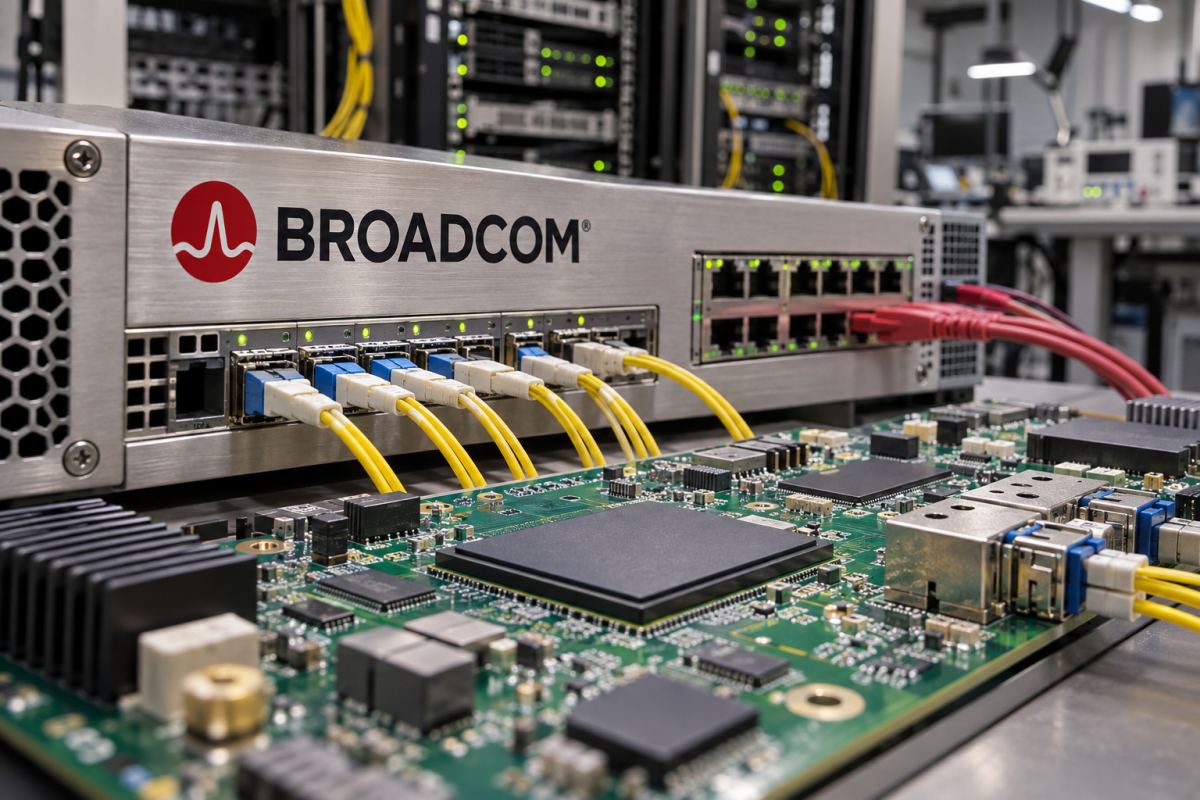
An artificial intelligence system is only as useful as the equipment that lets its processors exchange information. Behind the models and conversational interfaces are chips moving data among servers, racks and networks. Broadcom occupies that less visible layer of the technology economy. It also sells software that businesses use to run essential computing systems, giving it a second source of revenue beyond semiconductors.
That combination helped place Broadcom among the world's largest listed companies. In the market capitalization snapshot of November 5, 2026, its equity was valued at approximately $1.391 trillion. To understand the valuation, it is useful to follow two connected histories: the accumulation of specialized chip technology and the acquisition of software businesses embedded in customers' operations.
A technology group assembled across generations
Broadcom's corporate ancestry reaches into Hewlett-Packard and AT&T's Bell Laboratories, among other businesses. The modern group did not emerge from one uninterrupted line of products. Avago, established in 2005, became the vehicle for assembling technology and engineering capabilities through acquisitions. Its 2016 combination with Broadcom Corporation brought the Broadcom name to the enlarged company.
The strategy subsequently crossed more decisively into software. CA joined in 2018, followed by Symantec's enterprise security business, while the VMware acquisition closed in November 2023. These deals expanded the company from components inside devices and networks to programs used to operate corporate computing environments. They also created a business whose history is visible in its balance sheet, through substantial goodwill and acquired intangible assets.
Buying a business brings customers, technology and engineers more quickly than building every capability internally. The financial outcome depends on what happens afterward: retaining customers, developing products, controlling expenses and generating enough cash to justify the purchase price. Acquisition history therefore tells only part of Broadcom's story. The durability of the acquired businesses matters more than the number of transactions completed.
Chief executive Hock Tan leads a group focused on infrastructure that organizations need even when consumers barely recognize the supplier. Broadcom's products support networking, wireless connectivity, storage and other applications. Their commercial value often lies in solving a specific technical problem inside a much larger system, rather than putting the company's brand on the finished product a customer buys.
Why AI needs custom chips and connections
The semiconductor business includes custom accelerators and networking products for AI. A custom chip is designed around a customer's requirements, potentially matching particular workloads more closely than a general-purpose product. Such relationships can involve extensive engineering cooperation. They also create dependence on the customer's deployment plans: winning a design does not guarantee an unlimited or perfectly predictable stream of orders.
Networking matters because processors need to receive information and work together. Increasing computing power without moving data effectively can leave expensive hardware waiting. Broadcom sells technology addressing those connections, including Ethernet switching and optical components. Its opportunity extends across the system surrounding AI computation, which helps explain why its growth cannot be assessed solely by comparing one accelerator with another.
Broadcom outsources most manufacturing operations, including much of its wafer production, to external providers such as TSMC. It retains internal facilities for certain specialized processes. The distinction matters financially. A company can support a vast semiconductor business without owning all the factories making its products, but it then depends on suppliers for capacity, technology and execution.
The software side has a different relationship with infrastructure. VMware's products help organizations manage private and hybrid computing environments, while other acquired businesses serve security and established enterprise systems. Replacing such software can require time, staff and changes to operating processes. That can make customer relationships durable, but customers still weigh prices, service quality and alternatives when deciding what to renew or replace.
What the latest annual accounts actually show
For the fiscal year ended November 2, 2025, Broadcom reported revenue of $63.887 billion, up 24% from the previous year. Semiconductor solutions contributed $36.858 billion and infrastructure software $27.029 billion. Software represented approximately 42% of sales. Describing Broadcom simply as an AI chip company would therefore leave out a large part of its latest full-year business.
Annual operating income was $25.484 billion, while net income reached $23.126 billion. The income statement included a net tax benefit, illustrating why after-tax earnings do not move solely with sales and operating expenses. Management's adjusted figures exclude specified items, including costs associated with acquisitions and share-based compensation. Those measures can assist comparisons, but they should remain distinct from the reported accounting results.
At the fiscal year-end, assets totaled $171.092 billion. Goodwill of $97.801 billion and net intangible assets of $32.273 billion together represented about three-quarters of that amount. Property, plant and equipment was much smaller, at $2.530 billion. This is a balance sheet shaped by acquisitions, intellectual property and customer relationships, rather than a direct inventory of semiconductor factories.
Goodwill is the accounting residue of paying more for a business than the recognized value of its identifiable net assets. It is not money waiting in a bank account. The practical question is whether the acquired operations keep producing enough value to support the investment. If expectations deteriorate materially, an impairment can affect earnings even without a new cash payment in that period.
A quarter transformed by AI demand
The most recent published results at the November cutoff were for the third fiscal quarter ended August 2, 2026, released September 2. Revenue rose 86% to $29.591 billion. Semiconductor sales reached $20.839 billion, up 127%, while infrastructure software revenue increased 29% to $8.752 billion. AI was changing the mix even as software continued to grow.
Broadcom reported AI semiconductor revenue of $16.7 billion, up 221% year over year. That is a subset of semiconductor revenue, not an additional business to add to the group total. The company linked the expansion to custom accelerators and networking. It also forecast further growth, but an outlook remains a management expectation rather than evidence that the next quarter's revenue has already been earned.
Reported operating income reached $15.955 billion and net income $13.088 billion. Operating cash flow was $14.197 billion; after $532 million of capital expenditure, free cash flow was $13.665 billion. The difference between this direct capital spending and the vast cost of building chip factories helps illustrate the effect of outsourcing. It does not eliminate research, supplier commitments or the cash cost of acquisitions.
Assets had increased to $188.148 billion by August 2. Cash and equivalents totaled $23.975 billion, while short-term and long-term debt on the balance sheet together amounted to approximately $59.4 billion. The ability to generate cash therefore supports several claims at once: developing products, servicing debt and returning funds to investors. The quarterly dividend was $0.65 per common share.
The advantages and limits of being essential
The annual filing disclosed that one customer accounted for 32% of 2025 revenue. Broadcom sells through direct relationships and distribution channels, so the figure should not casually be assigned to an unidentified end customer. It nevertheless demonstrates concentration. A large customer's timing, bargaining power or change in technology can matter even when the supplier has a broad collection of products.
The risk also runs through the supply chain. Advanced manufacturing capacity, packaging and critical components have to be available when customers need finished systems. Export restrictions, geographic disruptions and shifts in AI investment can affect the business. A technically important component may command attractive economics, but it is still part of a system in which several other organizations make consequential decisions.
Broadcom's Nasdaq shares trade as AVGO. Dividing the November snapshot capitalization by reported 2025 net income gives a historical multiple of roughly 60 times earnings. The comparison uses a completed fiscal year, including its tax effects; it does not measure what the fast-growing business will necessarily earn next. The valuation incorporates expectations about maintaining important positions as customers spend more on computing.
Broadcom's rise demonstrates how specialized technology can become a large business without being a household name. Its next test is to keep earning that importance: providing products customers need, preserving the value of acquired software and converting rapid AI demand into durable cash flows. The infrastructure may be hard to see from a phone screen, but its economics are increasingly difficult for investors to ignore.