Japan could fall to sixth among the world's largest economies in 2027: understanding the IMF forecast
India and the UK are projected to overtake Japan in nominal GDP measured in dollars. The comparison reflects growth and the yen's exchange rate; it does not mean Japanese output or living standards will suddenly fall.
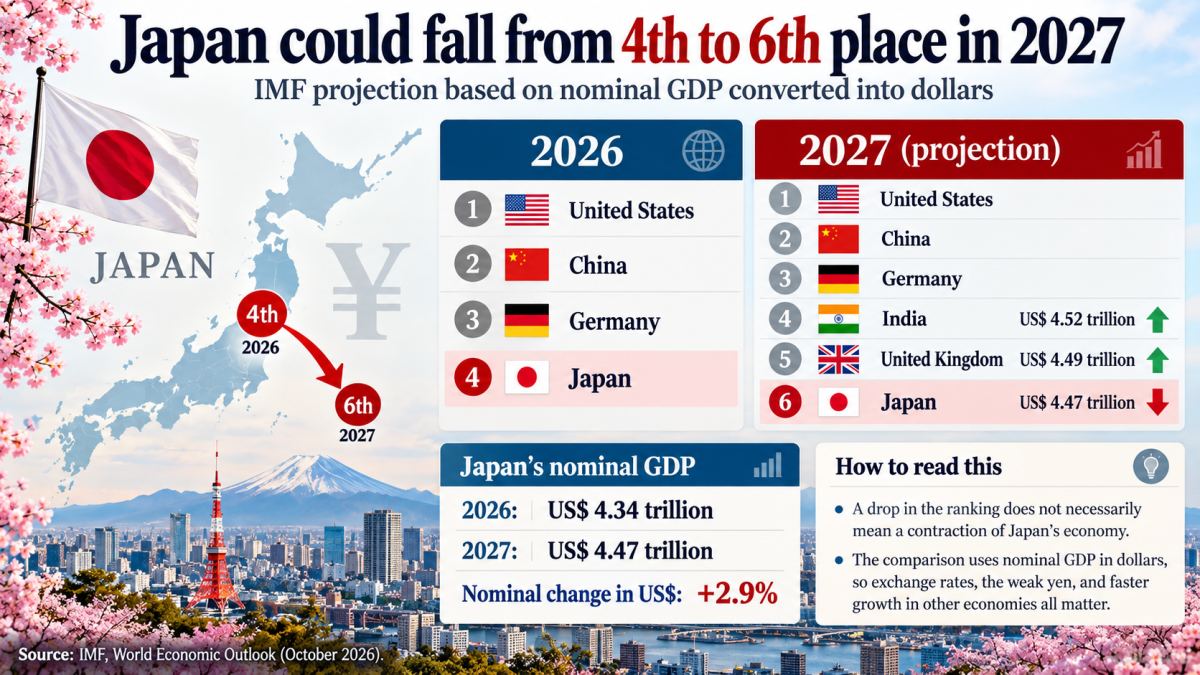
Japan could slip from fourth to sixth among the world's largest economies in 2027, behind India and the UK, according to International Monetary Fund projections reported by TBS. There is an important qualification: the ranking compares nominal gross domestic product converted into dollars. Growth in other countries and a weak yen influence the result alongside economic activity in Japan.
The report, published by TBS on October 14 and based on the October edition of the World Economic Outlook, puts Japan's GDP at $4.3419 trillion in 2026 and $4.4676 trillion in 2027. Japan would remain fourth this year, behind the United States, China and Germany. India and the UK are projected to overtake it the following year; that has not happened yet.
The figures themselves help put the headline in perspective. The value projected for Japan in 2027 is approximately 2.9% higher than in 2026. That calculation measures a nominal change in dollars, not real economic growth. Even so, it illustrates how a country can fall in a ranking without its total value declining: others need only grow faster and move ahead.
The yen also changes an economy's measured size
GDP measures the value of final goods and services produced within a country over a given period. Nominal GDP uses current prices; real GDP seeks to distinguish changes in output from changes in prices. Confusing the two can turn an international comparison into a misleading account of what is happening in factories, offices and shops.
Ranking economies that use different currencies also requires a common unit. Converting to dollars brings exchange rates into the calculation. If the yen weakens against the dollar, the same amount in yen is worth less when converted, even though the currency movement alone does not mean fewer cars were made or fewer services provided.
The reverse is also true: a stronger currency can raise the dollar value without a corresponding increase in the quantity produced. A nominal ranking therefore provides information about economic size at market exchange rates, but it is not enough to diagnose a recession. TBS points specifically to a weak yen and faster growth elsewhere as the explanation for the forecast.
A global ranking does not measure a family's living standards
Another common comparison uses purchasing power parity, or PPP. The IMF explains that this measure takes account of the cost of comparable goods and services in different countries, rather than relying solely on market exchange rates. It is particularly relevant to goods and services consumed locally, whose prices can vary widely.
No single ranking answers every question. Market exchange rates are appropriate when comparing figures tied to international financial transactions. Purchasing power parity helps assess how much a currency can buy in goods and services within an economy. Changing the measure can change countries' relative weight.
Neither aggregate national figure is, on its own, a measure of an individual's standard of living. A larger total GDP does not establish how much each resident receives or how income is distributed. Nor does it fully describe housing costs, the quality of services or unpaid work. The projected change in ranking does not establish that a Japanese family will live less well than a British or Indian one.
A forecast shaped by energy, trade and productivity
The October edition of the IMF report uses information available through October 1, 2026. That cutoff matters: the projections do not automatically incorporate every subsequent event. The organization updates its outlook database twice a year, in April and October, and its estimates can change as new data and assumptions become available.
The report projects global growth of 3.1% in 2026 and 3.4% in 2027, against a backdrop of pressure on energy importers and geopolitical and trade risks. Those are rates for the world economy, not Japan. They help frame an international outlook in which individual countries may follow a different path from the initial forecast.
The Fund also stresses the need to rebuild fiscal space and improve productivity. It recommends that support for those facing hardship be temporary and targeted, rather than taking the form of broad measures to hold down prices. That guidance addresses a wider tension: protecting incomes today without undermining governments' ability to respond to future crises.
For Japan, the forecast's value lies in raising those economic questions as well as identifying a place in a table. Real output, prices and the yen will need to be monitored to distinguish what is driving each revision. Sixth place is a scenario for 2027 under a particular measure. Treating it as a decline that has already happened would obscure both the forecast's limitations and the changes it is seeking to anticipate.