U.S. ends fiscal year with a nearly $2 trillion deficit and a growing interest burden
The shortfall widened by 12.2% from the previous fiscal year. Revenue increased, but spending grew faster, while annual net interest costs exceeded $1 trillion for the first time.
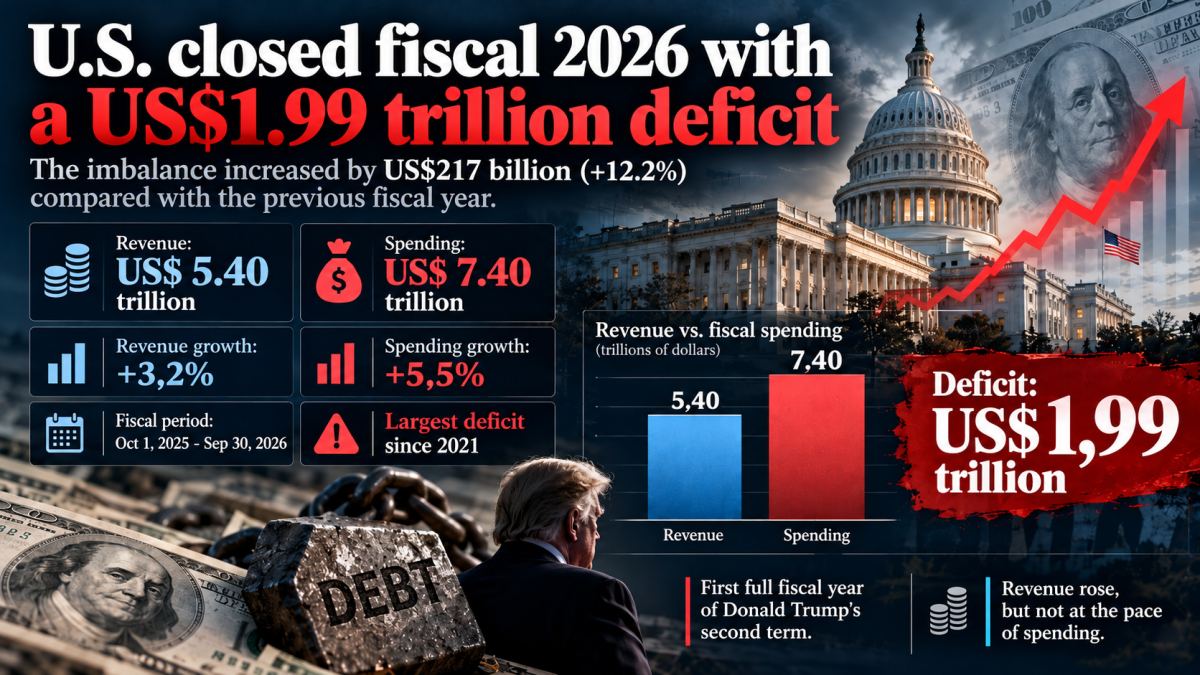
The United States ended fiscal 2026 with a $1.99 trillion deficit, about $217 billion more than in the previous fiscal year. Figures released by the Treasury Department on Friday, October 16, show the shortfall widened by 12.2%, as interest costs put increasing pressure on federal finances.
The government collected $5.40 trillion and spent $7.40 trillion. Revenue increased, but not quickly enough to keep pace with outlays: receipts rose by approximately 3.2%, while spending grew by 5.5%. The gap between them widened again.
The figures cover October 1, 2025, through September 30, 2026. They are neither a forecast through December nor a total for the first nine months of the calendar year. This was the first full fiscal year of Donald Trump’s second term.
Reuters described it as the largest deficit since 2021, when pandemic-related measures pushed the shortfall to $2.77 trillion. The latest annual figures bring the debt debate back to a basic question: how much of Washington’s spending can it cover with the money it collects?
Revenue rises, but spending rises faster
The year-over-year comparison shows the scale of the problem. Federal revenue rose from about $5.23 trillion to $5.40 trillion. Spending, meanwhile, increased from approximately $7.01 trillion to $7.40 trillion. The roughly $169 billion gain in revenue was outweighed by nearly $386 billion in additional outlays.
Calculated from Treasury’s totals, roughly $27 out of every $100 spent during the fiscal year was not covered by revenue collected over the same period. That proportion describes the overall funding gap; it does not mean that every federal program relied on borrowing to exactly the same extent.
September, the final month of the fiscal year, ended with a deficit of about $26.9 billion. The same month a year earlier recorded a surplus of nearly $197.9 billion. Monthly results can fluctuate considerably because of the timing of payments and receipts, making the annual balance a broader basis for comparison.
Net interest costs top $1 trillion
Financing the debt is taking up an increasing share of the budget. Under Treasury’s classification of spending by function, net interest totaled $1.05 trillion in fiscal 2026, compared with about $970.4 billion the previous year. That was an increase of approximately 8.4%.
Net interest exceeded national defense spending, which reached around $965.2 billion under the same classification. It also came close to Medicare’s $1.07 trillion, while Social Security accounted for approximately $1.67 trillion.
Net interest should be distinguished from broader measures of interest payments. Comparing different categories can produce misleading rankings of the government’s biggest expenses. Here, the comparison uses spending categories from the same official table.
Interest costs matter because they reflect obligations associated with financing debt, rather than the introduction of a new service. As those costs rise, a larger share of the budget goes toward meeting financial commitments. Reducing them does not depend on a single decision: both the amount of debt and the terms on which it is financed play a role.
Tariff refunds reduce net revenue
Tariff revenue also came under pressure during the fiscal year. Reuters reported that Treasury refunded about $145 billion in tariffs after the Supreme Court invalidated a substantial portion of the levies Trump had imposed.
According to that report, net tariff revenue came to nearly $173 billion, about $22 billion less than in the previous fiscal year. That represented a decline of approximately 11%.
The result shows why gross receipts alone are insufficient to assess tariffs’ contribution to the budget. Refunds change the amount left available. Even before considering the effects on businesses and consumers, the fiscal contribution needs to be measured after those repayments.
The political cost of closing the gap
The debate also reaches household finances. Speaking to NPR, Carolyn Bourdeaux, who heads the fiscal watchdog group Concord Coalition, argued that the government’s borrowing needs put upward pressure on interest rates, making it harder to buy homes and cars or finance small businesses.
That is her assessment of the shortfall’s consequences. The fiscal report alone cannot predict how far mortgage rates will rise or fall: rates also depend on inflation, monetary policy decisions and market conditions.
Marc Goldwein of the Committee for a Responsible Federal Budget told the same broadcaster that controlling the deficit requires cutting spending, increasing revenue or combining the two. He warned that the options could prove unpopular.
The fiscal 2026 figures do not resolve that political disagreement, but they establish its starting point. Washington collected more money and still ended up needing more additional financing. Rising interest costs make it harder to postpone indefinitely the debate over which commitments to maintain and how to pay for them.