U.S. inflation climbs to 3.7% as gasoline squeezes households and tests the Fed
Consumer prices rose 0.6% in September, with gasoline accounting for more than half the increase. Annual core inflation also picked up.
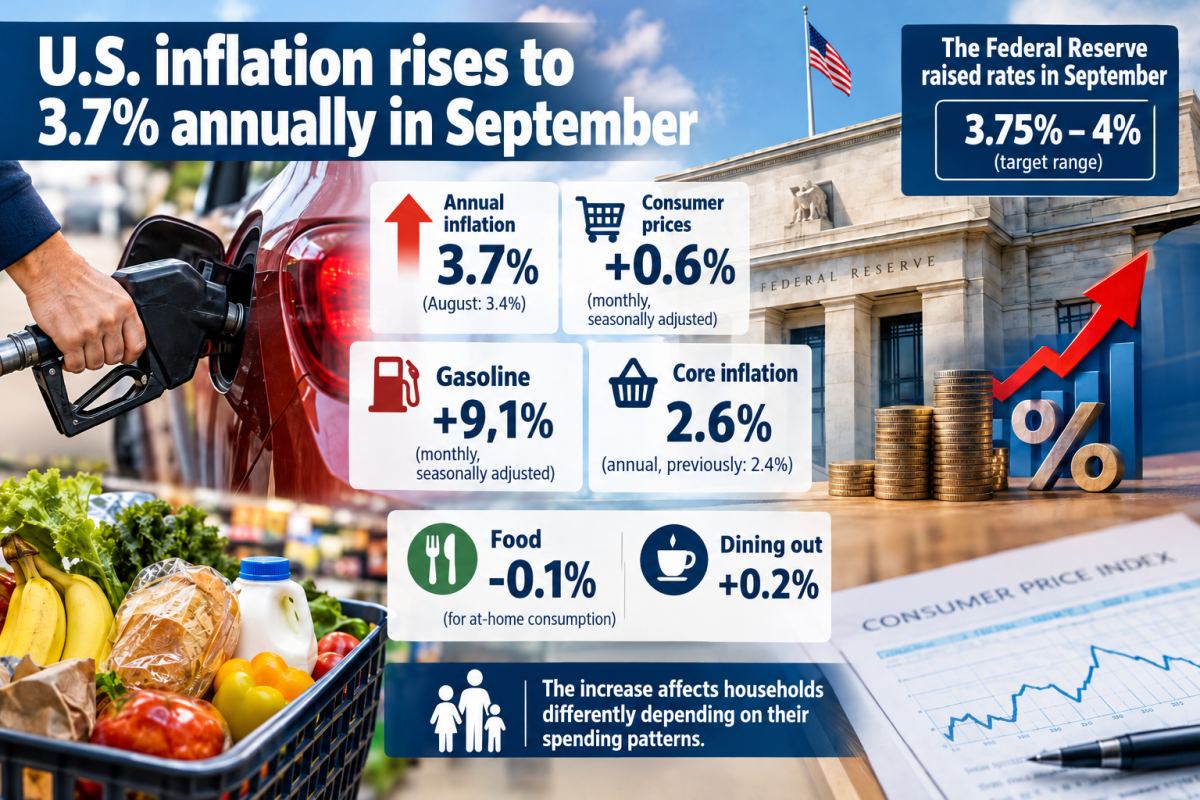
U.S. inflation rose to 3.7% in September from 3.4% in August, the Bureau of Labor Statistics reported Wednesday. Consumer prices increased 0.6% from the previous month on a seasonally adjusted basis. Gasoline accounted for more than half of that increase, bringing fuel costs back to the center of the squeeze on household budgets.
The gasoline index jumped 9.1% for the month, also seasonally adjusted. But energy was not the whole story. Core inflation, which excludes food and energy, increased to 2.6% over the year from 2.4%. Core prices rose 0.3% during the month.
The October 14 release comes after the Federal Reserve raised interest rates in September. Consumers face two costs that can overlap: paying more for everyday purchases and financing other spending with more expensive credit. The report will inform the Fed's next decision, without settling it on its own.
Gasoline leads the rise, but other prices tell a different story
Higher gasoline prices have an immediate impact on people who need to drive. They also highlight the difference between a family's expenses and a national average. Two households with similar incomes can experience the same price increase differently if one relies on a car and the other uses public transportation.
Food prices overall were unchanged in September. The index for food bought to eat at home fell 0.1%, while food away from home rose 0.2%. Those differences offer a more useful picture than assuming that everything became more expensive at the same pace.
Before the release, Associated Press had reported a FactSet forecast of 3.6% annual inflation. The official figure came in slightly higher. That comparison measures the surprise against this particular survey; economists' expectations and actual results remain separate things.
Annual and monthly inflation answer different questions
The annual rate compares prices with September 2025. The monthly figure measures the change from August 2026. Seasonal adjustment seeks to separate recurring calendar patterns from other price movements. These measures complement each other and should not be confused when assessing how much a purchase has become more expensive.
Core inflation helps track prices without two particularly volatile categories. That does not make food or gasoline any less important to households. A measure can be useful for identifying broader trends while offering only a partial account of the purchases someone needs to make every week.
The BLS notes that the Consumer Price Index reflects average household spending within the population it covers. It does not reproduce anyone's individual budget exactly. A family that spends a larger share of its income on a category rising sharply can face more pressure than the headline index suggests.
A paycheck also has to be measured by what it buys
Wages provide another point of comparison. In August, average hourly earnings for employees on private nonfarm payrolls rose 0.3%, while consumer prices increased 0.4%. The BLS calculated a seasonally adjusted decline of 0.1% in real hourly earnings.
Those figures describe August, not September, the month covered by the new CPI report. They illustrate why a nominal pay raise can still coincide with a loss of purchasing power. Earnings in dollars and earnings adjusted for inflation answer different questions.
Hours worked matter, too. In that August report, real weekly earnings increased 0.2% because the average workweek grew. A larger weekly paycheck can therefore reflect more hours worked even when each hour buys less. Both pay and working time matter when assessing whether a household budget has improved.
The Fed heads into its next meeting with rates already higher
On September 16, the central bank raised the target range for the federal funds rate by a quarter of a percentage point to 3.75%–4%. Its statement described inflation as still elevated and said the move was intended to speed the return to price stability.
The next meeting is scheduled for October 27–28. Policymakers will assess the latest CPI alongside employment, economic activity and other indicators. One month's increase is not enough to establish in advance that another rate hike is coming.
The Federal Reserve explains that monetary policy works through financial conditions and the cost and availability of credit. Those changes then influence household and business spending. The transmission is neither direct nor immediate: an interest-rate move does not instantly change the price of gasoline.
There is also an important distinction between inflation measures. The Fed's 2% inflation target refers to the Personal Consumption Expenditures price index, or PCE. The CPI is an important indicator, but it is not precisely the measure used to define that target.
For households, September's report confirms that price growth accelerated again, with energy playing a leading role. For the Fed, it complicates the balance between containing inflation and assessing the impact of borrowing costs on the economy. The next decision will depend on the broader evidence. In the meantime, Wednesday's increase leaves less room in the budgets of people who have to fill their tanks.