Kim Jong Un crosses new Dandong bridge into China as Beijing seeks closer ties
The North Korean leader met senior Chinese official Wang Huning, visited a Korean War memorial and toured a car plant. Beijing wants the recently opened bridge to expand cross-border exchanges.
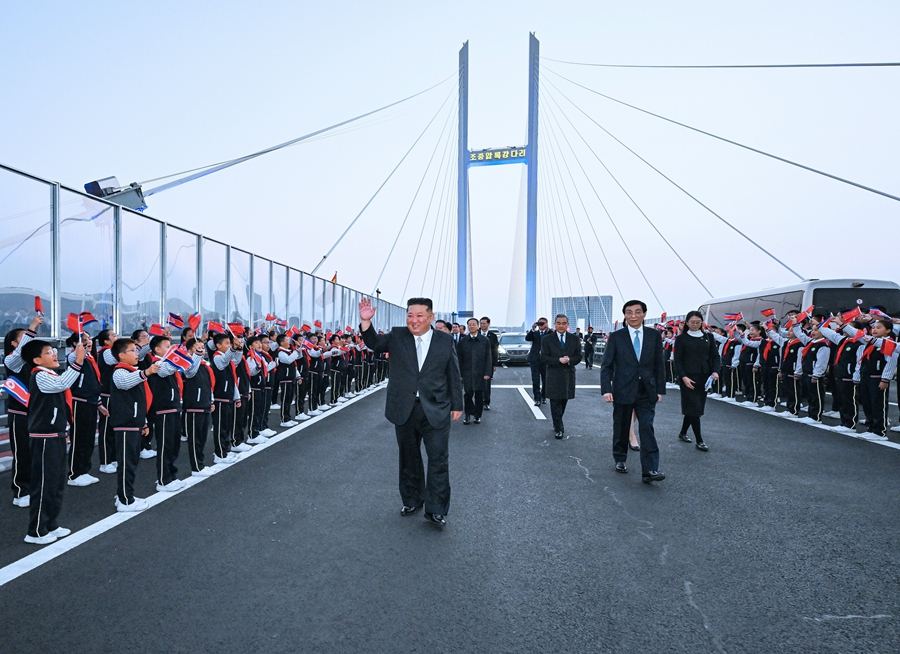
Kim Jong Un returned to North Korea after a brief visit on Saturday to Dandong, the Chinese city across the Yalu River from Sinuiju. The image that marked his departure was the new bridge over the river, opened this month and now central to Beijing's hopes for more movement of people and goods. While in China, the North Korean leader met Wang Huning, a senior member of the Communist Party leadership, paid tribute to Chinese troops who fought in the Korean War and toured an automobile factory.
The trip paired a ceremony of remembrance with a discussion of commerce. China's state news agency Xinhua reported that Wang conveyed greetings from President Xi Jinping and proposed using the bridge to expand exchanges and cooperation. It did not announce a new trade agreement, a timetable for projects or traffic figures. The visit establishes what both governments say they want; any economic results will have to be measured later.
A crossing years in the making
Dandong is a natural gateway between China and North Korea. Sinuiju, a major North Korean border city, lies on the opposite bank. The new road bridge links the two and adds to the routes the countries have long used. Its opening had been delayed for years, giving Kim's journey a practical as well as a symbolic dimension: he personally crossed an infrastructure project whose future capacity will depend on rules and operations on both sides.
Chinese officials say the link could support travel and trade. That does not guarantee an immediate surge in either, nor does it mean international restrictions have been lifted. North Korea remains subject to sanctions tied to its nuclear and missile programs, which constrain economic exchange. Opening a physical bridge and authorizing particular commercial activities are separate questions.
Kim did not meet Xi during this visit, according to Xinhua's account. His host was Wang, chairman of the Chinese People's Political Consultative Conference and a member of the Communist Party's Politburo Standing Committee. Xi's transmitted greetings show the political weight Beijing attached to the occasion, but they do not turn the Dandong meeting into another summit between the two countries' leaders.
Kim traveled with senior North Korean officials, according to South Korean reports published Sunday that cited Pyongyang's official news agency. They described a one-day visit. Xinhua said Wang accompanied Kim to the bridge when he left Dandong. The publicly established facts support calling this a high-level political contact. They do not disclose the content of private discussions or any unannounced commitments.
Korean War memory as diplomacy
The day began at a memorial to the Chinese soldiers who fought in the 1950–53 Korean War. Kim and Wang laid a floral tribute and viewed the exhibition. The visit came close to the anniversary of the entry of the Chinese People's Volunteers into the conflict. The ceremony recalled the wartime alliance that both governments present as a foundation of their relationship today.
The war occupies a different place in each country's history, but both leaders used its memory to reaffirm their ties. Wang spoke of deepening political trust and expanding cooperation; Kim thanked China for its support and described broad prospects for working together. Those are the authorities' stated positions, not an independent measure of bilateral relations. Their diplomatic meaning will depend on the decisions that follow.
In the afternoon, the two men toured an automobile plant in Dandong. Xinhua reported no contracts signed there. Alongside the bridge, the factory put economic questions at the center of a visit framed by history. China remains a decisive partner for North Korea, while Pyongyang is showing that it can maintain close ties with Beijing amid regional military tensions and sanctions.
The journey also took place during a week of fresh friction between North and South Korea. Seoul had proposed military talks to reduce the risk of incidents along their border. Kim's visit to China was not announced as an answer to that proposal and should not be treated as one. It does, however, place Beijing again in the diplomatic picture on the peninsula, where any expansion of economic or political cooperation attracts scrutiny.
What can be measured next
The bridge offers a visible sign of closer contact, but the scale of any change is not yet established. The test will be whether authorized crossings increase, which goods move and whether the two governments announce specific arrangements compatible with existing restrictions. Opening the link should also be distinguished from any change in North Korea's security policy; no such shift was announced.
Kim left Dandong after using the new crossing and meeting one of China's most senior officials. The episode provides a clear diplomatic image, but not a treaty or a completed transformation in the relationship. Beijing and Pyongyang say they want to deepen cooperation. The next chapter lies in the decisions they take after the visit, rather than in the expectations a bridge crossing may invite.