Magnitude 7 earthquake in Tibet kills 16; more than 12,000 moved to safety
The quake struck Baqen at night. Sixty-five people were injured, while aftershocks, cold weather and restricted access hamper the search in Nagqu's villages.
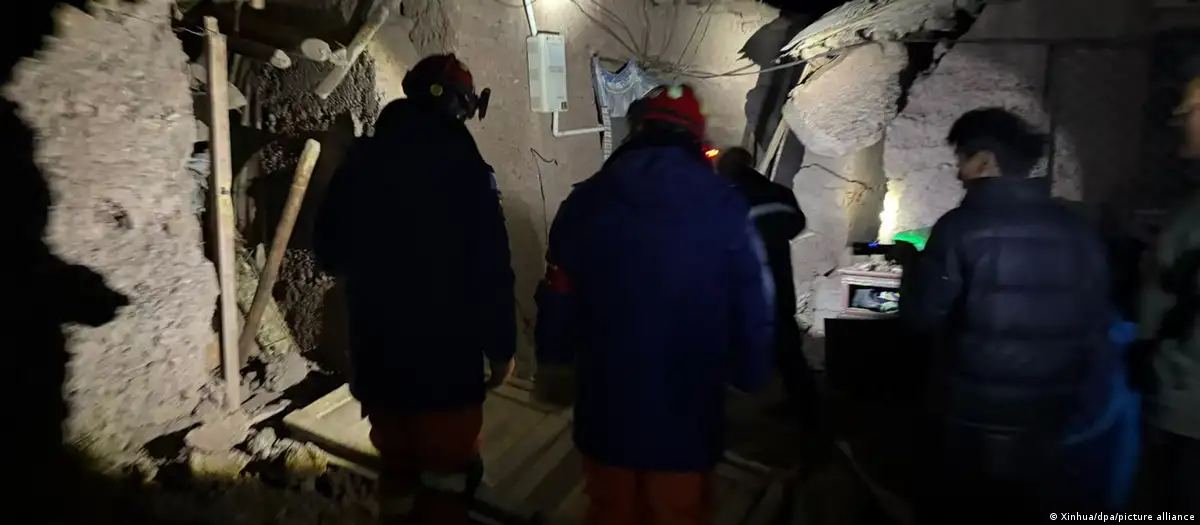
A magnitude 7 earthquake struck Baqen County in China's Tibet region on Thursday night, killing at least 16 people and injuring 65, according to figures released Friday by the state news agency Xinhua. Authorities in Nagqu said 12,489 people had been moved to safety by 10 a.m. local time. Rescue teams were still checking villages and homes across a remote area where cold weather, aftershocks and landslides have complicated the search.
The quake struck at 10:33 p.m. Thursday in China, when many residents were at home. China's seismic network placed it in Baqen, in Nagqu prefecture, at an estimated depth of 10 kilometers. The U.S. Geological Survey, using its own data and methods, also measured it at magnitude 7, about 191 kilometers east-northeast of the city of Nagqu and 18 kilometers deep. The agencies' different depth estimates do not diminish the urgency of the response; each should be attributed to its source.
Initial reports said 339 homes had collapsed and dozens of people were injured. The injury count rose from 54 to 65 in subsequent hours. These remain developing figures: the number moved to safety is not an injury count, and officials are still assessing damage house by house. In its morning report, Xinhua said 11 of the 65 injured were in serious condition and 54 had minor injuries.
Searching collapsed homes and isolated villages
Baqen lies at high altitude north of Lhasa. Long distances between settlements, low temperatures and damaged roads slow access to people who may need help. The Associated Press reported that authorities had organized repeated searches of homes and villages. Those sweeps are especially necessary when communications fail and an initial count cannot reach every community.
More than 5,000 people from three counties had joined the response, according to information local officials gave the U.S. news agency. Tents, prefabricated shelters, folding beds, flashlights and warm clothing were brought in. Clearing rubble is only part of the task: displaced families also need a place to sleep, food, medical care and roads that can carry supplies.
The Chinese military reported sending more than 300 personnel and around 20 vehicles overnight. A drone was dispatched around midnight to survey the affected area and transmit images. Figures for different agencies' personnel cannot simply be added together: some describe particular units, while others cover the operation as a whole.
The regional government activated a level II response to secondary geological hazards. Technical teams were sent to assess slopes and advise local officials. The danger does not end with the main shock. Aftershocks can weaken walls and trigger rockfalls onto roads or already damaged homes.
Highway 317 was cleared, but access remains restricted
Fallen rocks blocked a section of National Highway 317. Tibet's transport department said the debris had been cleared at about 3 a.m. Friday. That did not mean the road had reopened immediately to all traffic. Officials kept restrictions in place to give ambulances, rescue workers and government vehicles priority, and advised other drivers to take alternative routes.
The distinction explains the actual state of access. Saying only that the road was closed would overlook the clearance work; saying it was open to everyone could send civilians toward a section still under control. Authorities also stopped trains passing through the area as a precaution while they checked the infrastructure.
The U.S. Geological Survey recorded several aftershocks, some above magnitude 5. They cannot, on their own, predict another larger earthquake, but they make it necessary to check structures, slopes and bridges before using them. Xinhua said intermittent snow was expected over the next three days, adding to the difficulty of rescue work and temporary shelter.
What remains unknown
Friday's toll is a snapshot of an operation still in progress, not a final damage assessment. Complete information is not yet available on uninhabitable buildings, basic services, schools or the needs of evacuated families. Officials will also have to distinguish collapsed homes from buildings still standing that cannot safely be occupied until inspected.
Chinese authorities have prioritized finding survivors, treating the injured and sheltering displaced residents. Progress in the coming hours will depend on reaching each community and keeping roads and communications working. Altitude, cold and possible aftershocks make it essential to date each set of figures and update the toll only when a new report can be verified.
The epicenter is far from major cities, but that distance does not reduce the danger to nearby villages. In mountain emergencies, the earliest reports may reveal more about where rescuers have managed to reach than about the full extent of the damage. For now, thousands of residents have been moved to safety, and the search continues.