U.S. adds wrongful detention warning to China travel advisory, keeps Level 2
The State Department added the “D” risk indicator on October 19. Americans are still advised to exercise increased caution as Washington warns of detention and exit bans in mainland China.
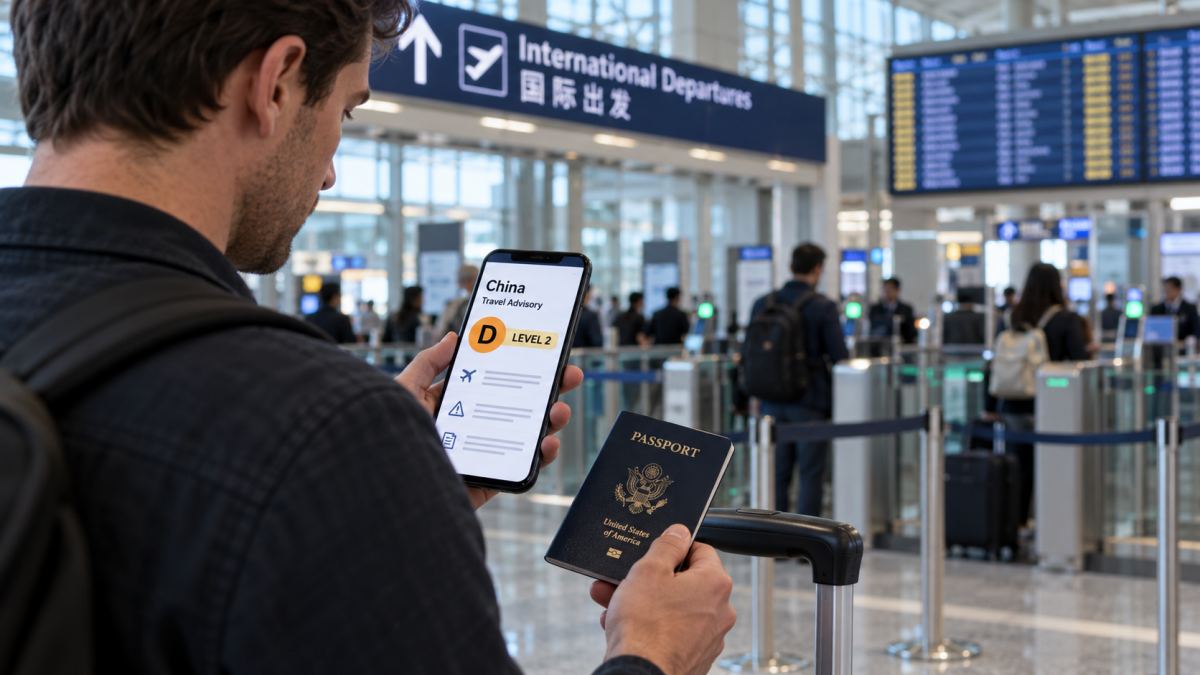
A new letter has accompanied the U.S. travel advisory for mainland China since October 19: “D.” The State Department uses it to flag the risk that U.S. citizens could be wrongfully detained by the destination country's government. China has not been moved to the “reconsider travel” category. It remains at Level 2, which calls for increased caution. The distinction is between a more explicit warning and a higher overall advisory level; it is not a ban on travel.
The advisory identifies two related but separate dangers. One is the arbitrary enforcement of laws, particularly national security laws. The other is the use of exit bans, which can prevent someone from leaving China without a fair and transparent way to challenge the restriction. The State Department also says there is a serious risk of wrongful detention of Americans. That is Washington's assessment, not a count of affected travelers or a claim that everyone entering China will be arrested.
What the “D” means and why it returned
The U.S. advisory system pairs four general travel-risk levels with indicators for specific threats. Level 2 means “exercise increased caution”; Level 3 means “reconsider travel”; and Level 4 means “do not travel.” The “D” is not a fifth level. Under the State Department's definition, it flags the risk that U.S. nationals could be wrongfully detained by authorities in the destination.
China's advisory previously carried the indicator when the country was at Level 3. In November 2024, Washington lowered the advisory to Level 2 and removed the “D” after three Americans who had been held in China for years were released, according to an account by Voice of America. Restoring the indicator imposes no new entry restriction and offers no basis for estimating how many detentions might occur.
A bipartisan Senate resolution introduced in September called both for restoring the “D” and for raising the advisory back to Level 3. The first change now appears in the advisory; the second was not adopted. The resolution was a legislative proposal, not an order that independently changed travel rules.
Anyone checking the advisory now sees the risk identified near the top. The State Department warns that a detainee could spend years in prison and have difficulty reaching family members or U.S. representatives. It recommends making a communication plan with relatives or employers before departure.
Two cases Washington has designated wrongful detentions
The United States has formally applied that designation to the cases of Youlin Chen and Min Zin, according to the State Department and reporting by Voice of America. The designation reflects the U.S. government's position on their detention. China rejects the characterization that it practices wrongful detention and says its judicial authorities act according to law.
Chen, a Chinese American seismologist, was detained in November 2024 as he prepared to return to the United States after visiting family. He had worked with Chinese researchers on a publicly funded U.S. project studying seismic signals from North Korean nuclear tests. Chinese authorities accused him of espionage in 2025. The United States designated his case a wrongful detention in March 2026. Those are conflicting positions; describing them does not resolve the criminal case.
Min Zin, a Myanmar-born American scholar who studies that country's politics and its relationship with China, was detained in June after traveling to Yunnan for a conference. Beijing has linked him to suspicions of espionage and endangering national security. The State Department designated his detention wrongful on August 20. Voice of America reported that Washington raised both cases with Beijing and that the families welcomed the new travel warning.
China's Foreign Ministry had already rejected the term “wrongful detention” in a statement in September 2025. That statement predated this week's advisory change and should not be read as a new response to the October 19 update.
The risk may become clear only when a traveler tries to leave
The warning extends beyond the possibility of arrest. The State Department says Chinese authorities can impose exit bans without a fair and transparent process. A traveler may not learn of the restriction until attempting to board a flight or cross a border. Washington identifies people involved in business disputes, researchers, journalists, and current or former U.S. government employees among those who may face heightened scrutiny.
The advisory also discusses the treatment of U.S. citizens of Chinese heritage and potential obstacles to consular assistance when someone enters on documents issued by China. It does not say that everyone in these groups will be detained. It identifies circumstances in which U.S. assistance could be limited or delayed. Hong Kong and Macau have separate travel advisories; the new “D” indicator for mainland China should not automatically be applied to them.
For Americans who decide to travel, the State Department advises checking the current advisory, entering on a U.S. passport and a valid Chinese visa when required, and agreeing with family or a host organization on how and when to check in. It also recommends enrolling in STEP, its free consular-alert program, and asking that the embassy or consulate be notified if detained. Those measures can help maintain contact. They do not remove the risk or guarantee immediate consular access.
The update comes as Washington seeks the release of Chen and Min Zin. Level 2 leaves the travel decision to each individual. The added “D” asks prospective travelers to consider what they would do if a legal dispute prevented them from leaving China or obtaining timely help.