Alberta Rejects Path to Another Separation Referendum as Nearly 76% Back Staying in Canada
The provisional count gives staying in Canada a wide lead. Carney welcomes a vote for unity while counting continues on nine other questions about immigration and provincial powers.
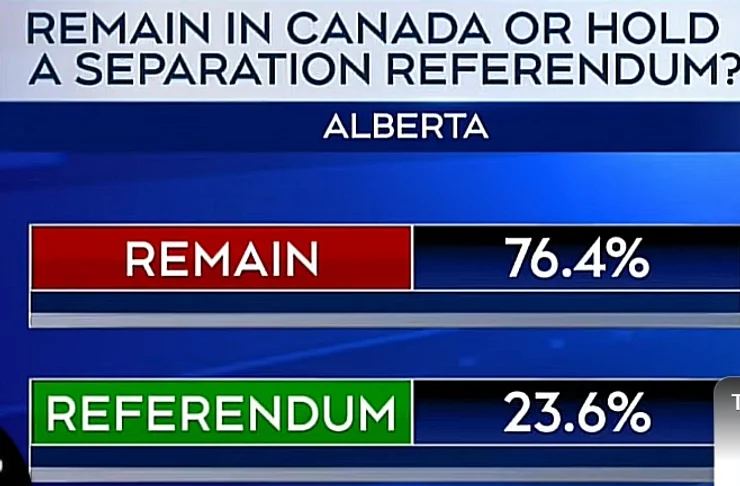
Alberta has voted overwhelmingly to remain in Canada, rejecting a proposal to begin the process of holding another referendum on separation. Provisional Elections Alberta figures consulted at 5:42 a.m. local time on Tuesday, October 20, showed 1,346,102 votes for remaining and 426,800 for opening the way to a further referendum: 75.93% against 24.07% of the valid responses counted for that question.
The result provides political relief for Canadian Prime Minister Mark Carney, who welcomed it as a choice for unity. It also requires an important distinction: voters were not deciding directly on a declaration of independence. The defeated alternative proposed beginning the constitutional process to subsequently hold a binding referendum on leaving Canada.
The gap between the two options is wide at that point in the count, but the figures remain provisional. Elections Alberta has set October 29 for the official declaration of results. Counting continues on other questions from a vote in which each elector could receive ten separate ballots.
A Question About the Next Step
The tenth ballot offered two paths: Alberta could remain a Canadian province, or its government could begin the legal process needed to hold a binding referendum on separation. It was not an automatic instruction to leave, nor a vote that could redraw the country's borders on its own.
That design explains what voters have rejected. Votes against opening the process prevent the result from being presented as a popular mandate for a second vote on independence. They do not mean disagreements with Ottawa have disappeared or that all voters share the same views on how power should be distributed within the federation.
The same day included nine other questions. Among them were proposals concerning control over immigration, eligibility for provincial programs, proof of citizenship to vote, the selection of judges and the abolition of the federal Senate. The answer on remaining in Canada does not predict the outcome of any of those other questions.
Ten Counts Running on Overlapping Timelines
Elections Alberta prioritized counting the separation question. Questions one through nine are then processed in that order. The count is manual and includes advance votes, special ballots, mobile polls and votes cast on the main polling day. Adding responses across all ten questions does not produce a measure of voter turnout.
The official notice states that counts must be completed and provisional results published within 48 hours of the confirmed closing of all polling locations. Offices then review the material and verify the results before the final declaration. That sequence distinguishes information available in the early hours from the certified outcome.
The election dashboard also carries a warning about its progress indicator: a polling location can appear as having reported once it has submitted results for at least one question. Even a high percentage of locations reporting therefore does not establish that every ballot for all ten questions has been counted. Interpreting the vote on remaining requires using that question's specific totals, rather than the aggregate number of responses across the entire vote.
Carney Seeks to Turn Unity Into an Economic Agenda
In his statement on Tuesday, Carney presented the result as an opportunity to move forward together. He linked unity to diversifying trading partners, accelerating major infrastructure projects and developing Canada as an energy power, with Alberta at the heart of that effort.
That is a political interpretation of the result, not a list of projects approved at the ballot box. The referendum did not choose a pipeline route, a budget or a new trade agreement. It does, however, give the federal government an argument against those who advocated seeking the province's future outside Canada.
The prime minister's statement acknowledged that counting across the full set of questions remained underway. That caution sets limits on his victory: he can celebrate remaining in Canada without yet claiming provincial backing on other issues. Relations between Ottawa and Alberta's government will continue to depend on specific negotiations, even after a decisive vote on national unity.
Why Secession Would Never Have Been Immediate
The central legal precedent remains the Supreme Court's 1998 Quebec secession reference. The court established that a province cannot separate unilaterally under the constitutional framework. A clear majority answering a clear question in favor of secession would give the initiative democratic legitimacy and create obligations to negotiate, but would not allow it to impose its terms on the federation's other participants.
The court connected those negotiations to federalism, democracy, the rule of law and minority rights. It did not predetermine the outcome of secession talks. Applying that reasoning to public debate requires avoiding two oversimplifications: that a vote alone is enough to achieve independence, or that a clear democratic decision has no constitutional consequences.
Alberta has not reached that stage. The message from the ballot box comes earlier in the process and is more direct: a large majority of votes counted favors staying in Canada rather than opening the way to the next referendum. The immediate task is to finish counting the other questions. After that, the contest between provincial autonomy and federal power will continue within the country voters have chosen to preserve.