Nvidia pitches modular AI data centers for Europe, with power and data control still unresolved
At its GTC event in Berlin, the company unveiled a prefabricated infrastructure design and expanded its European partnerships. Germany wants to bring AI into industry, but deployment times still depend on whether each site has the power, cooling and network capacity it needs.
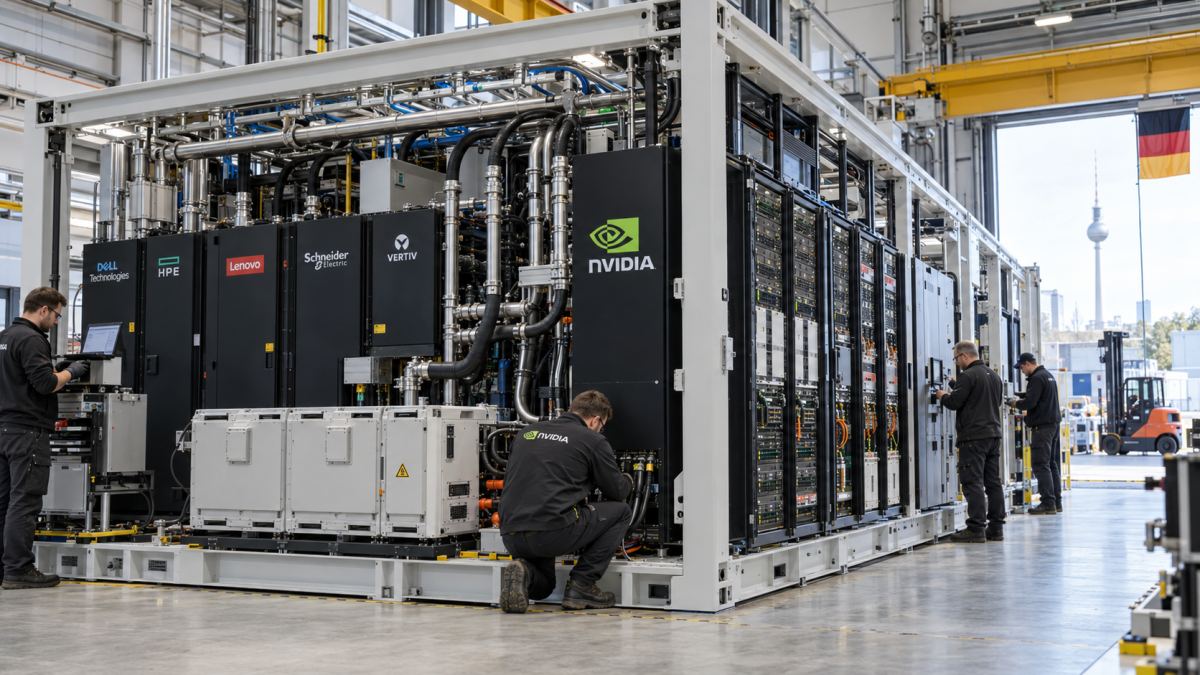
Nvidia has unveiled a plan in Berlin to speed up the installation of AI data centers in Europe using modules assembled and tested before they reach their destination. The design, called DSX POD, was among the announcements at its GTC event on Wednesday. Nvidia expects the first deliveries worldwide in early 2027. Its pitch addresses a constraint that goes beyond obtaining chips: finding the electricity, cooling and network connections needed to put them to work.
The announcement comes as Germany tries to bring AI into its factories and make use of industrial data. The German government and Nvidia have announced a declaration of intent to develop models that can work with the physical world, from machinery to production processes. The partnership reflects Europe's ambition to build more technological capacity, while also underscoring a continuing dependence on infrastructure supplied by a US company.
What a preassembled data center could change
Partners including Dell Technologies, HPE, Lenovo, Schneider Electric and Vertiv will manufacture the DSX POD design. It brings Vera Rubin equipment together in modules assembled and tested before shipment.
Nvidia says installation could be shortened from six months to 14 days, provided the site already has electricity, cooling and network connections. That is not a timetable for building a data center from scratch. The proposed advantage comes from moving assembly and testing into the factory; its performance will have to be assessed when the first installations are operating.
Power becomes part of the computing system
Adding processors does not automatically create usable computing capacity if a facility is already close to its electrical limit. Nvidia proposes coordinating the power draw of the equipment, cooling and grid conditions rather than designing each element separately. Its DSX platform combines advance simulations with operating tools.
The company describes work with energy suppliers to anticipate how a facility will perform before it is built. Hitachi Energy contributes battery storage; Schneider Electric is working on power and cooling designs; and Siemens Energy is developing an architecture linking generation, transmission and distribution to a data center's needs.
These initiatives aim to make better use of each facility. They do not, by themselves, generate more electricity or replace a connection to the grid. Expanding AI capacity will also require investment beyond the server room. Nvidia's technology offering therefore reaches into a problem shared by computing companies and utilities.
Germany wants to put its factory data to work
The German government's statement places its cooperation with Nvidia within its AI strategy and the Industry 4.0 platform, which brings together companies, researchers, trade groups and public officials. Its stated goal is to extend the use of AI in industry with the participation of German companies and research institutions.
“Physical AI” refers to systems able to interpret and act in material environments rather than only generate text or images. For an economy built around manufacturing, automotive production and engineering, the attraction is applying models to tasks and processes that already produce large amounts of information.
In discussions with Chancellor Friedrich Merz, Nvidia focused on Germany's small and medium-sized industrial companies. It also announced planned investments in businesses including Agile Robots, Avelios Medical, Mirelo and Reflex Aerospace. They work in different fields — robotics, hospital systems, audiovisual production and space — but all point to the search for practical uses of AI.
The government statement is a commitment to cooperate. It does not yet demonstrate a productivity gain or an economic benefit for German industry as a whole.
More capacity in Europe, but who controls it?
Nvidia also said its cloud-service partners are expanding the capacity to train and run models closer to their customers. Nscale plans to add Vera Rubin infrastructure and expand across five European markets. Crusoe is developing liquid-cooled modular facilities to bring its services nearer to users.
The promise of technological sovereignty rests partly on choosing where data is stored and where applications run. Keeping that capacity in Europe could give businesses and institutions more options. Geography alone, however, does not settle who operates the systems, which suppliers are involved or what access their contracts allow.
The offering also extends to local computing. Austrian broadcaster ORF reported on the presentation of RTX Spark devices for running AI tasks on a desktop without relying on external data centers for every task. That serves a different need from shared facilities: not every application requires the same scale of infrastructure.
ORF also highlighted Jensen Huang's argument for Europe's potential at the conference. Berlin broadcaster rbb reported his criticism of Germany's technological delays and bureaucracy. His message paired an invitation to invest with a warning about the difficulty of putting plans into practice.
The first deliveries expected in 2027 will begin to show how far the project can move from announcement to operation. For European industry, the outcome will depend on power, skilled people and useful applications being available for the new machines — and on turning years of accumulated data into measurable improvements at work.