UN projects 2.8°C of warming under current policies and calls for urgent emissions cuts
UNEP’s 2026 report focuses on limiting how far and for how long warming exceeds 1.5°C. Meeting national pledges would improve the outlook, but still leave the world far from its climate goal.
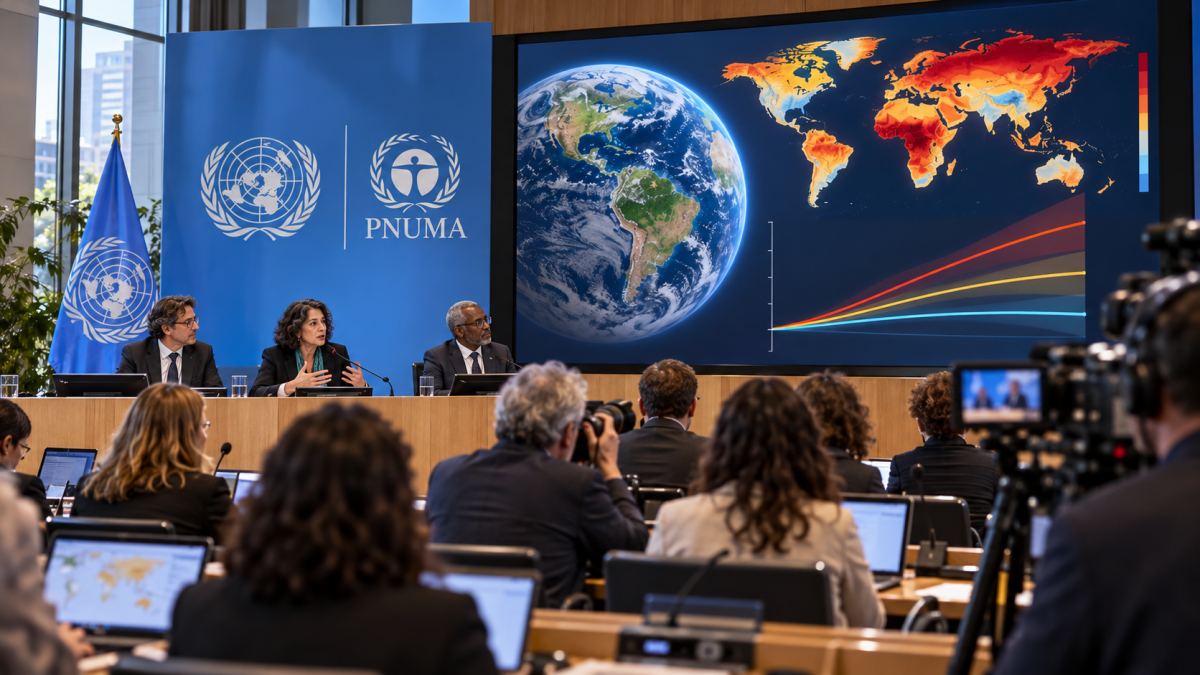
The world is heading for warming of 2.8°C above preindustrial levels by around 2100 if current policies remain in place, the United Nations Environment Programme warned on Wednesday. Its new Emissions Gap Report concludes that keeping the temperature increase below 1.5°C without substantially exceeding that threshold is no longer possible. The task is now to limit the size and duration of that overshoot.
The warning does not present 2.8°C as inevitable. It compares pathways that depend on policy decisions and the fulfillment of commitments. If all national plans were implemented and similar efforts continued, warming would be limited to about 2.6°C. If additional net-zero targets were also met, the estimate would fall to 2.1°C.
The difference between those scenarios captures the central problem: existing policies fall short of pledges, and the pledges themselves are insufficient to meet the ambition of the Paris Agreement. The report calls for action on both gaps, without treating a target announced for the coming decades as an emissions reduction already achieved.
What it means to exceed the 1.5°C limit
The Paris Agreement, adopted in December 2015 and in force since November 2016, aims to keep warming well below 2°C and pursue efforts to limit it to 1.5°C. The comparison is with preindustrial levels. It does not mean adding another 1.5°C to the warming the planet has already experienced.
UNEP’s assessment concerns averages over several decades, not the temperature on a particular day, in one city or during a single especially hot year. That distinction helps explain why temporarily crossing an annual threshold and establishing a long-term level of warming are related but different issues.
In its 17th edition, the report examines a pathway with the lowest possible overshoot. Under it, warming would peak at about 1.7–1.8°C around midcentury and could return to 1.5°C or below by 2100. The agency puts the probability of that return at approximately 50%: it describes a demanding possibility, not a guaranteed recovery.
UN Secretary-General António Guterres argued as the findings were presented that exceeding the threshold should not mean abandoning the effort. Every additional fraction of a degree and every year above 1.5°C increases risks to health, ecosystems and economies, according to the agency.
National plans fall well short of the cuts needed
To follow that pathway, global greenhouse gas emissions would have to fall 18% by 2030, 45% by 2035 and 69% by 2040, all relative to 2025. The baseline year is essential: those percentages cannot be compared directly with targets calculated against 1990, 2005 or 2019.
Full implementation of current national commitments would deliver much smaller reductions: 5–8% by 2030 and 11–15% by 2035, also relative to 2025. These are the plans each country submits under the Paris Agreement, known as nationally determined contributions, or NDCs.
UNEP attributes the deterioration in projections from the previous report to the U.S. withdrawal from the Paris Agreement and revisions to estimates of historical emissions. The UN climate convention’s records date the U.S. withdrawal to January 27, 2026. In this assessment, it is therefore a completed event, not a decision still pending.
Reuters highlighted that new plans submitted since the previous report had barely changed the projections. The challenge is not simply to announce more ambitious intentions: it requires policies that change actual emissions.
Carbon removal has limits, too
Returning to 1.5°C would require not only emissions cuts but also the removal of carbon dioxide from the atmosphere and its permanent storage. The pathway examined envisages about 320 gigatonnes over the course of this century, equivalent to 320 billion metric tons. That is a cumulative amount, not an annual requirement.
The report itself warns of the technological and socioeconomic difficulties of achieving that scale. Future carbon removal therefore does not eliminate the need to cut emissions now. The longer reductions are delayed, the greater the burden left for later and the smaller the room to limit peak warming.
The assessment also records progress. Renewable energy expansion has exceeded expectations made when the Paris Agreement was adopted, and evaluations of climate policies document emissions reductions in different countries and sectors. The challenge is to extend and sustain those results, rather than assume that successes in a few places have already changed the global trajectory.
For the United States, Europe and Japan, as for other economies, the test will be the implementation of decisions on energy, transportation, industry and efficiency. The report does not turn its calculations into new legal obligations for each country. It shows the distance between the collective effort and the desired temperature outcome—and why narrowing that gap still matters, even as preserving the 1.5°C limit becomes harder.