Judge limits Brooke Rollins’ religious emails to USDA employees
The preliminary injunction requires the agriculture secretary to observe boundaries in her own religious-expression policy. The department disputed the ruling and said it is considering an appeal.
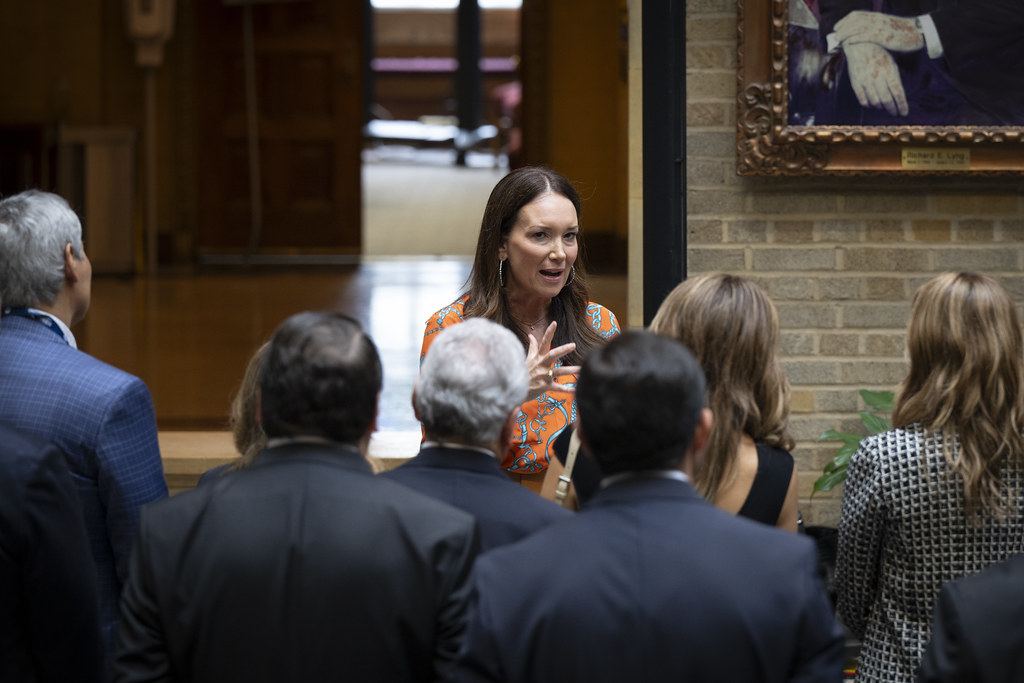
A federal judge ordered US Agriculture Secretary Brooke Rollins to observe limits when using her office and official email to send religious messages to department employees. The ruling, issued Thursday, November 19, found that the Christmas and Easter communications challenged in the lawsuit placed pressure on employees to conform to the secretary’s Christian beliefs.
US District Judge Trina L. Thompson of the Northern District of California granted a preliminary injunction on the employees’ constitutional claim. Her order incorporates USDA’s own rules: stop when a colleague asks, avoid creating a hostile workplace through persistent unwelcome advances, and do not use official authority to pressure subordinates.
Six employees and the National Federation of Federal Employees, or NFFE, filed the case on May 13. According to the court record, the union represents about 110,000 federal employees, including more than 19,000 at the Department of Agriculture. Rollins is being sued in her official capacity. The case continues on the First Amendment claim.
The Christmas and Easter messages examined by the court
The ruling traces a series of communications sent from the secretary’s official account to all USDA employees. They included messages for Independence Day and Thanksgiving in 2025, followed by two others the judge examined particularly closely because of their explicitly Christian content.
In a December 23, 2025, email, Rollins included a video attributing the generosity of Christmas to Jesus’ birth and describing him as the recipients’ savior. The April 5, 2026, Easter message celebrated the resurrection and compared employees with the first disciples.
The Easter email was addressed to the entire workforce and used collective pronouns when discussing faith. Thompson concluded that the language assumed all recipients shared those beliefs and linked the agency’s mission with the particular religious outlook of its most senior official.
The judge considered three factors together: Rollins’ authority, the use of an official channel to reach the whole workforce, and language that could make people with other beliefs feel like outsiders. Her reasoning addressed the First Amendment’s Establishment Clause, which restricts government establishment of religion.
The account is also used for consequential workplace matters, including reorganizations, relocations and preparations for a government shutdown. The court therefore rejected the argument that employees could simply ignore the religious messages. Even holiday emails can contain information about leave and other employment conditions, the ruling noted.
The boundaries come from a policy signed by Rollins
USDA Secretary’s Memorandum 1078-019, addressing religious expression and workplace accommodations, recognizes broad protections for employees. It allows them to discuss their beliefs with interested colleagues, explain why their faith is personally meaningful and politely invite coworkers to religious services or events.
The same document sets boundaries against persistent unwanted approaches and pressure on subordinates. Thompson drew on those provisions in framing the order directed at the secretary. Her analysis places particular weight on the power held by the person at the top of the department’s hierarchy.
The policy also provides for religious objects and symbols in workspaces, along with prayer or study groups during nonduty time and subject to rules for using facilities. Those provisions illustrate the protection for personal religious expression that remains part of USDA’s workplace rules.
The ruling preserves voluntary, appropriate conversations about religion and says it expresses no view on Rollins’ conduct in her personal capacity. The court’s intervention concerns how she uses her authority and official platform to address people whose employment places them under her supervision.
USDA considers an appeal as the employees welcome the decision
In court, the government argued that Rollins had shared her personal views about the meaning of particular holidays. It maintained that she had neither required employees to take part in a religious exercise nor compelled them to adopt her beliefs. Thompson assessed that position against the workplace setting and how the messages were distributed.
After the ruling, a USDA spokesperson told The Associated Press that the department viewed it as an unprecedented attempt to silence a Cabinet secretary and was considering an appeal.
The employees alleged that the emails made them feel excluded and pressured them to conceal their own convictions or appear to share the secretary’s. The ruling describes those arguments and concludes that the circumstances, taken together, provide sufficient grounds for the preliminary protection they sought.
NFFE and the employees’ lawyers welcomed the decision. In a statement released by Democracy Forward, union President Randy Erwin said public employees should be able to do their jobs without feeling that their religion, or lack of it, affects their standing at work. Democracy Forward, Americans United for Separation of Church and State, and Bryan Schwartz Law represent the plaintiffs.
The constitutional case continues; the administrative claims are dismissed
The order provides protection while the litigation proceeds. Thompson found that the plaintiffs had shown a likelihood of success on their constitutional claim, as well as a risk of irreparable harm if the challenged communications continued. The decision was made at this preliminary stage of the case.
The court also considered the balance of interests between the parties and the public interest in deciding whether to grant the injunction. Its reasoning identifies protection of First Amendment freedoms as an interest supporting action before the case reaches a final resolution.
Thompson dismissed the claims brought under the Administrative Procedure Act. She concluded that the emails did not constitute final agency action: they neither created rules nor definitively resolved agency matters. The lawsuit continues on its constitutional basis following that part of the decision.
The judge also explained why restricting distribution of the messages can benefit employees who are not parties to the case. Because the department does not offer an opportunity to opt out, limiting dissemination is necessary, in her analysis, to provide complete relief to the people who sued.
The next case management conference is set for December 17, with a joint case management statement due on December 10. The continuing dispute concerns the use of public authority to convey religious beliefs and the protections employees have against religious pressure from their superiors.