Trump says Flávio Bolsonaro can stay in the US “as long as he wants”
The president offers public support to the former candidate who left Brazil after losing the election. Rubio denies direct official help with the trip as both governments continue talks.
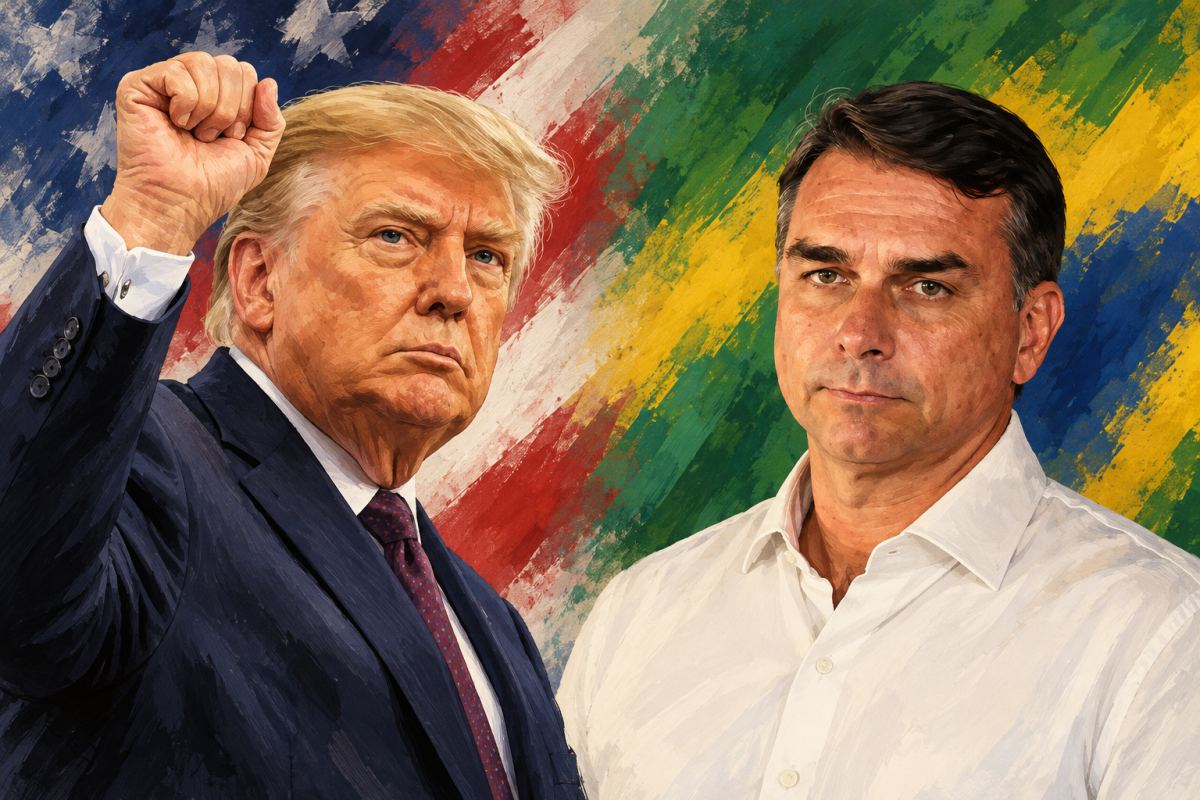
President Donald Trump said Saturday night that Flávio Bolsonaro can remain in the United States “as long as he wants.” He spoke to reporters at a Halloween celebration at Mar-a-Lago in Florida, four days after the former Brazilian presidential candidate arrived in the Miami area following his runoff defeat to Luiz Inácio Lula da Silva. Trump called Brazil’s election a “disgrace” but said he had no plans to meet Bolsonaro, Reuters reported.
The president’s remarks publicly reinforce his political welcome for the defeated candidate. They do not establish how long Bolsonaro may legally remain in the United States or change Brazil’s certified election result. Reuters reported that he entered under a temporary humanitarian parole. No individual immigration document has been made public that would establish the length of his authorization or the conditions for a possible extension.
Bolsonaro disputes the official result
Brazil’s Superior Electoral Court announced Lula’s reelection on October 25. The president received 64,256,232 votes, or 51.79% of valid ballots, to Flávio Bolsonaro’s 59,826,041, or 48.21%. The margin was more than 4.4 million votes. The Liberal Party senator has not conceded and has questioned the legitimacy of the election without producing evidence that would invalidate the official count.
Bolsonaro left Brazil after the Supreme Federal Court ordered him to surrender his passports as part of an investigation. According to Agência Brasil, he crossed into Argentina with his wife and daughters on the night of October 27. From there, the family traveled by private plane to Ecuador and then to Florida, landing at Opa-locka airport on the morning of October 28. The Brazilian news agency attributed the border-crossing information to Argentina’s National Directorate of Migration.
The passport order is connected to an investigation into alleged money laundering. Bolsonaro denies wrongdoing. An open criminal investigation and a precautionary court order are not convictions. His departure after the judicial order has also added a diplomatic dimension to his situation. Brazil’s Federal Police had requested that his passport be held because they considered him a flight risk, Agência Brasil reported.
Rubio denies direct official help with the trip
Hours before Trump spoke in Florida, Secretary of State Marco Rubio answered questions about Bolsonaro’s arrival in the United States. At the G20 foreign ministers’ meeting in Atlanta, he said the U.S. government had not facilitated the journey or been directly involved in the movements that took Bolsonaro out of Brazil, according to The Associated Press and Reuters. Rubio acknowledged that Washington knew of his arrival and that Trump had decided to let him enter.
That account does not settle every question about contacts before the journey. Reuters reported that a White House official helped arrange it; the account of that official’s role comes from the agency’s reporting and has not been publicly confirmed by the State Department. Rubio’s comments leave open the distinction between assistance from an individual connected to the government and direct official involvement.
The case comes as Brazil and the United States seek to keep diplomatic channels open. Brazilian Foreign Minister Mauro Vieira and Rubio spoke briefly at a G20 reception in Atlanta and agreed to meet again before the leaders’ summit scheduled for December in Miami, according to Agência Brasil. Rubio later said he expected to see Brazilian representatives again in France in November. The conversation did not amount to an agreement on Bolsonaro or resolve differences between the governments, but it showed that diplomatic contact continues.
In Brazil, lawmakers and officials have questioned the former candidate’s departure after the court order. In the United States, Democratic lawmakers have sought explanations about possible assistance with his trip, Agência Brasil reported. Questions about events in Argentina, Ecuador and the United States are separate from the validity of the election result announced by Brazil’s electoral court.
Immigration rules govern his stay
The humanitarian parole cited by Reuters is a temporary, discretionary authorization. U.S. Citizenship and Immigration Services says the mechanism allows a person to be present in the country for a specified period because of urgent humanitarian reasons or a significant public benefit. It does not by itself confer permanent immigration status or provide an automatic path to permanent residence.
Trump’s statement that Bolsonaro can stay “as long as he wants” expresses a political position; it is not a published decision on Bolsonaro’s individual immigration status. U.S. authorities have not released a document establishing the length of his stay, and there is no basis to say he has been granted asylum. Any formal change would require decisions under applicable immigration rules.
Trump’s latest remarks convey two messages. He continues to welcome Bolsonaro and has again disparaged an election whose result has been certified. At the same time, he says he has no plans for a personal meeting, while Rubio seeks to continue talks with Lula’s government. What happens next will depend on the legal proceedings in Brazil, Bolsonaro’s immigration status in the United States and whether the two countries can advance their relationship without allowing the case to dominate their agenda.