SK hynix: The Memory Maker That AI Can’t Afford to Keep Waiting
High-bandwidth memory has changed its industrial position. Its history, factories, financial recovery and capital-return plans show why technological importance still comes with a cycle.
A powerful processor can spend much of its time waiting for data. That unglamorous limitation helps explain the transformation of SK hynix from a highly cyclical memory producer into one of the companies commanding the largest stock-market valuations. Artificial intelligence needs arithmetic, but it also needs a continuous supply of information close to the processors performing it. Memory has become a strategic component of that system.
The distinction matters because the Korean company's opportunity is more demanding than simply selling more chips. It must manufacture increasingly complex memory, package it reliably and qualify each generation with customers whose computing systems are changing quickly. Its November 5, 2026 market capitalization of approximately $613.55 billion reflects expectations about that position. Its factories, earnings and financial obligations are measured on a different basis, mainly in Korean won.
A survivor of the memory industry's upheavals
The business began in 1983 as Hyundai Electronics. Its first semiconductor factory in Icheon established a manufacturing base that would grow through investment, borrowing and consolidation. A Korean stock-market listing followed in 1996, and the acquisition of LG's semiconductor business in 1999 expanded its scale. Those milestones also belong to an industry in which adding capacity can undermine the prices that justified the investment.
Restructuring became central to the company's survival. It adopted the Hynix name in 2001 and separated from the Hyundai group that year, while creditors participated in a debt restructuring. SK Telecom's acquisition of a stake in 2012 brought another change of ownership and the SK hynix name. This was a history of financial reconstruction as well as engineering progress, rather than a smooth ascent through successive chip generations.
The company remains listed in Korea under 000660. Another chapter opened on July 10, 2026, when its American depositary shares began trading on Nasdaq as SKHY. Each ADS represents one-tenth of an ordinary share: ten ADSs correspond to one Korean common share. Comparing prices or dividends across those securities without that conversion would produce a tenfold error before exchange rates or depositary fees even enter the calculation.
Two memory businesses, several kinds of demand
DRAM holds information that a computer needs while operating; NAND flash retains information without power and underpins storage products such as solid-state drives. Both businesses benefit from more computing, yet their customers, production economics and supply cycles differ. SK hynix participates in both, so a strong artificial-intelligence narrative should not obscure the wider mix of server, device and storage demand that influences its results.
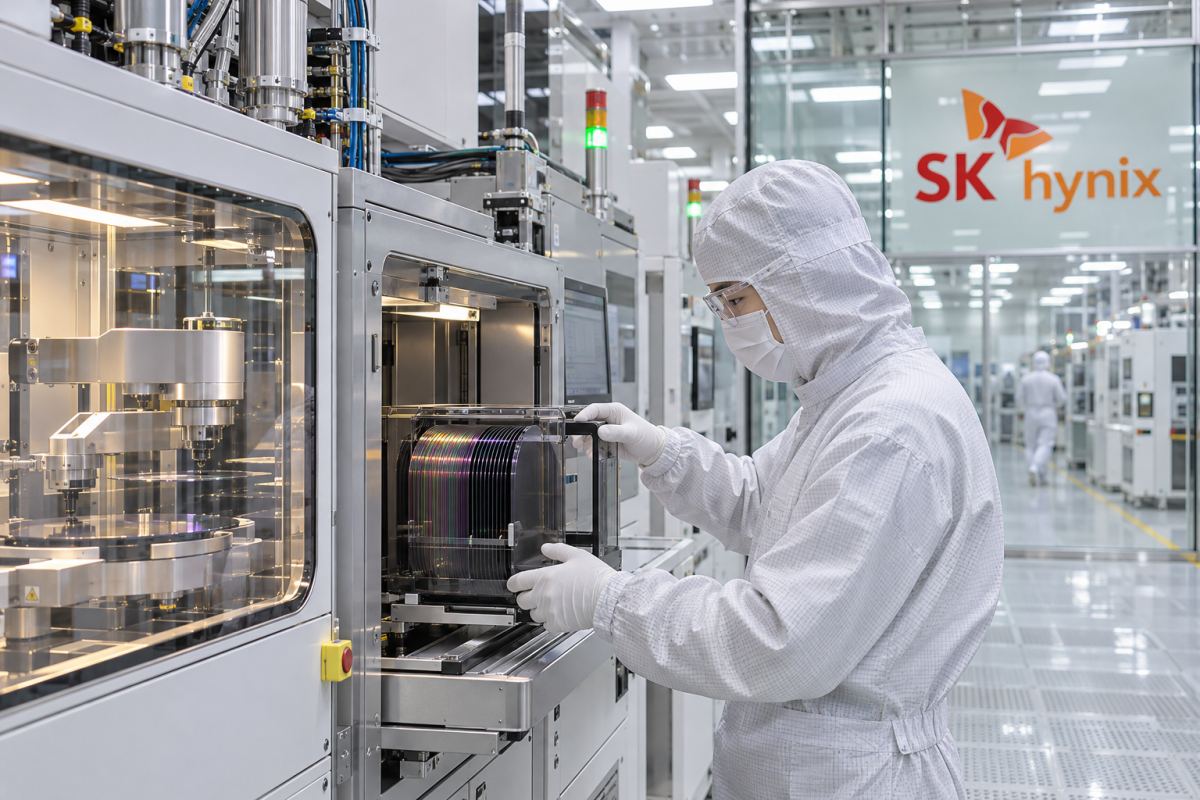
High-bandwidth memory, or HBM, is a specialized form of stacked DRAM designed to deliver large amounts of data rapidly. Stacking and connecting memory layers allows greater bandwidth within the constraints of the computing package. The challenge is not just producing a functioning individual chip: the completed stack must meet exacting performance, power and reliability requirements. Manufacturing yield therefore has a direct influence on how much valuable output comes from installed capacity.
NAND adds another route into data centers. The business acquired from Intel, operated under the Solidigm brand, gives the group a position in enterprise storage as well as memory components. That brings complementary technology and customer relationships, but integration and investment still consume resources. It would be misleading to treat every part of the group as if it shared HBM's margins or faced identical competitive pressures.
Annual accounts show the scale of the recovery
For calendar 2025, SK hynix reported revenue of 97.147 trillion won and consolidated net profit of 42.948 trillion won. Revenue had been 66.193 trillion won in 2024, with net profit of 19.797 trillion. The audited figures establish a sharp improvement, but the earlier comparison is just as instructive: the company lost 9.138 trillion won in 2023. A memory producer's earnings history can turn dramatically within a few years.
Its December 2025 balance sheet carried 176.108 trillion won of total assets, including approximately 77.503 trillion of property, plant and equipment. These are accounting values, not a market appraisal of all its technology or a replacement-cost estimate for its factories. They nevertheless reveal the industrial base behind the stock-market story. Advanced memory remains a capital-intensive manufacturing activity even when the products acquire greater strategic importance.
Operating activities generated 53.373 trillion won in cash during 2025. Cash capital expenditure on property, plant and equipment was 27.519 trillion won, while research and development expense reached 6.466 trillion. The figures describe different commitments: factories and equipment expand or maintain production capability, while research supports future products. Strong operating cash flow gives management more room to fund both, but does not make either expenditure optional in a competitive technology business.
The latest quarter raises the stakes
Results announced on October 28 for the third quarter of 2026 showed revenue of 104.616 trillion won, operating profit of 83.334 trillion and net profit of 39.776 trillion. Revenue increased 32% from the preceding quarter, while operating profit rose 38%. These are preliminary quarterly results, not a completed annual account. Their extraordinary size also makes it particularly important to distinguish operating profit from the smaller bottom-line figure rather than use the terms interchangeably.
The company said HBM4 shipments began in earnest during the quarter and expected that generation to become its mainstream HBM product in the fourth quarter. It also pointed to server DDR5 demand and enterprise solid-state drives using 321-layer TLC NAND. These developments describe a broadening infrastructure opportunity, although customer qualification, production yield and the timing of purchases will determine how much of that opportunity becomes profitable shipment volume.
Management reported 114.5 trillion won in cash and equivalents and 15.8 trillion in borrowings at quarter-end, giving 98.7 trillion in net cash on its presentation's basis. That financial cushion changes its ability to invest and return capital. It should still be read alongside spending commitments and a business model exposed to price changes, rather than interpreted as money with no competing industrial use.
Contracts offer visibility, not an escape from economics
SK hynix said long-term agreements covered more than half its production capacity for 2027 and 2028. That gives manufacturers and customers a stronger basis for planning factories and computing systems. However, management also said pricing would reflect market conditions. Reserved capacity does not mean every future selling price, revenue figure or margin has already been locked in; contractual visibility and guaranteed financial returns are different things.
The company expects tight supply to persist through 2030. That is its outlook, not an established description of years that have yet to occur. Rival capacity additions, improvements in production efficiency, changes in AI architecture and customers' own investment returns could alter the balance. HBM's complexity can create barriers to entry while simultaneously increasing execution risk for the supplier trying to satisfy demand.
President and chief executive Nohjung Kwak oversees a business whose competitive position depends on customers accepting successive product generations. The same relationships that support long-term planning can create concentration and bargaining risks. A delayed platform, qualification problem or change in a major customer's purchasing strategy can matter even when the overall market continues to expand. Revenue growth alone cannot capture that dependence.
Shareholders face a new scale of distributions
The October capital-return plan envisaged approximately 100 trillion won of returns for fiscal 2026, including at least 30 trillion of cash dividends and at least 60 trillion of treasury-share acquisitions and cancellations. Implementation extends through the payment date of the annual dividend. These are planned amounts, subject to business conditions and further decisions, rather than a statement that the entire sum had already reached shareholders.
The declared third-quarter dividend was 20,000 won per ordinary share. Half reflected earnings and half was a special distribution linked to gains from the company's indirect investment in Kioxia. Distinguishing that exceptional component matters when considering future income. Shares bought for employee compensation also have a different economic purpose from shares acquired and cancelled for shareholder returns; grouping all purchases together would exaggerate the reduction in ownership outstanding.
SK hynix's investment case now combines an essential position in AI infrastructure with a manufacturing industry's old disciplines. Its record shows both a severe loss year and exceptional profitability, substantial factories and a much stronger cash position. The durable achievement will be to preserve technological relevance and investment discipline after today's shortages ease. For shareholders, the crucial measure is how much value remains across that cycle, after the cost of staying indispensable has been paid.