Nvidia revenue doubles to $115.8 billion as next-quarter margins face a squeeze
Data centers supplied about 93% of quarterly sales. Nvidia forecasts $130 billion in revenue for a fourth quarter that includes an extra week, while projecting lower gross margins.
Nvidia reported quarterly revenue of $115.8 billion on Nov. 17, 2026, a 103% increase from a year earlier, as its data-center business continued to expand. The U.S. chipmaker earned $65.3 billion in net income and forecast another increase in sales next quarter, while warning through its guidance that gross margins would narrow.
The results cover the third quarter of fiscal 2027, which ended Oct. 25, 2026. Nvidia’s fiscal-year label therefore differs from the calendar year in which the business occurred. Revenue also rose 20% from the preceding quarter, showing growth against both comparison periods.
For the fourth quarter, management expects revenue of $130 billion, plus or minus 3%. That is an outlook rather than revenue already recognized. The distinction is particularly relevant because the company identified an extra week in the coming quarter and specified an important assumption about China.
Data centers account for nearly all sales
Data-center revenue reached $107.6 billion, up 110% from a year earlier and 21% from the preceding quarter. Using the rounded figures in the release, the business generated approximately 93% of Nvidia’s total revenue.
Edge Computing contributed $8.2 billion, an increase of 42% year over year and 14% sequentially. Nvidia described activity spanning personal computing, automotive and robotics, but the relative segment sizes show where most of its current financial scale resides.
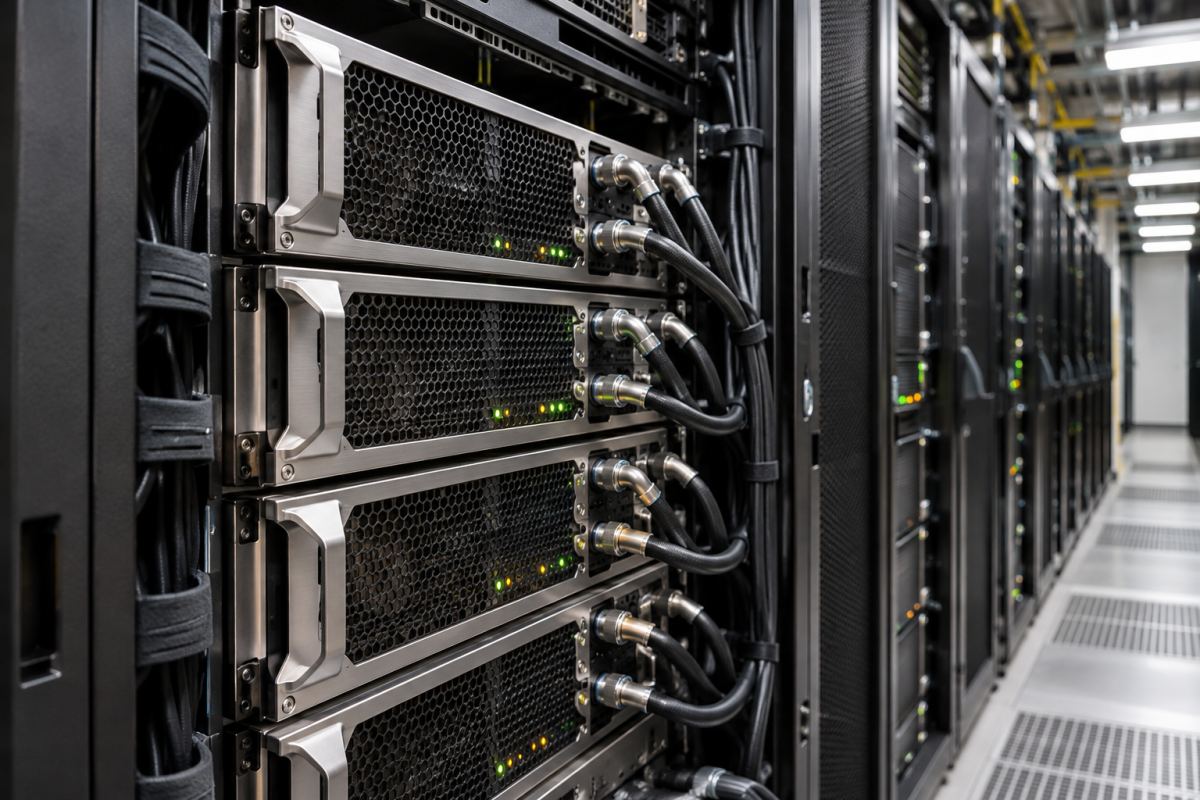
The company said it had increased production and begun shipping Vera Rubin NVL72 systems. It identified partners including CoreWeave, Google Cloud, Microsoft Azure, Oracle Cloud Infrastructure and Nebius as operating the systems. Those are company-reported deployment milestones; the segment’s revenue figure does not disclose sales attributable to each named partner.
Colette Kress, Nvidia’s interim chief executive and chief financial officer, expressed confidence in Vera Rubin’s launch and the company’s technology roadmap. Her assessment describes management’s expectations for the business and should be read alongside the reported financial results rather than as an independent forecast.
Profit rises, but the next margin forecast declines
Operating income rose 115% year over year to $77.5 billion. Operating expenses increased 57% to $9.2 billion, a substantial rise that nevertheless remained below the rate of revenue growth. Net income under U.S. generally accepted accounting principles, or GAAP, increased 105% from a year earlier.
GAAP diluted earnings per share were $2.70, compared with $1.30 a year earlier. Nvidia also reported adjusted, or non-GAAP, diluted earnings of $2.68 per share. The measures use different accounting treatments and need to be identified consistently when making comparisons.
GAAP gross margin was 74.8%, down from 75.0% in the preceding quarter but above 73.4% a year earlier. Gross margin measures the share of revenue remaining after the cost of goods sold, before other operating expenses and taxes.
For the fourth quarter, Nvidia expects both GAAP and non-GAAP gross margins between 71% and 72%. Compared with the just-reported GAAP margin, that would be a decline of 2.8 to 3.8 percentage points. The outlook therefore combines higher projected sales with less gross profit retained from each dollar of revenue.
The fourth quarter has an extra week
A 3% range around the $130 billion revenue forecast translates to approximately $126.1 billion to $133.9 billion. The midpoint is roughly 12% above third-quarter revenue, using the rounded numbers in the announcement.
Nvidia explicitly noted that the fourth quarter includes an additional week. The sequential comparison consequently does not measure business activity over identical lengths of time. That qualification matters when assessing how much of the projected increase represents a change in demand versus a longer reporting period.
The company also said its outlook assumes no Data Center compute revenue from China. That is a specific forecast assumption for a defined business category. It is broader than the evidence to read it as a statement that every Nvidia activity connected with China has ceased.
Management expects fourth-quarter GAAP operating expenses of approximately $11 billion. Revenue, gross margin and operating costs each affect future earnings, so a higher sales forecast alone does not establish the net income the company will eventually report.
Receivables and inventory expand with the business
Nvidia’s balance sheet showed accounts receivable of $81.033 billion on Oct. 25, compared with $38.466 billion on Jan. 25. Inventory increased to $39.724 billion from $21.403 billion over the same dates.
Those figures are balances at particular points in time, unlike the income statement’s revenue generated during a quarter. Receivables represent money owed by customers, while inventory reflects assets connected with production and sales. Increases alone do not establish that customers cannot pay or that products cannot be sold.
They do provide another way to follow the expansion. A business growing this quickly must manage production, customer collections and the capital supporting both. Cash and cash equivalents stood at $29.089 billion at quarter-end, in addition to other financial assets shown on the balance sheet.
Buybacks and the next dividend
Nvidia returned $28.1 billion to shareholders through share repurchases and cash dividends during the quarter. In September, its board increased the repurchase authorization by $150 billion. Approximately $227.3 billion remained under that authorization at quarter-end.
An authorization is permission to repurchase shares, rather than proof that the remaining amount has already been spent or will be deployed immediately. Nvidia also announced a quarterly cash dividend of 25 cents a share, payable Dec. 23 to shareholders of record on Dec. 2.
The release shows the financial scale of Nvidia’s AI infrastructure business and the continuing importance of its data-center customers. The next reporting period will test the conversion of new-system shipments into recognized revenue, while investors can compare actual margins, operating costs and collections with the expectations management has now set.