Visa’s Hidden Power: Earning From Payments Without Making the Consumer Loan
Visa coordinates banks and merchants rather than lending to cardholders. Its history, incentives, financial results and competitive pressures reveal the economics behind the familiar card logo.
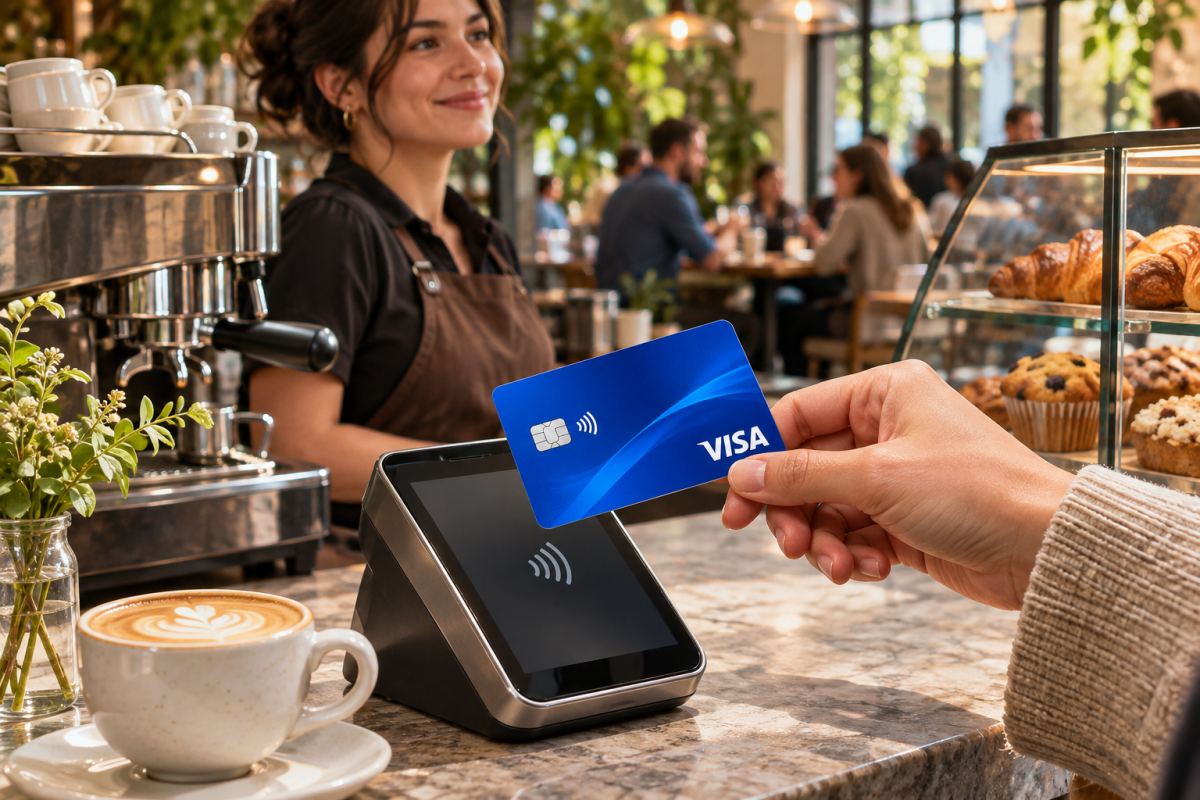
When a customer pays with a Visa card, several businesses participate in the transaction. The bank that issued the card, the merchant’s financial partners and the network perform different jobs. Visa’s position in that chain has produced one of the world’s most valuable companies, even though it does not operate like the consumer lender many people imagine when they see its name on a card.
Its equity value was approximately $789.82 billion in the November 5, 2026 snapshot. The attraction is a business that can participate in enormous payment volumes without financing each consumer purchase itself. The challenge is preserving the usefulness and economics of that network as regulators, banks, merchants and competing technologies seek a larger role in how money moves.
From a bank program to a global network
Visa’s origins lie in Bank of America’s 1958 launch of BankAmericard. The organization became independent of that bank in 1970 and adopted the Visa name in 1976. The transition is important: a payment system could grow beyond the customer base and geographic reach of one issuer by enabling different financial institutions to participate under a shared framework.
Regional businesses were combined into Visa Inc. in 2007, followed by the company’s public listing in 2008. Visa Europe remained separate until its acquisition closed in June 2016. These changes helped create the present corporate structure, but the underlying commercial proposition remained coordination. A payment network becomes more useful when consumers can pay in more places and merchants can reach more cardholders.
That relationship creates a network effect, but it does not make customers passive. Banks can work with competing networks, merchants can question acceptance costs and governments can promote domestic alternatives. The company must maintain incentives for multiple participants whose interests do not always align. A system valuable to a shopper must also remain commercially acceptable to the institutions and businesses supporting the purchase.
Visa says it does not issue cards, extend credit or set account holders’ interest rates and fees. Those activities generally belong to financial institutions. Interchange reimbursement fees usually flow from acquiring institutions to issuing banks; they are not simply Visa revenue. Understanding that separation is essential before drawing conclusions from the total fee a merchant pays to accept a card.
A small share of a vast flow
For fiscal 2026, ended September 30, Visa reported net revenue of $45.903 billion, up 15%. GAAP net income was $23.504 billion, up 17%, and diluted earnings per share were $12.32. Chief executive Ryan McInerney described a business still expanding across payment activity and associated services. These were full-year results released on October 27, rather than estimates for an unfinished year.
The revenue calculation reveals the economics of attracting and retaining participants. Annual service revenue was $19.918 billion, data processing $23.374 billion, international transactions $15.251 billion and other revenue $5.677 billion. Client incentives of $18.317 billion reduced those categories to reported net revenue. Adding gross categories without deducting incentives would substantially exaggerate the size of Visa’s business.
The network processed 281.3 billion transactions during the year, 9% more than the previous year. That is a transaction count, not a dollar value or a revenue figure. Payments volume also grew 9% in constant dollars. Different transaction sizes, geographic mixes and service arrangements mean that the number of purchases and the company’s revenue do not need to rise at identical rates.
Cross-border activity is particularly relevant because international transaction revenue depends on more than domestic shopping. Annual cross-border volume excluding transactions within Europe increased 12% in constant dollars. Travel and international commerce can support this activity, but currency movements and shifts in customer behavior affect comparisons. A worldwide footprint creates opportunities while exposing the company to economic conditions across multiple markets.
The latest quarter and the cost of growth
Fiscal 2026’s fourth quarter produced $12.139 billion in net revenue and $6.002 billion in GAAP net income. Diluted earnings per share were $3.19. Revenue grew 13%, while the network processed 74.2 billion transactions, up 10%. Cross-border volume excluding intra-European transactions increased 14% in constant dollars. These indicators describe related aspects of activity, not interchangeable measures of the same thing.
Timing also matters. Service revenue is recognized using the preceding quarter’s payments volume, whereas other main revenue categories reflect current-quarter activity. A sudden change in spending may therefore appear differently across revenue lines. This makes it risky to read a single quarter’s volume figure as though every fee in the income statement was generated from exactly that period’s purchases.
The company’s high profitability does not mean its costs are negligible. Annual operating expenses were $17.793 billion, including litigation provisions and severance expenses. Visa’s adjusted presentation excludes selected items and reported higher net income than GAAP. Those adjustments can help compare operating trends, but legal and organizational costs still affect shareholders. The existence of an adjustment is not proof that an expense has no economic significance.
Network reliability is another recurring requirement. Authorization, processing and settlement depend on systems functioning securely and consistently. Fraud prevention, tokenization and related services can deepen relationships with clients, but also require investment and adaptation. The company’s position rests on being useful as transactions change form, whether the payment begins with a plastic card, a phone or another digital interface.
A balance sheet different from a bank’s
At September 30, 2026, Visa reported $94.360 billion in total assets. Cash and equivalents were $12.938 billion, with cash and investment securities together amounting to approximately $14.2 billion. Net property, equipment and technology were $5.066 billion. The company can process very large payment volumes without owning a corresponding consumer loan book or a manufacturing estate on a similar scale.
Goodwill of $20.801 billion and intangible assets of $27.370 billion also formed a substantial part of the balance sheet. These amounts reflect accounting values associated with acquired businesses and other rights; they are not interchangeable with cash available for distribution. Debt included $2.716 billion due within a year and $19.355 billion classified as long term.
Visa nevertheless has financial risk. Its settlement arrangements can require it to cover losses if a participating institution fails to meet obligations. Not extending consumer credit therefore does not mean the company has no exposure to counterparties. Liquidity, collateral and the management of participating institutions remain important parts of operating a system that moves money between others.
Acquisitions introduce a separate execution risk. In August 2026, Visa agreed to buy fraud-intelligence company BioCatch for $2.4 billion in cash. As of November 5, the transaction remained subject to conditions and regulatory approvals, with completion expected during fiscal 2027’s second quarter. An agreement to acquire a capability is not yet an integrated business producing the anticipated benefits.
The stock, the distributions and the competitive question
Visa’s publicly traded Class A shares are listed on the New York Stock Exchange under V. Other share classes carry different conversion arrangements and interests, including connections to legacy litigation protections. The company’s capital structure is therefore more complicated than counting only the publicly quoted Class A shares. Conversion rights can influence the ownership represented by each security.
During fiscal 2026, Visa returned $25.6 billion through repurchases and dividends, including $20.5 billion used to buy back approximately 61 million Class A shares. An additional repurchase authorization is permission to spend, not money already distributed. On October 27, the board increased the quarterly dividend to $0.780 per Class A share, payable in December; that payment was still in the future on November 5.
The dated equity value of $789.82 billion equaled about 34 times fiscal 2026 GAAP net income. This historical comparison does not determine future returns. Investors must assess how pricing, incentives, regulation and new payment methods will affect profits. Real-time bank payments and other alternatives can compete even if consumers continue to move away from cash.
Visa’s history shows how coordinating a system can become as economically important as supplying the money used within it. Its next advantage must come from maintaining trust and relevance while commerce changes. The most useful test is whether the network keeps creating enough value for banks, merchants and consumers to support both growing usage and durable shareholder earnings.