CXMT’s Memory Boom Raises a Crucial Question: Who Owns the Profits?
A new Shanghai listing and exceptional DRAM results transformed its scale. Factory ownership, minority interests and the investment cycle explain what shareholders actually retain.
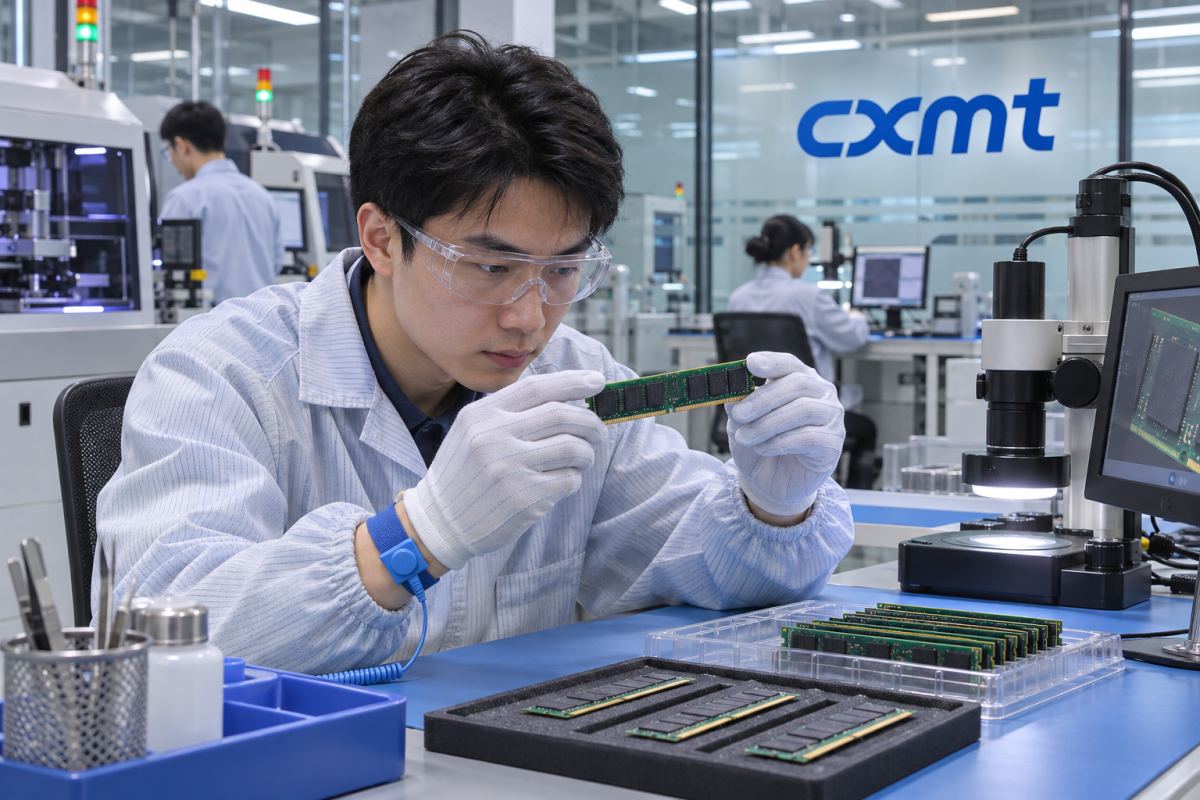
Memory shortages have propelled CXMT into a financial scale that would have seemed remote during its loss-making years. The Chinese DRAM producer now combines rapidly growing revenue, new stock-market capital and major manufacturing commitments. Its position reflects both demand for computing and China's effort to build a stronger domestic semiconductor industry. The shareholder's result, however, also depends on a less visible question: who owns the factories generating the profit?
CXMT's equity market capitalization was approximately $431.05 billion in the November 5, 2026 snapshot. Its A shares had only begun trading on Shanghai's STAR Market on July 27 under 688825. The valuation captures expectations about a business expanding during an exceptional memory cycle. To understand it, the market story needs to be connected to industrial history, the financial accounts and the ownership structure of important subsidiaries.
From a new entrant to commercial memory production
Founded in 2016, CXMT built its business around researching, designing, manufacturing and selling dynamic random-access memory. Construction of its first Hefei fabrication facility began in 2017. A functioning factory requires much more than a completed building: equipment installation, process development, repeated testing and customer qualification must turn an engineering project into reliable production. That progression consumes capital before commercial returns are assured.
The company's history records an 8-gigabit DDR4 design reaching the manufacturing stage in 2018, followed by successful testing in 2019. It announced mass production that September and began product sales that November. A Beijing trial-production line followed in 2022. These milestones matter because memory manufacturing develops through cumulative process knowledge and production experience, as well as investment in physical equipment.
DRAM supports working memory in computers, mobile devices and servers. It holds information while systems operate, with product generations balancing speed, power consumption, density and cost. CXMT's broad opportunity therefore extends across computing markets. A rise in AI-related investment can strengthen demand, but its overall business should not be treated as if every memory product were a specialized AI accelerator component.
The economics depend on useful output
In a fabrication plant, revenue depends on how much working memory emerges from production and what customers will pay for it. Better yield spreads factory costs across more saleable chips. More advanced processes can improve density or performance while requiring further equipment and development. The challenge is to advance quickly enough to remain competitive without allowing the cost of that advancement to overwhelm its commercial benefit.
Qualification creates another discipline. Customers need memory that performs reliably inside their own devices and systems, and changing suppliers can require testing and redesign. Successful qualification can support durable relationships, but a delayed product or quality problem can also restrict access to demand. Installed wafer capacity is therefore an incomplete measure of a producer's commercially useful capability.
Industry prices add a powerful external influence. CXMT's listing documents explicitly warned that sustained sharp increases in DRAM prices were not indefinitely sustainable. Rival manufacturers can expand capacity, customers can alter purchases and rising memory costs can weaken demand in some end markets. A shortage can produce exceptional margins while encouraging the investment that eventually changes the supply balance.
Annual results capture a turning point
For 2025, the company reported approximately RMB61.799 billion in revenue, up 155.6%. Net profit attributable to parent-company shareholders was approximately RMB1.875 billion. That followed attributable losses of RMB7.145 billion in 2024 and RMB16.340 billion in 2023. The sequence shows both a commercial recovery and the severity of the earlier investment and industry cycle. A single profitable year does not erase that volatility.
Total assets at December 31, 2025 were RMB336.785 billion. The scale of the balance sheet relative to annual earnings underlines how much industrial and financial commitment had accumulated before the latest surge in profitability. Assets include factories, construction projects, financial resources and other recognized balances. They are an accounting record of the group, separate from the stock market's assessment of its future earning power.
The July 2026 offering was priced at RMB8.66 per share. The base issue raised approximately RMB57.919 billion before expenses and before the overallotment option, with different totals if that option was fully exercised. The offer price was a financing milestone, not the stock's November 5 trading price. New capital expands resources and also enlarges the number of shares participating in future earnings.
The latest quarter changes the scale again
Third-quarter 2026 revenue reached RMB118.714 billion, up 19.30% from the preceding quarter. Consolidated net profit was approximately RMB88.983 billion, while profit attributable to shareholders of the listed parent was RMB54.435 billion. Those figures increased 19.38% and 3.01% respectively from the previous quarter. The difference is essential: the faster growth in the whole group's profit did not all accrue to the listed company's shareholders.
For the first nine months, revenue totaled RMB269.024 billion. Consolidated net profit was RMB196.532 billion, comprising RMB132.040 billion attributable to parent shareholders and RMB64.492 billion attributable to minority interests. Adding those two ownership components reconciles the group total. Using the consolidated amount as if it all belonged to investors in 688825 would materially overstate their share of earnings.
The third-quarter report put gross margin at 89.53%, an extraordinary result in a capital-intensive business. That is a reported quarterly margin, rather than a normal margin guaranteed for future years. Research and development input totaled RMB11.071 billion over nine months. Maintaining technology and productive capacity remains necessary even when selling prices generate unusually strong near-term returns.
Control and economic ownership are different
The interim report explains why minority interests matter. At June 30, the group held 30.68% of the equity in the important ChangXin Xinqiao subsidiary and 31.72% in ChangXin Jidian. Agreements with other shareholders gave it control of substantially larger voting percentages. The group could therefore consolidate those businesses even though its direct economic ownership was below half.
Consolidation brings controlled subsidiaries' revenue, assets and liabilities into the group accounts, with the other owners' interests separately identified. This is a legitimate accounting structure, but it changes how readers should interpret headline growth. A rapidly expanding factory can strengthen the group's total results while sharing substantial economic benefits with investors outside the listed parent.
The agreements also create a governance question. The interim report identified risks if their effective operation changed and control over those subsidiaries became less stable. Those arrangements should be evaluated alongside technological and manufacturing risks. A shareholder is purchasing an interest in a corporate structure whose rights and economic entitlements matter, rather than simply a direct claim on every yuan earned by every factory.
The balance sheet has gained considerable resources
By September 30, total assets had increased to RMB672.535 billion. Reported monetary funds were RMB285.165 billion and trading financial assets RMB68.457 billion. Monetary funds should not automatically be described as entirely unrestricted cash. New share capital, subsidiary investors' contributions and operating flows all need to be considered when explaining the increase in resources; it was not solely accumulated profit.
Net fixed assets stood at RMB184.900 billion, with another RMB44.235 billion in construction in progress. Nine-month operating cash flow was RMB254.751 billion, while cash spent acquiring fixed assets, intangibles and other long-term assets was approximately RMB36.998 billion. The different categories describe resources generated and commitments made over a cumulative period. They should not be annualized and presented as a completed year's results.
The listing also introduced a market-structure issue. Only a relatively small fraction of the enlarged share capital was freely tradable at debut, with significant holdings subject to lockups. Prices established in a limited float still determine a much larger headline market value. Changes in tradable supply and investor expectations can therefore influence the shares independently of the timing of factory production or recognized earnings.
The cycle will test the new financial strength
CXMT's listing documents described a dispersed ownership structure without a controlling shareholder or actual controller. The presence of government-related funds among investors should not be simplified into a claim that one shareholder owns the entire company. The rights of different investors, subsidiary financing and the stability of control agreements all belong in an assessment of its corporate development.
The company has moved from heavy losses to exceptional profits while building a more substantial position in memory manufacturing. The next test is to preserve competitive products, useful factory output and investment discipline as supply conditions evolve. For listed shareholders, the lasting measure will be their share of cash and earnings after other owners' entitlements and the cost of the next technology generation. The memory boom creates scale; ownership and industrial execution determine what they retain.