Voyager 1 reaches one light-day from Earth as radio signals take 24 hours to arrive
NASA's spacecraft has crossed a distance of about 16.1 billion miles after 49 years of travel. Two instruments are still studying interstellar space as engineers work with a steadily shrinking power supply.
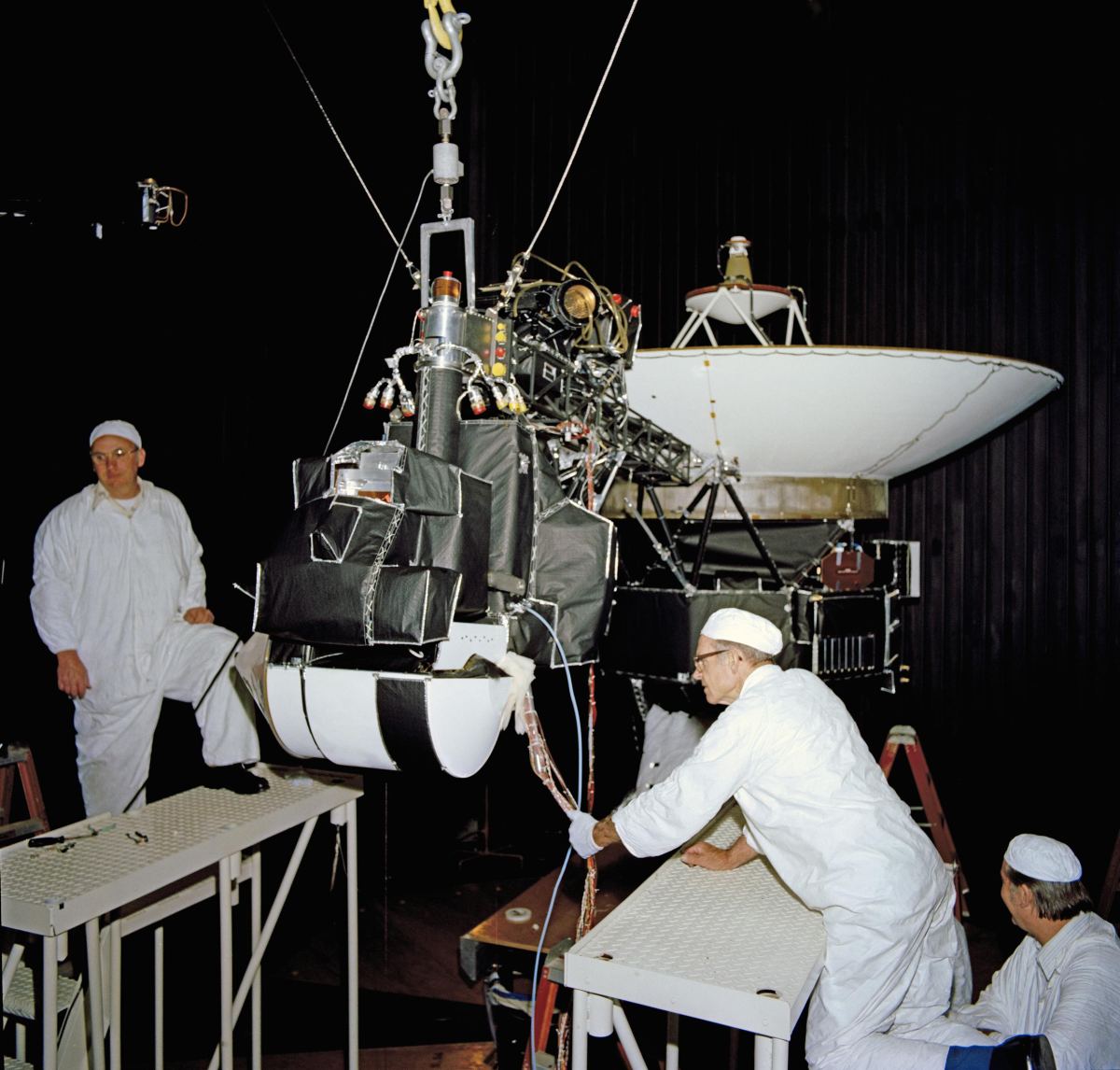
Voyager 1 reached a distance of one light-day from Earth on Wednesday, November 18, according to NASA's trajectory calculations. The most distant human-made object is now about 16.1 billion miles, or 25.9 billion kilometers, from our planet. A radio signal takes approximately 24 hours to travel that far.
NASA placed the crossing at 5:16:07 a.m. Eastern Standard Time. The spacecraft launched on September 5, 1977, more than 49 years ago, beginning a journey that took it past Jupiter and Saturn before it headed into interstellar space.
The distance record comes while the science mission remains active. Voyager 1 has two operating instruments, supported by a team that must conserve electricity, keep its systems warm enough to function and troubleshoot problems across a distance that rules out an immediate response from Earth.
A two-day exchange
A light-day is the distance light travels in 24 hours. Radio waves used to communicate with Voyager move at the same speed. An instruction sent from Earth takes a day to arrive, and information sent back needs another day, before allowing for the time required to carry out the command or schedule access to ground antennas.
The Sun provides a closer comparison: its light takes about eight minutes and 20 seconds to reach Earth. Communicating with a spacecraft at Mars can require between three and 22 minutes each way, depending on where the two planets are in their orbits.
Voyager's much longer delay means operations and the checks that follow them must be planned well in advance. Communications run through NASA's Deep Space Network, which has facilities in California, Spain and Australia. The network receives the spacecraft's data and transmits instructions from the mission team.
Wednesday's milestone measures the spacecraft's separation from Earth. Its significance lies in the scale of the journey and the mission's longevity. Voyager continues traveling through the same interstellar environment as it crosses that distance.
Two journeys that began in 1977
Voyager 2 launched first, on August 20, 1977. Voyager 1 left Cape Canaveral, Florida, a few weeks later but followed a faster route. Encounters with the giant planets helped change the spacecraft's trajectories as they continued toward increasingly distant destinations.
Voyager 1 flew past Jupiter on March 5, 1979, and reached Saturn on November 12, 1980. The exploration revealed active volcanoes on Jupiter's moon Io and showed Saturn's rings and moons in extraordinary detail. Images of Titan revealed the thick atmosphere that concealed its surface.
After Saturn, Voyager 1's course carried it above the plane in which the planets orbit. Voyager 2 continued to Uranus and Neptune and remains the only spacecraft to have visited both. Those different routes explain why two probes built for the same mission are now traveling in different directions and at different distances from Earth.
Science beyond the planets
Voyager 1 entered interstellar space on August 25, 2012. It crossed the heliopause, the boundary of the bubble of particles and magnetic fields that the Sun maintains through the solar wind. Voyager 2 reached that environment in November 2018.
The Sun's gravitational influence extends far beyond that bubble. Voyager 1 still has the distant Oort Cloud ahead of it, so entering interstellar space and leaving the full extent of the solar system involve different boundaries.
NASA's instrument status list shows Voyager 1's magnetometer and plasma wave subsystem as operating. Their measurements help researchers study the magnetic field and the surrounding environment. Its cameras were switched off in 1990 to conserve resources, after the mission's final images, including the view of Earth known as the Pale Blue Dot.
The team turned off the low-energy charged particles experiment in April 2026. The cosmic ray subsystem had been switched off to save power in February 2025. Reducing the suite of science instruments allows the available electricity to support those that continue sending information home.
Saving electricity while keeping warm
The Voyagers' generators convert heat from decaying plutonium into electricity. Each spacecraft loses about four watts of available power a year. Engineers have progressively switched off equipment and heaters to sustain essential functions.
In September, they completed an operation on Voyager 1 nicknamed the "Big Bang," simultaneously replacing three powered devices with three lower-power alternatives. The change reduced electricity use while maintaining a suitable distribution of heat. The same swap had already been carried out on Voyager 2.
Voyager 1 also experienced a communications interruption in October. The Deep Space Network did not detect its signal during scheduled contacts on October 18 and 19. Reception returned on October 20, before the team sent troubleshooting commands to the spacecraft.
In its October 29 account, NASA said engineers were investigating the cause and had identified an automatic switch from one set of thrusters to its backups. The episode underscored the need to retain protective systems on a spacecraft that must respond on its own while commands from Earth are still on their way.
A record that will keep traveling
Each Voyager carries a gold-plated copper record with pictures, natural sounds, music and spoken greetings in 55 languages. Its cover includes instructions for playing it and references for locating Earth. The collection was designed to convey the diversity of life and cultures on our planet to anyone who might encounter it in the distant future.
How long communications last depends on the power supply and the condition of the spacecraft's systems. After their science operations end, the probes can continue traveling with those records, even when there is no longer a radio link with Earth.
NASA has scheduled a discussion with mission leaders at the Jet Propulsion Laboratory in California for noon EST on Thursday, November 19. The event will examine the condition of both spacecraft and offer a preview of a NASA+ documentary planned for 2027, when Voyager's journey reaches its 50th anniversary.