Abelardo de la Espriella: a hard-line presidency overtaken by an earthquake
Colombia’s new president promised immediate transformation, but an earthquake rewrote his agenda. His first decisions reveal authority, personalism and reliance on the private sector.
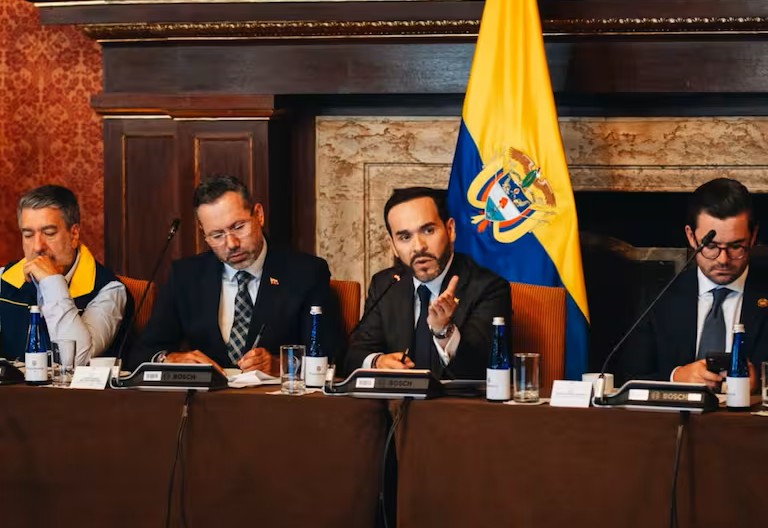
Abelardo de la Espriella entered Colombia’s presidency insisting that he would need no period of adjustment. On the campaign trail, he said roughly 70 decrees were ready for his first day in office: measures to freeze public spending, confront armed groups, shrink the bureaucracy and restore the military to the center of national life. The opening of his government, however, bore little resemblance to the one he had planned.
De la Espriella took office on August 7, 2026, after defeating the leftist senator Iván Cepeda by less than one percentage point. His first presidential image was made not at the Capitol in Bogotá but in Cali, where he moved the inauguration and then addressed troops at the Pichincha Battalion. The setting distilled his political message: a recovery of order, full backing for the security forces and a break with former President Gustavo Petro’s “Total Peace” strategy.
Three days later, on his first working day in office, a magnitude 7.4 earthquake struck western Colombia. The disaster pushed aside the security and austerity agenda the new administration had prepared. Since then, De la Espriella’s most consequential decisions have not been the measures advertised during the campaign. They have been emergency acts intended to rescue victims, mobilize money and begin a reconstruction expected to cost tens of trillions of Colombian pesos.
An opening built more on symbols than decrees
The administration’s first formal act was to constitute itself. Through Decree 1136, De la Espriella appointed all 18 cabinet ministers, nine women and nine men, and installed the senior officials responsible for the presidential office, legal affairs, communications and regional relations.
Beyond those appointments, the promised burst of executive action did not materialize. During his first 48 hours, the president moved among Cali, Barranquilla and Medellín, chaired security councils and cultivated the image of a government prepared to operate beyond Bogotá. He favored videos, public appearances and images of command over the immediate publication of detailed policy.
Hard-line security as the government’s first identity
In his inaugural address, De la Espriella ordered the military and police to confront all criminal structures and declared the era of negotiation exhausted. He promised an official list of “narco-terrorist” organizations, operations against high-value commanders, renewed aerial spraying of coca crops and maximum-security prisons modeled in part on President Nayib Bukele’s system in El Salvador.
As of August 20, several major security promises remained declarations of intent. The decree identifying terrorist organizations had not appeared, and there were no verifiable contracts, budgets or construction schedules for the proposed mega-prisons. Nor had the government published a comprehensive framework to replace the peace negotiations. The change in language is unmistakable; the legal and financial architecture remains largely unfinished.
The earthquake becomes the first real policy
The August 10 earthquake killed more than 300 people, injured thousands and damaged homes, schools, hospitals, roads and airports across western and central Colombia. On August 11, the government issued Decree 1171, declaring a national disaster for 12 months. It was the new administration’s first major substantive decision.
The decree activated the special disaster provisions of Law 1523 of 2012, placed the National Unit for Disaster Risk Management, known as the UNGRD, in charge of coordinating the response and required a specific recovery plan. It authorized transfers to territorial governments, facilitated emergency contracting and created a separate “Sismo 2026” account so that relief and reconstruction funds could be tracked independently.
On the same day, Decree 1170 named geological engineer David Santiago Tamayo as director of the UNGRD. The appointment put an official trusted by the new president in charge of the crisis, but it also revealed the cost of the troubled transition. De la Espriella had suspended the formal handover with Petro’s administration. When the earthquake struck, the agency was still headed by an official associated with the outgoing government. Three days of national mourning were also declared.
On August 19, nine days after the quake, De la Espriella issued Decree 1261, declaring a 30-day economic, social and ecological emergency across 15 departments. Under Article 215 of the Constitution, the measure allows the president and his cabinet to issue decrees with the force of law, but only when they are directly related to the catastrophe. The Constitutional Court must automatically review those decrees, while Congress retains its power of political oversight.
A reconstruction plan built with private capital
The administration has named its strategy the “Miracle Reconstruction Plan.” It calls for rental subsidies, technical inspections, the delivery of completed social housing and, during 2027 and 2028, the construction of homes, schools, health centers and roads.
De la Espriella summoned construction companies, banks and trade groups, while assigning his wife, Ana Lucía Pineda, a role in coordinating some private donations. The formula reflects his economic outlook: the state directs and contributes funds but shares execution with companies and civic organizations. It is still too early to determine how many rental subsidies have actually been paid or when large-scale construction will begin.
The emergency response also produced early failures. The government was slow to coordinate foreign rescue teams and ultimately authorized specialists from the United States, Israel, Ecuador and El Salvador, all led by political allies. Officials denied using an ideological test and said they relied on technical certification, but other governments offering experienced rescuers encountered obstacles during the critical period after the quake.
Crisis communications were concentrated in the president’s office. De la Espriella restricted independent statements by officials and at times appeared before the press without taking questions. In Buenaventura, he distributed soccer balls bearing the emblem of his Defenders of the Homeland movement. The gesture overshadowed announcements of medicine and health assistance and intensified criticism that partisan branding, humanitarian aid and presidential spectacle were being mixed together.
Austerity under pressure from catastrophe
The earthquake confronted the president with an immediate contradiction. De la Espriella had promised to freeze spending, abolish the wealth tax, reduce the size of the state and simplify the tax system. He must now finance reconstruction estimated at roughly 30 trillion pesos. By August 20, the general spending-freeze decree had not been published, and the legislation required to eliminate the wealth tax had not been introduced.
De la Espriella has meanwhile accelerated Colombia’s diplomatic turn. His government has moved closer to the United States and Israel, joined the U.S.-backed Shield of the Americas security coalition and announced the closure of 14 embassies and about 15 consulates. It has also said it will sever relations with Cuba and Nicaragua. Not all of those diplomatic changes had been fully completed by August 20, but the direction is clear.
The first days reveal an administration still being formed: forceful in language, personalist in communication, close to the military and business and determined to define itself against Petro. Yet much of its security and austerity platform remains at the level of promises. For now, the concrete work of De la Espriella’s presidency is the earthquake response. His real test will begin when reconstruction money starts to flow and Colombians can judge whether the authority displayed before cameras becomes durable institutional capacity.