Is Peru the Oldest State in the Americas?
If a state is understood as the organized administration of a territory, Peru has never ceased to have one: first an autonomous state, built on the remains of the Wari Empire; then a kingdom; then a republic. None began from scratch.
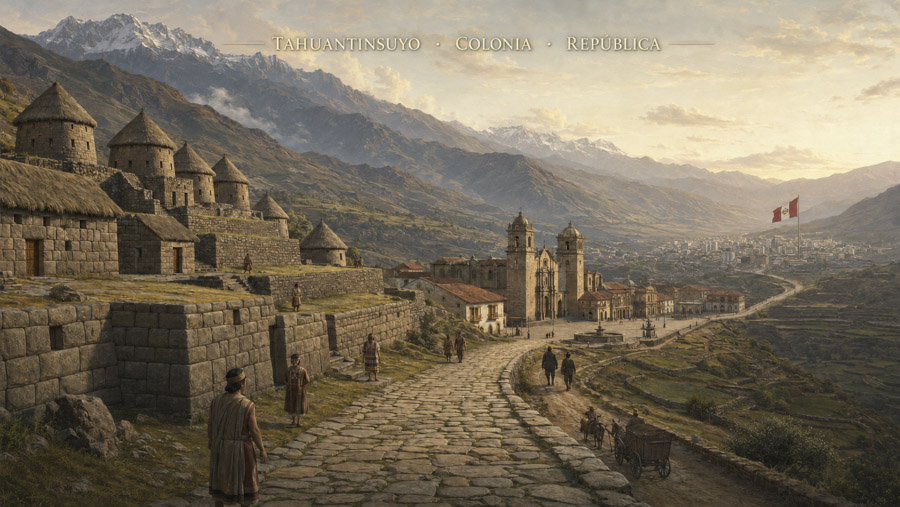
The question may strike many as chauvinistic, but it is a historical one, and its answer depends on two words: what we mean by “state” and what we mean by “old.” Political science defines a state by concrete features: a clearly defined territory, an administration that governs it directly, officials in its service, infrastructure projects and public services that it maintains. Dominating a territory and collecting tribute are not enough; a state must govern it.
By that standard, the answer to the question in the title is yes. Peru is an ancient nation, but its origin as an organized state can be dated to the mid-fifteenth century, when the Inca Pachacútec expanded the former city-state of Cusco and organized the empire into four suyus, or regions. On that basis, we must recognize that Peru has possessed a state as an administrative organization since 1438, according to John H. Rowe’s Inca chronology, and that it is therefore as old as several modern European or Asian states.
It is useful to begin where the state begins in the Andes, which is not with the Incas. Between approximately AD 600 and 1000, centuries before imperial Cusco, the Wari Empire flourished, with its capital near present-day Ayacucho. It was the first power to organize much of the Andean heartland under a single administration. It built planned provincial centers — Pikillacta, near Cusco; Viracochapampa, in the north; and Cerro Baúl, in Moquegua — with state warehouses for the redistribution of production and a road network that connected the whole. It relocated entire populations according to its needs, spread an administrative language and exercised direct rule over its provinces.
In short, the Wari state created the Andean model of government: territorial, administered and integrative. It was not merely an authority that collected tribute, but an apparatus that resettled populations, stored goods and exercised power. When that state dissolved around AD 1000, the Andes fragmented for four centuries into competing regional lordships, in a dispersal comparable to that experienced by Italy after the fall of the Roman Empire.
What the Incas did from the first decades of the fifteenth century was not to invent an empire, but to recover one. They reunified the fragmented territory, reused Wari roads and revived the earlier logic of government, bringing it to a degree of precision rarely seen in the ancient world: a decimal organization of the population, rotational labor through the mit’a, warehouses that stored harvests for times of scarcity, the planned relocation of communities and the Qhapaq Ñan connecting it all.
They did not merely preserve local lords in exchange for tribute, as empires concerned only with domination often did; they administered the territory directly and incorporated those lords into their structure of government. The Incas thus established the pattern that explains much of what followed: in the Andes, each new power did not completely destroy the apparatus of its predecessor, but inherited and adapted it. Rulers changed through force — the Incas also conquered violently — but the machinery of government was not rebuilt from the ground up. It passed from one set of hands to another.
One proof of this state system survived almost everything else: language. Great states often leave a common language behind. Alexander spread Greek across the eastern Mediterranean, and it survived his empire for centuries as the language of administration, commerce and Scripture in the Middle East, until the Arab conquests. The Arabs spread their language from the Atlantic to Persia, and Arabic survived the caliphate that propagated it. Rome left Latin, from which the Romance languages of Western Europe emerged and which also exerted a profound influence on English.
A lord who merely collects tribute is unlikely to produce such an effect; a state that administers, organizes, teaches and plans can do so. Something similar happened in the Andes. The Andean state spread Quechua — whose first great expansion linguists now attribute to the Wari, and which the Incas adopted as a language of government — from southern Colombia to northern Argentina. Like Greek and Arabic, Quechua survived the empire that had spread it: the Spanish Crown adopted it as a language of evangelization, and the Republic eventually granted it official recognition. It remains the most widely spoken Indigenous language in the Americas.
The Spanish conquest repeated the pattern. It did not completely erase the Inca state; it subordinated it and used many of its structures. The Spaniards, who had brought the name “Peru” from Panama, did not govern an anonymous colony, but the “Kingdom of Peru,” one of the realms incorporated into the Spanish Crown. Sovereignty passed to the Spanish monarch, but much of the administrative body, the roads, the labor system, the local lords and the language came from the state they had overthrown.
An important fact is that the Inca nobility retained many of its former privileges during the Viceroyalty and even into the early years of the Republic. The transfer of power can be traced on a map. When Pedro de Valdivia founded Santiago, Chile, in 1541, he did not settle in an empty territory, but in a functioning Inca province with a governor belonging to the royal house of Cusco: Quilicanta, who administered tribute, according to the chronicler Gerónimo de Vivar. The Spaniards laid out their Plaza de Armas over the Inca administrative center, and it was in the tambo itself that Valdivia had himself proclaimed governor.
There was more continuity than is usually acknowledged. The Crown recognized Indigenous communities and declared their communal lands — direct heirs to the Inca ayllu — inalienable, prohibiting third parties from acquiring them, even if they were Spaniards. It did not necessarily do so out of benevolence, but because the collection of tribute depended on the community remaining intact. The result, however, was that the old Andean territorial foundation remained protected by law for three centuries.
In 1821, the Republic adopted the same name and the central core of the same territory, and it preserved many colonial and Inca institutions. At this point, however, the pattern broke. In the name of turning the Indigenous person into a citizen and an individual property owner, the young Republic withdrew a protection that the king of Spain had guaranteed.
In 1821, San Martín declared Indigenous people citizens and abolished tribute. Bolívar, through the decrees issued in Trujillo in 1824 and Cusco in 1825, ordered communal lands to be divided into private properties and any land considered surplus to be auctioned. Throughout the nineteenth century, the result was the dismantling of many communal lands inherited from the ayllu and their gradual absorption by large estates.
Indigenous communities regained constitutional recognition only in 1920. The Republic therefore inherited the state, as its predecessors had done, but it was the first to undermine one of its deepest continuities — the territorial foundation of the Andean community — before partially restoring it a century later.
Is Peru, then, the oldest state in the Americas? If the state is understood as the administrative organization of a territory, the answer is yes in a rigorous sense.
Since the Incas reunified the Andean realm on the Wari model, this territory has never remained without a state organization. It has existed under three successive regimes — the Inca state, the Viceroyalty or Kingdom of Peru, and the Republic — without a prolonged vacuum of administrative authority. The political unity of the Italian peninsula, for example, disappeared after the fall of the Western Roman Empire in AD 476 and was not restored until 1861; for almost fourteen centuries, the territory was divided among different states. Peru experienced no comparable vacuum.
Its antiquity does not rest on the myth of a primordial nation, but on a fact that can be documented: the continuity of a governing apparatus that each succeeding power chose to preserve, adapt or recover rather than destroy completely.