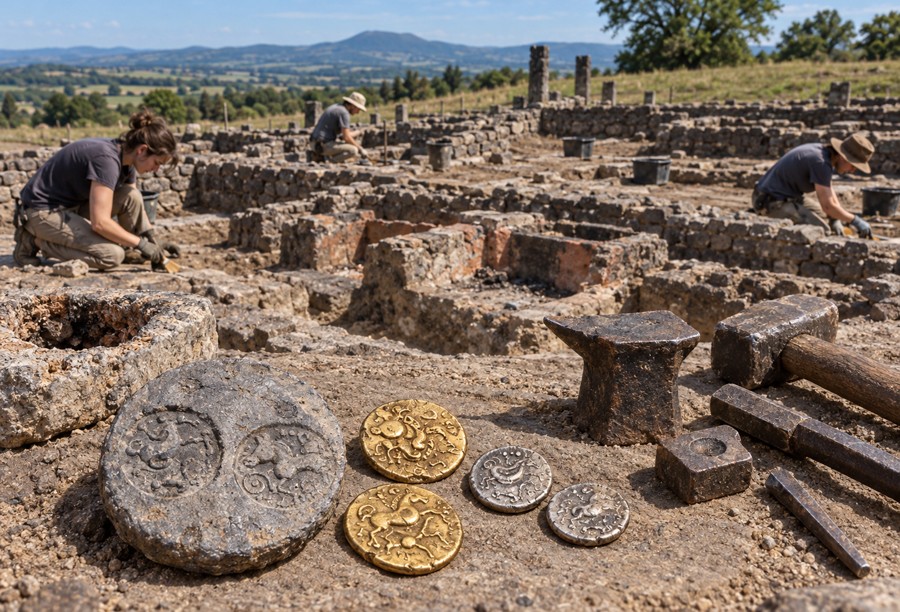
On a windswept basalt plateau in central France, half an hour south of Clermont-Ferrand, archaeologists have uncovered what may be the largest mint of the ancient world. Not a Roman one, nor a Greek one, but a Gaulish workshop: the place where, in the decades before Caesar's conquest, the Arverni struck the gold and silver coins that circulated across Gaul.
The site is the oppidum of Corent, a fortified Gaulish town that a French team has been excavating for a quarter of a century. This summer's campaign, led by the archaeologist Matthieu Poux of the University of Lyon, closed in mid-September with results its authors are willing to call exceptional. Across some 5,000 square feet, a hundred students and volunteers exposed an extraordinary building: a wall three to six feet thick and at least 130 feet long, pierced by a narrow passage and lined with a row of small cells fitted with hearths and furnaces, and supplied with water.
The structure extends a bronze-coin workshop found in 2024 — but with one difference that changes everything. That first workshop was built of wood, in the usual Gaulish manner; the new one is built of stone, in a style that echoes Mediterranean architecture. The Gauls, far from the shaggy barbarians of schoolbook caricature, ran a coin industry organized down to the last detail.
Iron control over precious metal
One detail betrays the rigor of the place. Where the 2024 dig turned up manufacturing rejects and strings of unfinished blanks in abundance, this year produced not a single scrap of waste metal — only a few flecks of gold and silver clinging to the recovered tools: small anvils, chisels, hammers. Everything points to an establishment under draconian control, where not an ounce of precious metal could go missing. Poux even imagines that the workers had their pockets searched every evening.
The prize of the season is a lead disc bearing the impression of two dies from a stater type well known in Arverni country, the so-called "charioteer and quartered wheels." Under magnification one can make out a horse's back, a rider and the beginning of a chariot wheel; on the reverse, a stylized curly head standing for the issuing authority. Those motifs appear only on the gold and silver coins of the period — the long-sought proof that Corent minted not merely the local bronze but precious metal too.
According to the numismatist Katherine Gruel of France's national research center, who took part in the dig, this kind of disc — only one other Gaulish example is known, found at Grenoble — was used to test how cleanly the dies struck and to let the sponsor approve the effigy before production began. The impressions on the Corent disc were then defaced with a graver, so that no one could take a fraudulent mould from them. The war on counterfeiting is not a modern invention.
Other clues fill out the picture of a sophisticated operation: a rare little bronze punch carrying a stylized face; polished stones worn in a way that suggests each coin was filed down at the end of the line to bring it to exact weight; and quantities of flint that, mixed with salt, could separate gold from silver in electrum. Corent, it seems, mastered the whole chain, from raw ore to finished coin.
The Arverni, a power of iron and gold
To grasp the weight of the find, it helps to recall who the Arverni were. Settled in the Massif Central, in what is now the Auvergne, they were among the most powerful and wealthiest peoples of Gaul, contesting the region's primacy with their neighbors the Aedui. Their strength rested on the intensive farming of the Limagne plain and, above all, on the mineral wealth of the surrounding highlands: gold and silver mines worked for centuries.
Coinage reached Gaul by imitation. The first Celtic gold staters copied the coins of Philip II of Macedon, with their head of Apollo and racing chariot, which had passed through Gaulish hands as mercenary pay. In time each people developed its own imagery. The Arverni cast bronze "potins" bearing a bull borrowed from Marseille, and by the first century B.C. were striking gold and silver staters under the direct control of the political authority. Their money traveled far: in the lower Rhône valley, more than half of all Gaulish coins are Arvernian.
Corent sat at the heart of that system. The vast quantities of Italian wine amphorae found on the plateau testify to a massive wine trade, paid for in metals, salt, farm produce and slaves. This was an economy open to the Mediterranean long before the legions crossed the Alps.
Vercingetorix's capital?
Beyond the technical feat, the discovery revives an old argument among archaeologists over the rank of Corent, Gergovia and Gondole before the Roman conquest. Poux has long held his position: with its great sanctuary, its craftsmen's quarter, its public square and its assembly amphitheater, it was Corent — not Gergovia, four miles away — that served as the true Arverni capital.
Gergovia is where Vercingetorix handed Caesar his famous defeat in 52 B.C., a few months before the final collapse at Alesia. On Poux's reading, the Gaulish chief emptied his capital to mass his forces at Gergovia and to keep Rome from seizing his wealth, as it had already done at Bourges. To learn that gold was struck at Corent strengthens that case: this is where the treasure was. After the Roman victory, both oppida would fade in favor of Augustonemetum, the future Clermont-Ferrand.
The inquiry has only begun. The site has been covered over again to protect it from looters until the next season, and the team is seeking funds to analyze the finds and resume digging in 2027. For now, a lead disc barely larger than a coin has been enough to confirm what was for decades only a suspicion: that on this Auvergne hilltop, the Gauls melted, weighed and sealed gold with the precision of a state.

