Claude and gene editing: new lab tests advance Anthropic’s ART discovery
Claude helped identify a biological system that could lead to new ways of changing genes. Laboratory tests show that two of its enzymes can make DNA, while researchers investigate whether the process can be controlled and used for gene editing.
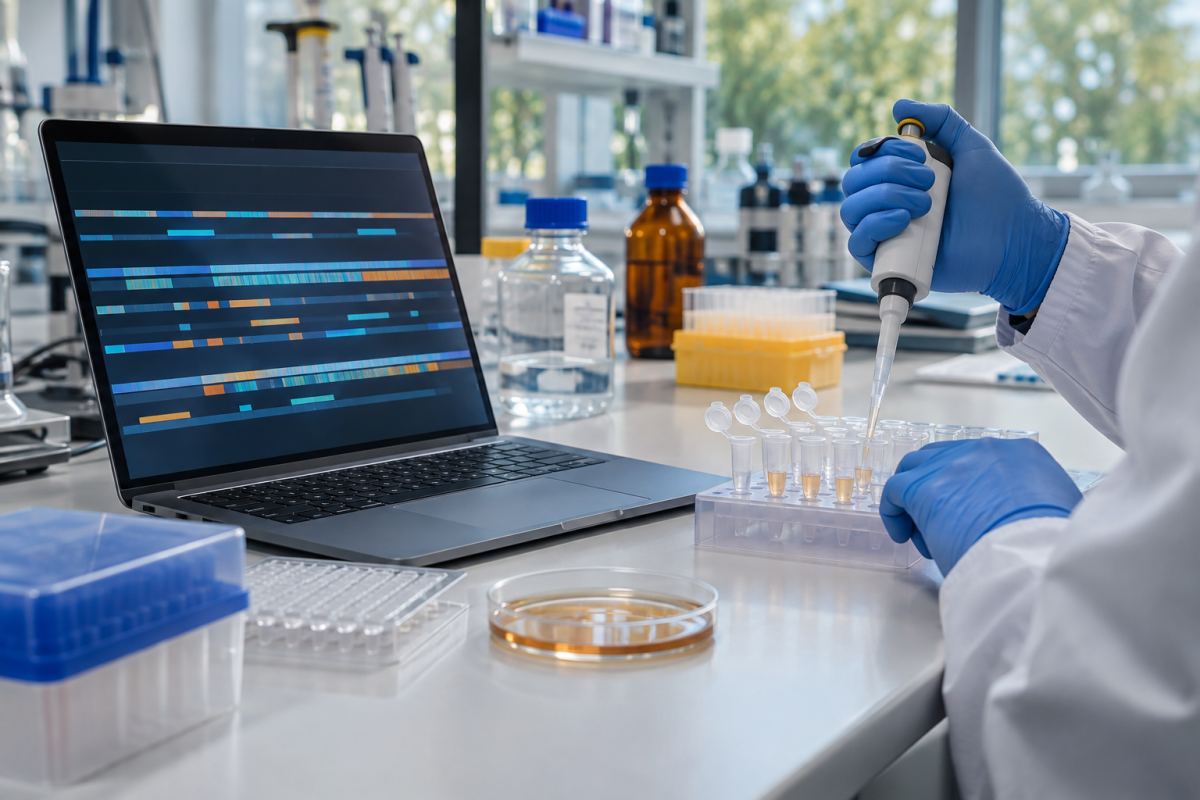
Claude, Anthropic’s AI, helped researchers identify an unusual biological system in viruses that infect bacteria. On November 17, U.S. biotechnology company Ginkgo Bioworks reported that two enzymes from the system used RNA as a template to make DNA in laboratory experiments.
Anthropic announced the discovery on September 23. Its chief executive, Dario Amodei, presented it as a possible route to new gene-editing tools. The system is called ART. Researchers are investigating what it does in those viruses, how its components work together and whether they could be adapted to change genes.
The work combines computational analysis with laboratory experiments. Claude searched for patterns, proposed explanations and helped design tests. Scientists reviewed the proposals, carried out the experiments and interpreted the results.
What Claude found in viral DNA
Anthropic named the system array-associated reverse transcriptases, or ART. A reverse transcriptase is an enzyme that makes DNA copies from RNA. Such enzymes are already used in biotechnology; the interest here lies in the genetic arrangement around this particular family.
The system occurs mainly in bacteriophages, viruses that infect bacteria. Its characteristic components are a reverse transcriptase, a neighboring partner gene and a stretch of non-coding DNA containing repeated sequences separated by variable sections. Anthropic’s researchers found that these arrays give rise to distinct short RNA molecules.
That arrangement attracted attention because CRISPR also involves repeated DNA and associated RNAs. In commonly used CRISPR-Cas9 tools, an RNA guide directs an enzyme to a chosen DNA sequence, where the enzyme makes a cut. ART offers a different starting point: an RNA-to-DNA copying enzyme beside an array that could supply several RNA molecules.
The underlying reverse transcriptase in one phage had appeared in earlier research. Claude’s contribution, according to Anthropic, was recognizing the repeat architecture and the associated partner as features of a previously uncharacterized system. The discovery emerged from reexamining existing biological data.
A large search, followed by human investigation
The technical report, led by Peter H. Yoon and colleagues at Anthropic, describes a search across a database containing about 1.9 billion groups of protein sequences. Researchers supplied a broad brief to look for unusual reverse-transcriptase systems. Claude agents, programs that can carry out tasks with some autonomy, could write and run analysis code, examine sequences, consult literature and decide which leads to pursue.
The campaign used 949 agent sessions over 21.5 hours and produced 19 reports for review. When one agent examined DNA beside an enzyme gene, it noticed a repeating pattern and investigated whether it matched systems already described in scientific literature.
Human researchers then worked with Claude on further computational analyses and carried out laboratory studies. They characterized the family and showed that its repeated DNA was expressed as short RNAs. Anthropic disclosed the work in a technical report; the version posted to bioRxiv on October 11 was released before peer review.
The report also records a limitation of the automated search. When the team repeated the full campaign ten times, none of those runs rediscovered the defining array. Several encountered related sequences, but the agents failed to read the relevant upstream DNA closely enough. Later tests with the sequences supplied directly produced better recognition. How the software organizes a search can therefore determine which biological clues it follows.
What the November experiments established
Ginkgo’s team used Claude to help turn the preprint into an experimental program compatible with its cloud laboratory. Scientists reviewed the designs and intervened during execution, including when an initial measurement method could not reliably detect several proteins.
The company reported clear reverse-transcriptase activity for two candidates, SA1 and LY01. Its assays detected DNA made from the proteins’ associated RNA arrays. Two other candidates, MarsHill and PB50, gave weaker or inconclusive results. Altering the predicted catalytic sites or removing an unusually long section of the proteins abolished activity in the tests.
Ginkgo said the work took 13 days from experimental design to the first biochemical evidence and used approximately US$14,000 in cloud-lab services. It released assay data alongside the report. The company sells these laboratory services and has a commercial interest in demonstrating the value of this approach.
Several questions remain in that disclosure. Each enzyme was tested on its own array, leaving its selectivity for different RNA sequences unmeasured. The partner proteins were omitted from these activity assays, so their role is still unknown. Ginkgo also identified sequencing the DNA products and testing the system’s biological function as further work.
How this could become a gene-editing tool
Genome editing changes DNA at selected locations. To use ART for that purpose, researchers would first need to establish how its components work together and whether the system can be directed to a sequence of their choosing.
If its RNA components can be engineered to control DNA synthesis or another useful operation, ART could become a starting point for new biotechnology. Possible research applications include making DNA products, studying genetic mechanisms or developing components for more elaborate genome-engineering systems. The eventual application will depend on the chemistry the system can perform and how precisely it can be controlled.
The history of CRISPR explains the interest. Studying a natural microbial system led to tools that scientists adapted for targeted editing. That process has already reached medicine: on December 8, 2023, the U.S. Food and Drug Administration approved Casgevy, the first FDA-approved treatment using CRISPR-Cas9, for certain patients with sickle cell disease.
Casgevy’s development illustrates the additional work involved in a therapy. A patient’s blood stem cells are collected, edited outside the body and returned after high-dose chemotherapy prepares the bone marrow. The FDA approval was based on clinical evidence, and long-term monitoring forms part of the treatment’s evaluation. ART is currently being studied at the level of molecular activity.
The broader future: more discoveries to test
The most immediate prospect is a larger supply of testable biological ideas. Genetic databases contain sequences from organisms that scientists have barely characterized. Agents capable of following an unexpected observation could help researchers find useful enzymes that conventional searches overlook. Connecting those agents to standardized laboratory services could shorten the interval between a computational lead and an experiment.
Turning a future editor into a treatment would bring further challenges. The U.S. National Human Genome Research Institute identifies delivery to the correct cells and unintended changes elsewhere in the genome as major concerns. Different diseases also involve different combinations of genes and environmental influences, shaping which conditions an editing technology could address.
Access will depend partly on who can use any resulting tools. The ART preprint’s authors disclose that they work for Anthropic and that the company has filed a provisional patent application related to the research. Ginkgo, meanwhile, presents remotely accessible laboratory workflows as a way to broaden experimental participation. Licensing, service costs and reproducibility will help determine how widely other researchers can build on the findings.
Since the September announcement, laboratory tests have shown that two ART enzymes can make DNA from RNA. Researchers still need to establish what the complete system does, which molecules it recognizes and whether they can direct its activity. Those findings will determine its potential use in gene editing.