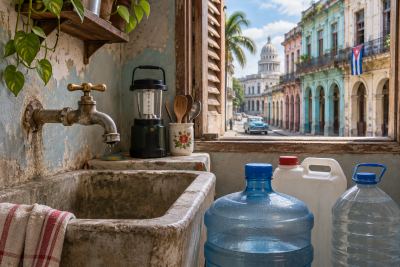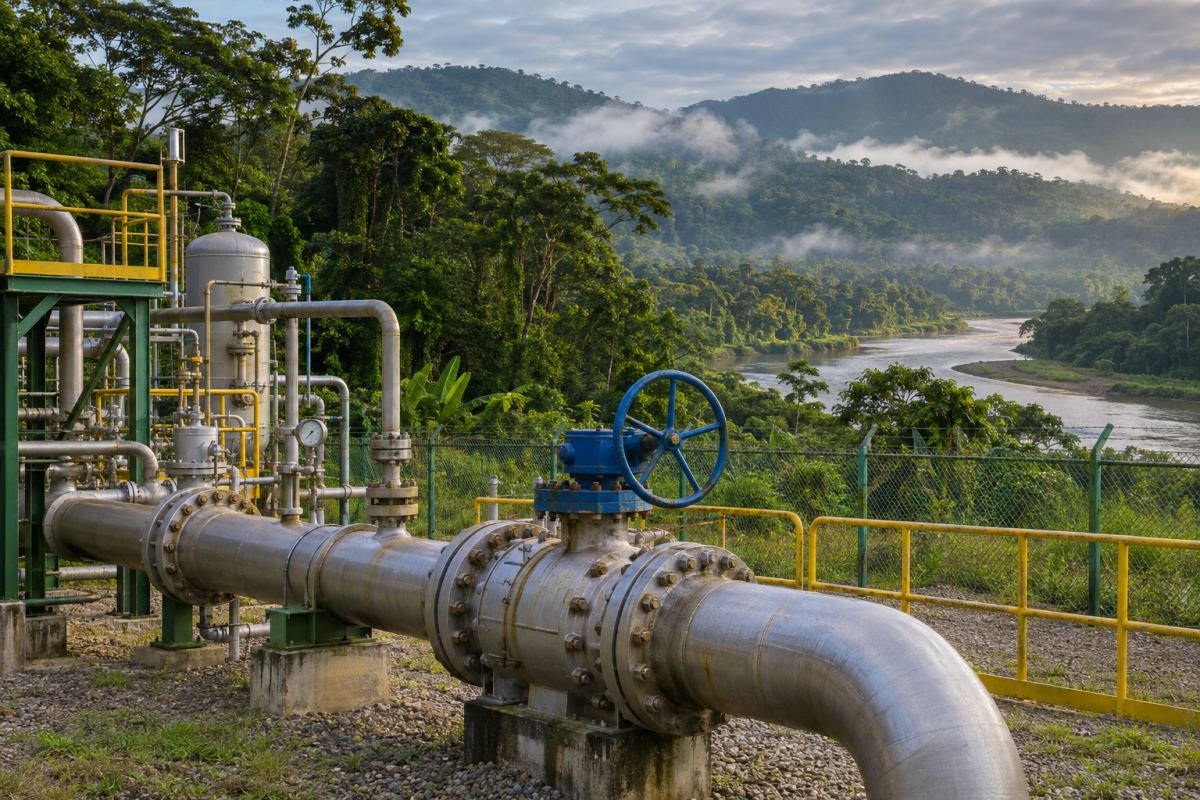

On January 19, 2026, the Cusco regional government announced the opening of a regasification station in San Jerónimo and the installation of natural gas equipment in a first home. The project aimed to serve an initial 1,000 households before expanding to 8,000. In the region that produces most of Peru’s gas, residential supply was still developing on a small scale.
Ten months later, the government signed a $550 million agreement with Cálidda to extend distribution to seven regions in central and southern Peru. The commitment comes as the country’s reserves shrink: the Ministry of Energy and Mines, known as MINEM, puts the supply horizon for proved gas reserves at 12 to 13 years. Plans to bring the fuel to more households are moving forward while the industry has far fewer exploration contracts than a decade ago.
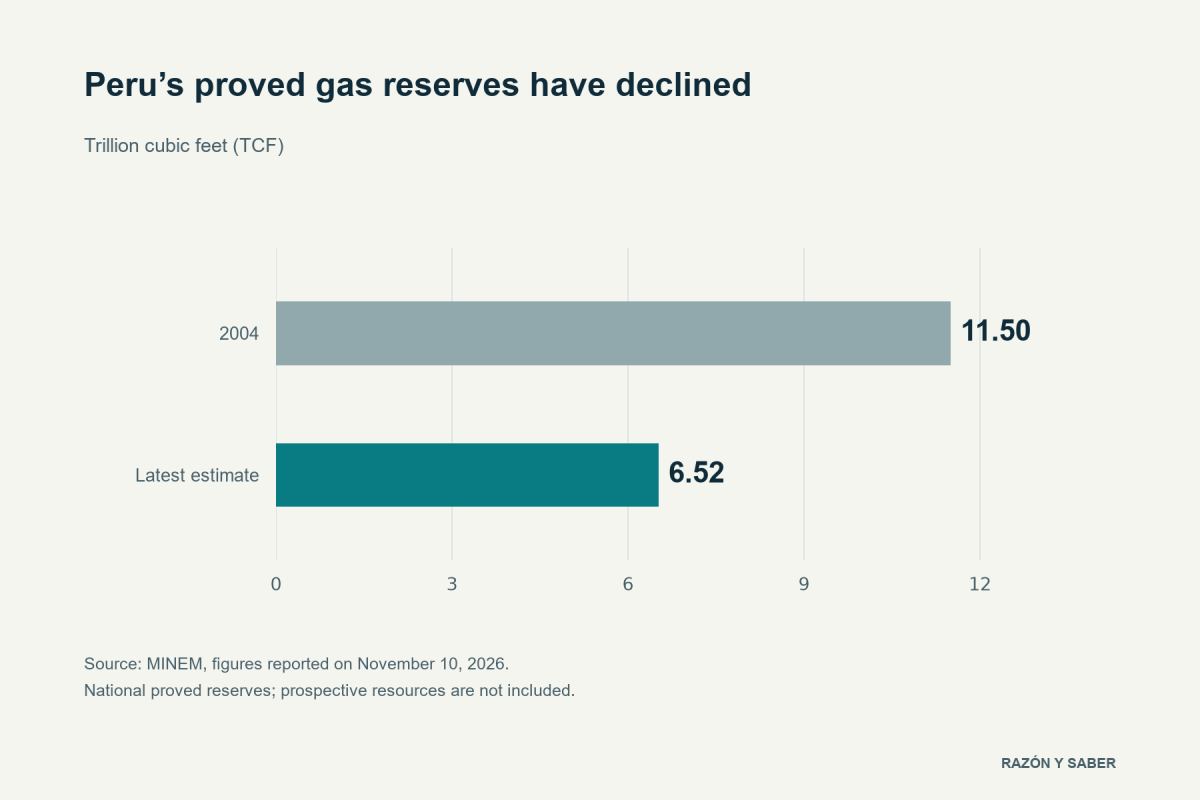
Proved reserves have fallen 43%
Peru has 6.52 trillion cubic feet, or Tcf, of proved gas reserves, according to the assessment Deputy Hydrocarbons Minister Iris Cárdenas presented to Congress on November 10. Blocks 88, 56 and 57 in the Camisea gas-producing area hold 95% of the total.
In 2004, the inventory stood at 11.5 Tcf. The cumulative decline is about 43%, according to MINEM. The Peruvian Hydrocarbons Society, or SPH, an industry association, also reported an 8.5% fall between 2024 and 2025, reflecting production and technical revisions to the fields.
The 12-to-13-year horizon reflects the relationship between known reserves and the rate at which they are used. Faster extraction with few discoveries would shorten it; bringing commercially viable fields into the reserve base would extend it. That balance will shape supplies for power stations, factories and vehicles, as well as new residential customers.
Exploration has lost ground
Exploration contracts fell from 41 in 2015 to five in 2025, according to SPH. The association is calling for changes to attract investment in oil and gas exploration.
On November 13, MINEM said it was working on revisions to the Organic Hydrocarbons Law and its regulations. Cárdenas identified oil and gas contract terms, the qualification of prospective operators, environmental procedures and the institutional strengthening of Perupetro, the state body responsible for promoting and contracting the activity, as areas under review.
She also announced preparations for a decree to coordinate procedures across public agencies. The government’s exploration agenda was therefore still at the drafting stage. Declining reserves provide the backdrop to those proposals, while distribution projects are advancing under signed investment commitments.
Block 58 and the Madre de Dios frontier
The project with the nearest scheduled start is Block 58, operated by China’s CNPC. Perupetro’s March 2026 management handover report listed November 30 as the expected date for commercial production. The company reiterated that date in June, according to Perú Energía. As of November 28, production was scheduled to begin two days later.
Development would expand production in the Camisea gas-producing area. Beyond that near-term supply, MINEM identifies 45.6 Tcf of prospective gas resources nationwide, with 51% in the Madre de Dios basin. Those geological estimates concern gas whose presence and commercial potential require drilling and evaluation.
The basin also contains 2.1 Tcf of contingent resources: gas that has been discovered but whose development faces legal and environmental restrictions. Candamo, one of the fields attracting attention, lies inside Bahuaja Sonene National Park.
In her November presentation, Cárdenas said there were no exploration or production contracts, or technical evaluation agreements, covering Candamo or the park. Protected areas and Indigenous reserves constrain development options. Madre de Dios offers a longer-term prospect, with environmental and territorial decisions still pending before any commercial development.
Cusco’s stalled pipeline and local networks
Southern cities’ wait for gas has been prolonged by interrupted projects. In January 2017, the government terminated the Southern Peruvian Gas Pipeline concession after the consortium of Odebrecht, Enagás and Graña y Montero failed to meet the deadline for financial close. The major infrastructure planned to carry the fuel south was left unfinished.
Urban distribution also faces the costs of Andean terrain, scattered housing and limited initial demand. Networks need enough customers to spread investment and operating costs. In an analysis for the GĚRENS graduate school, economist and former deputy energy minister Arturo Vásquez identified market scale and the integration of services as central to the viability of regional supply.
The San Jerónimo station takes another route: receiving liquefied natural gas, or LNG, and returning it to a gaseous state for local distribution. The regional government’s January announcement described an initial phase involving more than 25 kilometers of networks. The targets of 1,000 and 8,000 homes refer to the project’s planned stages.
MINEM also continues to pursue the Integrated Gas Transportation System for Southern Peru, known as SITGAS. At the November 26 signing, Energy and Mines Minister Guillermo Shinno said the government was working to deliver pipelines to Cusco and Puno to complement regional distribution networks.
What the Cálidda agreement commits to
The ninth amendment adds Apurímac, Ayacucho, Huancavelica, Junín, Cusco, Puno and Ucayali to Cálidda’s distribution area. The approving ministerial resolution, dated November 23 and published on November 25, sets an initial commitment of 201,411 residential connections within 114 months, with at least 3,738.9 kilometers of networks. The design provides capacity to serve 300,613 potential customers.
In return, the Lima and Callao distribution concession is extended by ten years, moving its expiry from 2033 to 2043. The signing ceremony included the announcement of $550 million in private investment. Cálidda’s chief executive, Martín Mejía, told Gestión that the first connections would be made between 18 and 24 months after signing.
The application process began in November 2023. The joint assessment by state agencies ended in May 2026, and the Ministry of Economy and Finance issued its favorable opinion on November 9. President Keiko Fujimori’s government completed the approval and signing of a proposal that had been under consideration for three years.
The agreement faced opposition in Congress. At an October 13 hearing in Cusco, Energy and Mines Committee chair Yenifer Paredes challenged the contract extension and warned of possible higher charges for users. Other lawmakers called for a review of the negotiating terms. The government defended the expansion as a way to accelerate regional access and announced support for household connections through BonoGas, run by the Energy Social Inclusion Fund, or FISE.
How the fuel will reach homes
The contract provides for a combination of pipeline supply and LNG transport by road. Under the latter system, tankers deliver fuel to a regasification station, and local pipes then take it to homes and businesses. Natural gas, composed mainly of methane, is cooled to about −162°C for transport as a liquid in cryogenic tanks.
That arrangement already operates in cities within the northern distribution concession. In March 2025, regulator Osinergmin set a tariff of $14.66 per million British thermal units for that concession, covering the gas, road transport, regasification and distribution. The system enables urban networks to be supplied from a distant plant, while adding transport expenses and dependence on reliable road access.
Large pipelines require substantial upfront investment and sustained flows to spread their costs. Trucks allow service to expand in stages in smaller markets. The approach contracted for the seven regions combines the two methods according to local conditions and available infrastructure.
Piped residential natural gas follows a different supply chain from the familiar cylinders of liquefied petroleum gas, or LPG, which contain mainly propane and butane. In cities supplied with LNG, customers receive gas through the network after regasification.
Law 32315, published in April 2025, introduced a compensation mechanism for regulated gas customers using no more than 50,000 cubic meters a month. It provides for the use of available FISE resources first, followed by a pipeline transport surcharge if those funds are insufficient. For power generators, the surcharge is offset through electricity transmission charges. Financing for expansion therefore involves the wider energy system and its users.
Exports, profits and regional revenue
Peru LNG Company, LLC’s accounts show an export business that moved from a loss in 2024 to a profit in 2025. Financial statements from MidOcean, a shareholder in the project, report revenue of $1.368 billion and a $12 million profit for the company in 2025, following a $61.7 million loss the previous year.
The 2025 profit represented about 0.9% of reported revenue. The export chain includes gas purchases, transportation, liquefaction and international marketing. MidOcean’s accounts, filed with the British corporate registry in June 2026, disclose that annual result for Peru LNG Company, LLC.
For producing regions, part of the revenue generated by gas reaches local authorities through the canon, Peru’s system for sharing natural-resource revenue. It allocates 50% of producers’ income tax and 50% of royalties under license contracts, together with the applicable component from service contracts. In June 2025, the Economy and Finance Ministry approved the distribution of 811 million soles from income tax for fiscal year 2024, primarily for regional and local infrastructure.
The next commitments have specific timetables: Block 58’s announced production start, the first connections under Cálidda’s expansion, and a contractual rollout of up to nine and a half years. During that period, Peru plans to expand its domestic market with a reserve base that has shrunk 43% since 2004. The southern expansion will unfold as the country works to revive exploration.