BepiColombo enters Mercury orbit after an eight-year journey
ESA has confirmed orbital capture for the European–Japanese mission. Its two spacecraft remain attached, with routine scientific observations scheduled to begin in April 2027.
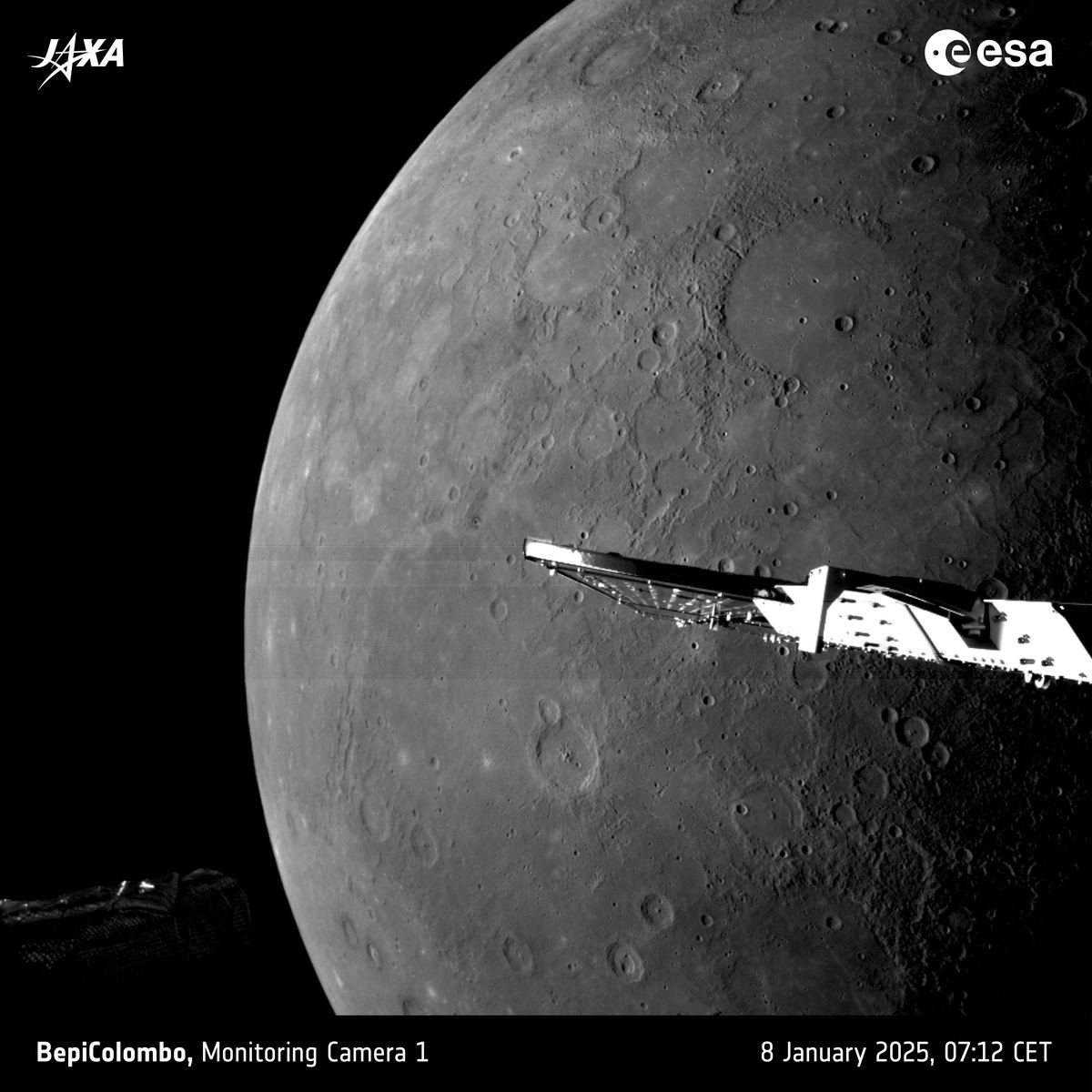
The BepiColombo mission entered orbit around Mercury on Saturday, November 21, after an eight-year journey through the inner solar system. The European Space Agency confirmed the achievement in an update posted at 00:56 UTC on Sunday, November 22, when it was still Saturday evening on the East Coast of the United States.
The operations team said contact with the spacecraft had been restored and flight dynamics specialists had already confirmed orbital capture. Controllers at the European Space Operations Centre in Darmstadt, Germany, were still assessing the telemetry: the data sent back by the spacecraft about its condition and performance. ESA said it would provide a further update early in the coming week.
BepiColombo is a joint mission between ESA and Japan's space agency, JAXA. It carries two observatories: Europe's Mercury Planetary Orbiter, or MPO, and Japan's Mio. They arrived still attached to each other. Entering orbit begins a sequence of separations, maneuvers and checks that must be completed before their routine scientific observations, scheduled to start on April 6, 2027.
The engine burn that secured arrival
ESA announced the start of the orbit insertion burn at 18:24 UTC on Saturday, or 1:24 p.m. Eastern Standard Time. The maneuver was scheduled to last 37 minutes, using MPO's four chemical thrusters. Its purpose was to slow the spacecraft relative to Mercury enough for the planet's gravity to hold it in orbit rather than let it pass by.
Before the maneuver, the team had warned that a change in the spacecraft's orientation would cause an expected loss of contact. It later reported that the burn should have finished and that it was awaiting the return of the signal. Confirmation came several hours later, when ESA announced that communications had resumed and flight dynamics specialists had verified orbital capture.
MPO took over steering after the Mercury Transfer Module separated on September 3. The module had supplied power and propulsion during the interplanetary journey. Since its release, the European orbiter has also been supplying electricity to the remaining assembly, which still includes Mio and its protective sunshield. The insertion burn therefore used MPO's own thrusters while the two orbiters remained attached.
The transition required checks of the systems that would operate in this new configuration. In September, ESA tested MPO's thrusters and switched on its scientific instruments following the transfer module's release. Those tests were part of the preparations for arrival. In its latest announcement, the operations team said it was continuing to examine the data received after the insertion maneuver.
A route involving nine planetary flybys
BepiColombo launched on an Ariane 5 rocket from Kourou, French Guiana, on October 20, 2018. Before settling into orbit around Mercury, it flew past Earth once, Venus twice and Mercury itself six times. These nine encounters gradually reshaped its path by using the planets' gravity, rather than relying on propulsion alone to make every change required along the way.
Reaching Mercury involves more than covering the distance from Earth. A spacecraft must approach with the speed and direction needed to enter orbit. JAXA explains that gravity assists require waiting for planets to reach suitable positions, sometimes after the spacecraft has made several circuits of the Sun. The timing of those encounters helped determine the length of BepiColombo's journey.
The transfer module's solar electric propulsion system also operated during the cruise. It used electricity from the solar arrays to ionize xenon gas and expel it at high speed. ESA shut the system down permanently on June 15, 2026, at the end of its final thrust period. Later maneuvers, including orbital capture, depended on MPO's chemical propulsion system instead.
The schedule had changed because a problem with the transfer module's electrical system prevented the ion engines from operating at full power. JAXA's fact sheet, updated this November, records the difficulty reported in 2024 and the revised arrival in November 2026. The mission is named after Italian mathematician Giuseppe Colombo, known as Bepi, a pioneer in using gravity assists for planetary exploration.
What the two spacecraft will investigate
MPO carries 11 scientific instruments to investigate Mercury's surface and interior. Its measurements will cover topography, the composition of surface materials, gravity and the magnetic field. Images and spectral observations will allow researchers to examine terrain shaped by impacts and ancient volcanic activity, and connect those features with questions about how the planet formed and how it has changed over time.
Mio, Japan's Mercury Magnetospheric Orbiter, carries five instrument packages. It will study magnetic fields, particles, plasma waves, dust and sodium around the planet. The magnetosphere is the region where a planet's magnetic field interacts with the solar wind, the stream of particles flowing from the Sun. Understanding that interaction is a central part of the Japanese spacecraft's work.
Observing from two locations at once offers an advantage over a single spacecraft. According to JAXA, disturbances caused by the solar wind make it difficult to isolate the magnetic field generated inside Mercury. Simultaneous measurements will help distinguish those contributions and provide more precise information about the interior. The two observatories are intended to operate in different polar orbits suited to their respective tasks.
The United States is contributing NASA's Strofio instrument, part of the SERENA suite aboard MPO. Strofio will analyze Mercury's exosphere, the extremely thin envelope of particles around the planet. Its observations will complement measurements of the surface and the surrounding space environment. Together, the mission's instruments are designed to investigate connected processes, although each spacecraft and each instrument has its own role.
The next steps through April 2027
BepiColombo follows Mariner 10, which made three flybys in 1974 and 1975, and MESSENGER, which orbited Mercury from 2011 to 2015. NASA's MESSENGER investigated the planet's geology, composition and magnetic field, and provided evidence of water ice in polar deposits. The new mission will build on that work with two observatories making measurements at the same time from different orbits.
ESA's timetable, also included in JAXA's November fact sheet, calls for Mio to separate on December 9–10. The release of its protective sunshield is planned for December 16. MPO will then continue adjusting its trajectory to reach its final orbit on March 10, 2027. These are planned operational dates, which the agencies caution may change as the arrival sequence proceeds.
After separation, Mio must deploy antennas and booms and undergo checks and calibration before routine observations can begin. JAXA expects that work to continue through the opening months of 2027. The joint science phase is scheduled to start on April 6 and last one Earth year during the nominal mission. Thermal conditions and available power will limit periods for observations and data transmission.
ESA's next announced update is due early in the coming week and will address the steps following capture. After eight years in transit, BepiColombo is now in orbit around its destination. The coming months will be devoted to placing and preparing its two observatories to investigate the planet closest to the Sun.