Anthropic mathematician claims Riemann proof with Claude as checks advance
Levent Alpöge says he has solved the celebrated problem with AI assistance. Computer checks published by Andrew Sutherland have returned positive results, while further review remains underway.
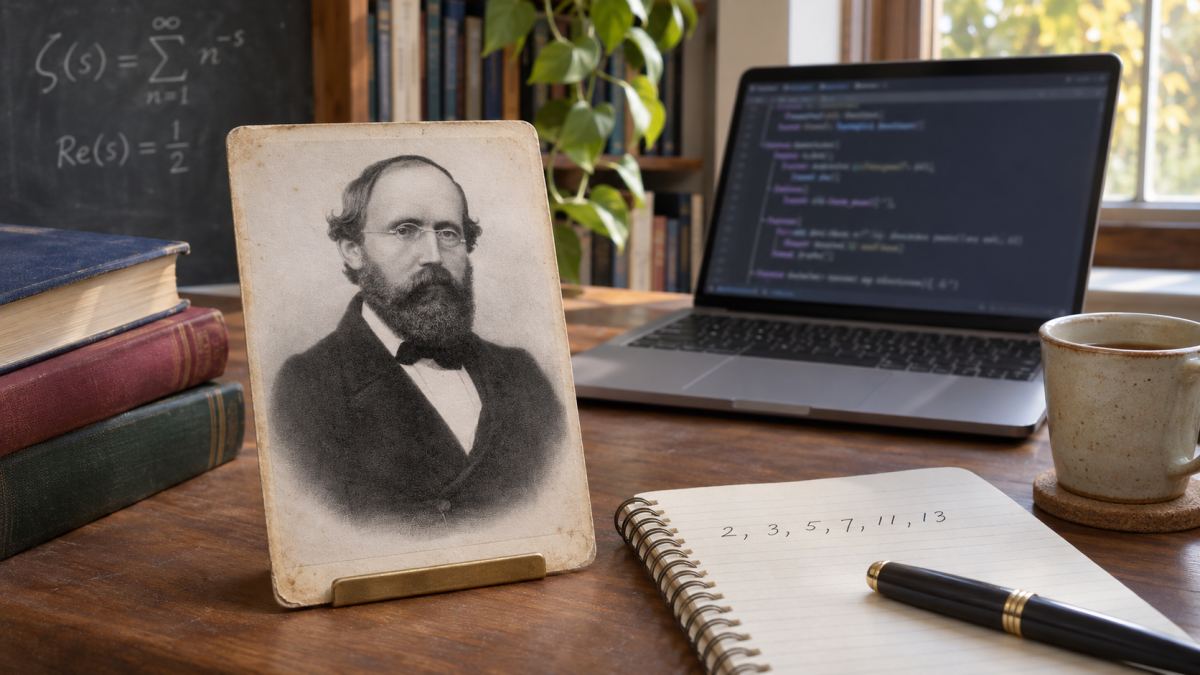
Levent Alpöge, a mathematician working at Anthropic, announced on Friday, November 20, that he believes he has found a proof of the Riemann hypothesis through work with Claude. His claim concerns one of mathematics' most important problems, proposed in 1859 and closely connected to the distribution of prime numbers. The proposed argument is available as extensive code for a proof-checking system.
The review has already produced specific results. Andrew Sutherland, a mathematician at the Massachusetts Institute of Technology, has published checks in which several verification programs accepted the argument. His report also lists checks still running and limitations of the process. These results mark progress in examining the submission, as researchers continue to assess its mathematical content.
The Clay Mathematics Institute, which includes the hypothesis among its Millennium Prize Problems, still listed it as unsolved when its website was checked on Saturday, November 21. The announcement and the available verification results are therefore separate from general acceptance by the mathematical community and from any eventual award of the prize attached to the problem.
The question hidden in the prime numbers
Prime numbers are whole numbers greater than one that are divisible only by one and themselves. Examples include 2, 3, 5, 7, 11 and 13. Their appearance among the natural numbers is irregular. Understanding their distribution involves more than extending a list or finding the next prime; it means identifying patterns that hold across the number system.
The prime number theorem describes their average distribution. The Riemann hypothesis would provide much tighter control over departures from that average. The distinction matters: knowing the broad trend and establishing how far particular results can stray from it are related questions, but answering the first does not automatically settle the second.
The technical statement concerns the Riemann zeta function and particular values at which it equals zero. Those values are complex numbers, which have a real part and an imaginary part. The hypothesis says that every zero described as nontrivial has a real part of one-half. That compact statement has implications for the behavior of prime numbers.
Clay says the first 10 trillion of these zeros have been checked. Even that enormous collection of numerical tests cannot replace a proof covering every case. Alpöge's submission aims to establish such a universal statement. Assessing it requires examining both the reasoning and the mathematical definitions used, rather than simply adding more examples to the numerical evidence.
A short announcement with the argument in code
Alpöge released a four-page note and links to 14 parts of an archive containing work formalized in Lean. The note sets out his claim, some ideas and a timeline; the full argument is supplied as code. He also says the method establishes a generalized version of the hypothesis, extending the scope beyond the original problem.
In his account, he steered the research while Claude contributed crucial technical steps, particularly toward the end. That description comes from the researcher himself. It portrays a collaboration between a mathematician and an AI model. On its own, it does not measure their respective contributions or establish that similar results can be achieved in any other scientific task.
Alpöge says a conventional written presentation became extraordinarily long: he mentions a text exceeding 250,000 pages that he chose not to release. He acknowledges that he still needs to master and explain parts of the argument. Turning the formal material into an exposition that other mathematicians can study and discuss is therefore part of the work ahead.
Lean allows definitions, theorem statements and proof steps to be expressed in a formal language. A checking kernel examines whether the steps follow the logical rules. That role differs from a conversational model generating an answer. Confidence in the submitted argument depends on specific checks and the assumptions involved, rather than on the fluency of an AI explanation.
What the independent checking programs found
In an update dated November 20 at 22:05 UTC, Sutherland reported that all 175,187 modules compiled without errors. An audit found that the five main theorems relied only on the three standard axioms identified in his report. Every module had also been replayed through the Lean kernel, providing a further check on the compiled material.
Two independently written checkers, nanoda and con-leche, accepted the exported proof, according to the report. Another tool, lean4lean, accepted the compiled modules. A comparison of theorem statements using con-leche also passed. These are results documented by Sutherland; his report is not an institutional announcement by MIT declaring that the problem has been definitively resolved.
Sutherland's report covers the Riemann hypothesis as defined in the Mathlib mathematical library and four further theorems, including results for Dirichlet L-functions. He specifies that the generalized hypothesis examined here is restricted to those functions. The report does not certify every possible extension of the problem.
The full lake comparator run and the Lean-kernel checks of the exported file were still underway in that update. Sutherland also notes that the build ran on cloud machines without a sandbox and had not been compared with a complete sandboxed build. Those qualifications are part of the published verification record, alongside its positive results.
Checking the logic and understanding the mathematics
In an October explanation on Terence Tao's blog, Thomas Hales stressed the need to establish that formal statements and definitions actually match the announced mathematical problem. A checker examines a precisely stated proposition. Human review must also determine whether that proposition is the one researchers intended to prove. Successful execution and accurate formulation are connected responsibilities.
Writing on Friday, Tao said that digesting this submission and extracting its strategy would take time. He noted that having a human author available for discussion could help with that process. The difficulty of understanding the argument thus remains relevant even after verification programs return favorable results; mathematicians also want to know how the reasoning works.
The $1 million prize is not awarded simply because a claim has been posted. Before considering a solution, Clay requires publication in a qualifying outlet, the passage of at least two years and general acceptance by the international mathematical community. Those conditions are separate from a program's acceptance of a formalized argument and cannot be satisfied by an announcement alone.
The next developments will be the outstanding check results and assessments explaining the mathematics of the submission. If the argument withstands scrutiny, it would settle a question that has remained open for 167 years. For now, the extraordinary claim comes with public material and positive verification results, while the broader examination continues.