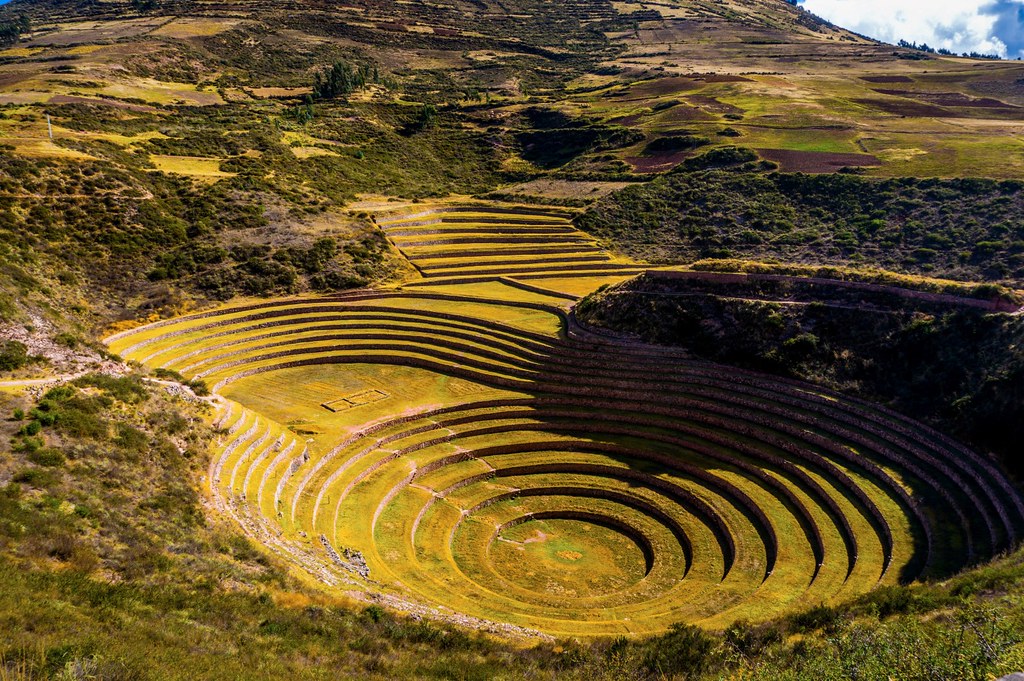


In the valleys of Cusco, the engineers of the Inca Empire built a climate laboratory six centuries ago that modern science has yet to replicate. Today, its secret could awaken a sleeping industry in the heart of the Peruvian desert.
When the world's winemakers speak of the great wine terroirs, the names that come up are always the same: Bordeaux, Burgundy, Napa Valley, Mendoza, Chile's Central Valley. Peru does not appear on that list. And yet, beneath its arid soil and along its Andean slopes, it holds something none of those regions possess: the millennia-old knowledge of a civilization that mastered the art of creating artificial climates on a monumental scale.
Moray, the enigmatic complex of concentric circular terraces in the Sacred Valley of Cusco at 3,500 meters above sea level, was neither an amphitheater nor a temple, although for decades that is what archaeologists believed. It was, in the fullest sense of the word, an agricultural experimental station: a climate-engineering device capable of recreating up to 20 distinct microclimates within a radius of just 150 meters of depth.
The laboratory that built an empire
To understand why Moray matters for twenty-first-century viticulture, one must first grasp what Inca engineers achieved with stone, earth, and an intuitive command of thermodynamics that still astonishes scientists.
The terraces of Moray are not decorative. They are the product of centuries of observation and refinement. Each concentric ring is built at a different height, with a specific orientation toward the sun, with internal irrigation channels, and with a careful selection of soils brought from different regions of the empire. The effect is extraordinary: the temperature on the uppermost terrace can be up to 15°C higher or lower than on the deepest terrace, depending on the time of day and the season.
① Thermal gradient by depth. The lower terraces receive less direct solar radiation and are shielded from the wind, producing cooler and more humid zones.
② Thermal mass of the stone. The retaining walls store solar heat during the day and release it slowly at night, amplifying the temperature difference between day and night.
③ Directed air circulation. The circular geometry generates its own convection currents, which distribute temperature and humidity in a controlled way.
④ Soils selected by composition. The Incas imported soil from different ecological zones to reproduce, on each terrace, the edaphic conditions of a specific geographic region of the empire.
The result was an altitude simulator. An Inca farmer could plant crops native to the Amazon rainforest in Moray, side by side with varieties from the high Andean puna, observe how they behaved, select the most resistant or productive, and then scale them out to other regions. It was, in essence, the first systematic agricultural improvement program in the Americas.
The Incas did not conquer territories to plunder them. They conquered them to cultivate them. Moray was the brain of that strategy: a climate-adaptation machine built in stone.
Archaeological analysis · Sacred Valley of CuscoThe Ica problem: too much sun, too much heat
The Ica valley has everything a viticulturist could wish for — except the climate. Its deep sandy soils, its near-total absence of rainfall (which allows humidity to be controlled), its abundant groundwater, and its generous sunlight make this valley a natural candidate for viticulture. In fact, Ica has been producing grapes — and good pisco — since colonial times.
The problem is the temperature. Located at 14° south latitude, Ica receives a sun that ripens the grape too quickly. In high-end viticulture, slowness is a virtue: a grape that takes months to ripen develops layers of aromatic complexity that a grape ripening in weeks simply cannot reach. Acidity — the soul of fine wine — dissolves in the heat. Subtle aromas evaporate. What remains is sugar and alcohol, but no poetry.
of Ica
temperature
at Moray
of the terraces
The world's great wine regions sit between 30° and 50° latitude, where the sun is oblique, the nights are cool, and the grape ripens slowly. Chile has the Casablanca Valley, cooled by the Humboldt Current and direct oceanic influence. Mendoza has the Andes and altitude. Napa has the Pacific morning fogs. What does Ica have? Untapped potential and — now that we look at it through a different lens — the legacy of a civilization that solved exactly this problem.
The proposal: terraforming the desert with Inca wisdom
The idea is neither romantic nor nostalgic. It is technically sound. Building complexes of deep circular terraces — inspired by Moray's architecture but designed specifically for viticulture — could create in the Ica desert the climatic conditions its grapes need to reach excellence.
The principle is the same one used by the engineers of Tahuantinsuyo, but applied in reverse. At Moray (3,500 meters above sea level, where cold is the problem), the terraces captured and stored heat. In Ica (sea level, where heat is the obstacle), the terraces would be designed to capture coolness, to cast strategic shade during the most critical hours of the day, and to amplify the temperature difference between day and night.
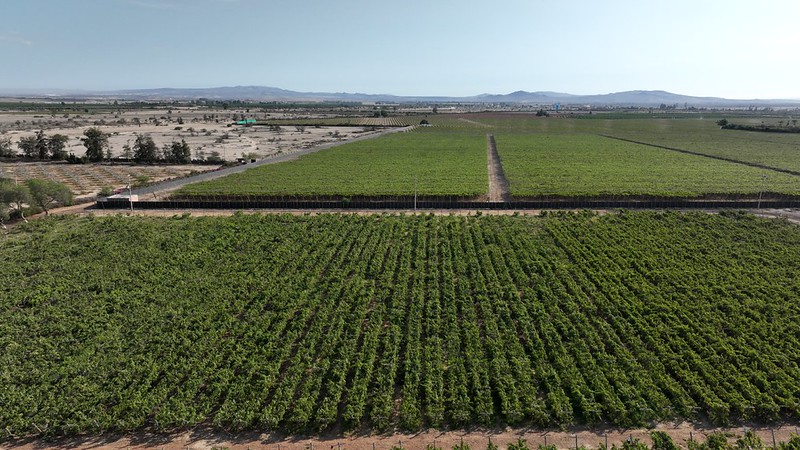
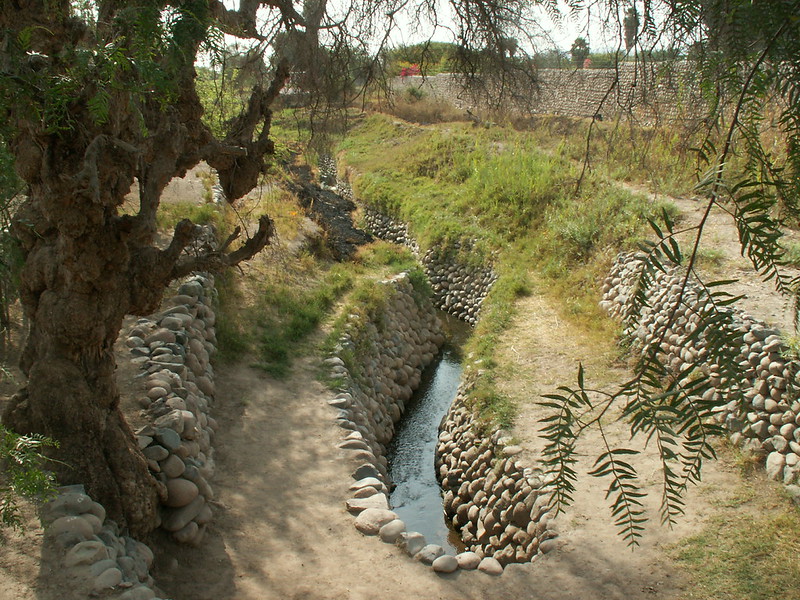
The design adapted for viticulture in a desert climate
| Variable | Original Moray (Cusco) | Ica viticultural proposal |
|---|---|---|
| Thermal objective | Accumulate heat in a cold zone | Reduce heat in a desert zone |
| Terrace orientation | Toward the sun (south → north) | Strategic shade during peak hours |
| Wall material | Local limestone | Stone + materials with high thermal inertia |
| Water system | Rainfall and glacier capture | Nighttime subsurface drip irrigation |
| Depth | Up to 150 m | 60–100 m would be enough for viticulture |
| Expected thermal difference | 15°C between extreme terraces | 8–12°C relative to the surrounding desert |
| Recommended varieties | Andean crops | Tempranillo, Syrah, Viognier, Chenin Blanc |
A vineyard planted on the middle and lower terraces of a Moray-style complex in Ica could enjoy temperatures 8 to 12°C below the exterior during the critical afternoon hours. More importantly, the thermal mass of the stone walls would reproduce the effect the Andes have in Mendoza: warm days that drive photosynthesis, cold nights that preserve acidity and aromas. In other words: the thermal amplitude that the Ica Valley simply does not have under natural conditions.
The business model: building an industry from scratch, with a narrative edge
Chile took forty years to place its wines on international markets. Argentina did the same with Malbec in thirty. Napa Valley built its reputation in fifty. All of them started from zero, with soils, climates, and varieties no one took seriously — until someone bet on them with conviction and the results spoke for themselves.
Ica has something none of them had: a story. A wine produced in agricultural complexes inspired by Inca technology would not merely be "a Peruvian wine". It would be the first wine in the world cultivated with pre-Columbian engineering, on terraces that replicate the most sophisticated climate laboratory humanity built before the Industrial Revolution. That is not marketing: it is a unique and unrepeatable cultural terroir.
Archaeological, climatic, and soil studies to identify the zones of Ica with the greatest potential and to design the terrace complexes.
Construction of a small-scale experimental terrace complex (5–10 ha) to validate the climate models and select varieties.
Program to adapt fine wine varieties to the artificial microclimate that has been generated: first Syrah and Tempranillo, then more delicate varieties.
First commercial harvest with an origin narrative. Positioning in premium markets with an emphasis on historical and technical singularity.
Progressive scale-up. "Terrazas de Ica" Designation of Origin. Wine tourism. Export to high-end European and Asian markets.
What comparable experiences tell us
High-altitude viticulture in the Andes has already proven that extreme heat is not an insurmountable obstacle when the complementary conditions are right. Wineries in Salta, Argentina, produce world-class wines at 2,400 meters above sea level. In Bolivia, the vineyards of Tarija and Cinti, between 1,600 and 3,000 meters, are producing wines that have begun to attract the attention of international critics.
In every one of these cases the mechanism is the same: altitude or special topographical conditions compensate for the tropical latitude, creating the thermal balance the vine needs. Deep Moray-style terraces in Ica would be a functional equivalent: not altitude, but engineering, doing the work that in the Andes is done by geography.
In market terms, the moment is favorable. International premium-wine consumers are actively seeking new regions, new stories, new terroirs. The Asian market — and China, Japan and South Korea in particular — has an enormous appetite for wines with authentic and culturally rich origin narratives. Few products in the world could compete on that ground with a wine produced on terraces that replicate the agricultural technology of the Inca Empire.
Peru has pisco. But it could also have the most singular wine in the world: the first one cultivated in a stone climate laboratory built six centuries ago.
Viticultural hypothesis · Moray Vitícola ProjectThe challenges that cannot be ignored
The proposal is solid, but it would be irresponsible to present it without its contradictions. The construction cost of terrace complexes on a viticultural scale is high; we are talking about monumental infrastructure in a desert region, with significant logistical challenges. Inca engineering was built by thousands of workers over decades; reproducing it today requires substantial private or public capital investment.
The availability of groundwater in Ica is also a sensitive matter. The valley's aquifer is already under pressure from industrial agro-export farming. A quality viticultural project, however, uses less water than today's intensive crops, and the terrace design can incorporate highly efficient water capture and recycling systems — in fact, the Inca engineers themselves had already solved this problem in their hydraulic systems.
Finally, there is time. The vine takes years to produce fruit of quality. A new vineyard, even under the best conditions, needs at least five years to offer its first serious wine. The investment is long-term. But so was Mendoza. So was the Casablanca Valley. And today no one disputes their place among the world elite.
The vineyard the Incas never planted
The engineers of Tahuantinsuyo did not know Vitis vinifera. They had no wine. But they had something more valuable for this project: the knowledge of how to make the earth produce what you need, even when nature is not on your side.
Moray was built to adapt crops to hostile climates. To take a seed from the tropics and make it thrive on the altiplano. To take an Andean tuber and teach it to grow under the Amazon sun. It was, in the end, a machine of possibilities.
Using that same principle — that same lapidary intelligence — to create in the Ica desert the conditions that would allow world-class grapes to be produced is not an archaeological fantasy. It is an industrial development venture grounded in science, supported by history and, above all, carrying an origin narrative that no winery in Bordeaux, Napa or Mendoza could ever claim as its own.
The most singular wine in the world could be born in Peru. On circular stone terraces. From grapes that ripen slowly in an artificial microclimate carved into the desert. And bearing the invisible, unmistakable seal of the civilization that learned, before anyone else, to speak the language of climate.