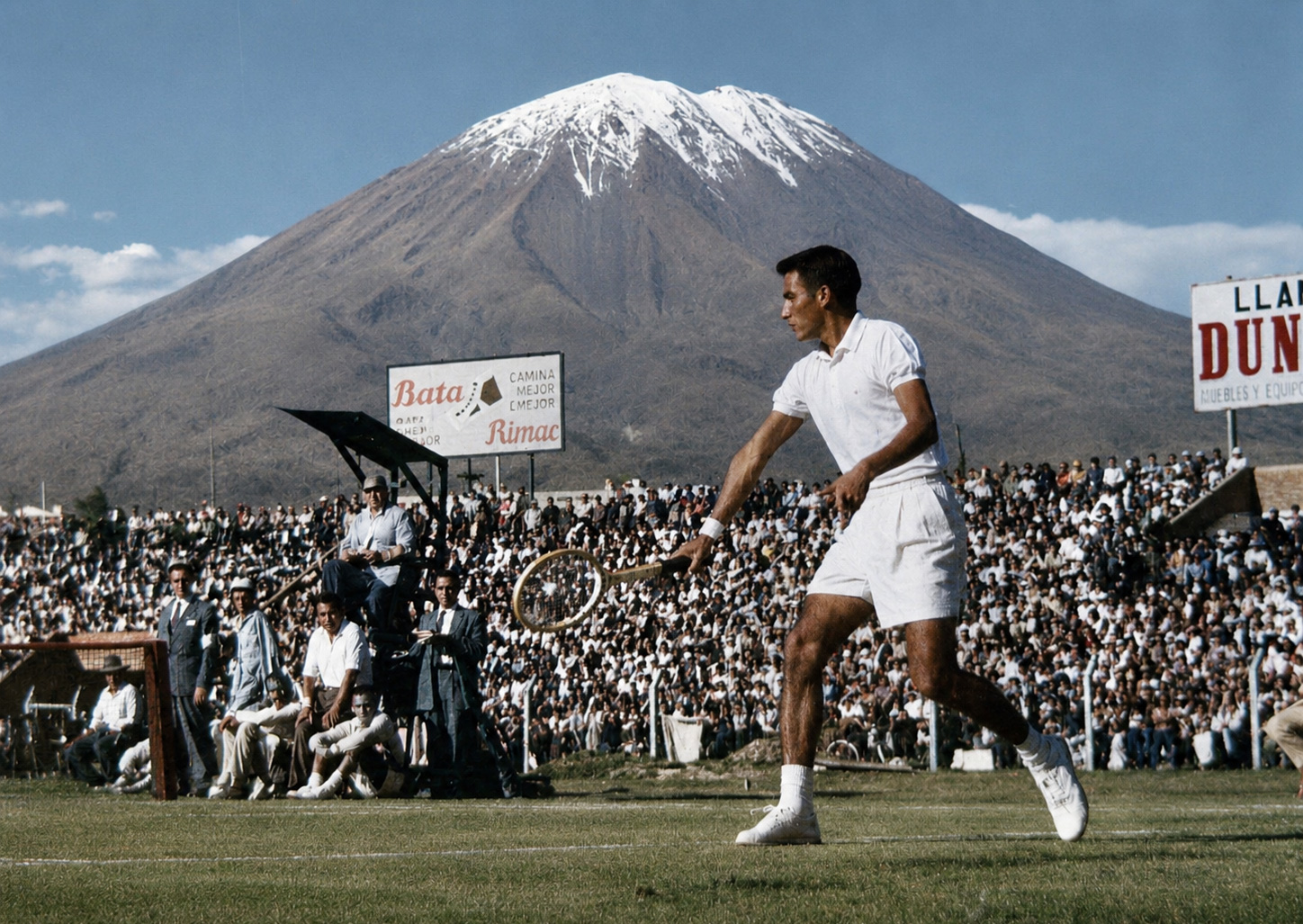

He was born in Arequipa, the son of a groundskeeper, with no money and no English. At 22, he had won the Davis Cup for the United States, the Australian Open, and Wimbledon. Today, May 23, 2026, a 22-year-old Peruvian has just won the ATP 500 in Hamburg. History repeats itself — and the movie is still waiting to be made.
There is a photograph from 1959 that the Wimbledon archives preserve with almost clinical precision. In it, the official tournament record identifies the champion of that edition with three letters in parentheses: (PER). Not (USA). Peru. Alejandro "Alex" Olmedo had won the most prestigious tennis tournament in the world representing, in the official records at least, his native country — a country that did not even have a Davis Cup team that year.
That paradox defines, better than any statistic, the whole life of Alejandro Olmedo: a man claimed by two nations, celebrated in one, who never surrendered the passport that bore the name of Peru.
The groundskeeper's son
Arequipa, 1936. Alejandro Olmedo was born in the White City, in a modest family whose only privilege was proximity to the tennis courts of the local club, where his father Salvador worked as groundskeeper — the invisible man who kept the courts clean, tightened the nets, collected the balls, and at whom the members never stopped to look.
That accidental access was the first stroke of fortune in a life that would accumulate many. Young Alejandro grew up literally on the clay of those courts. He learned by imitating adult players, chasing down stray balls, practising shots in the dead corners of the afternoon when the members had gone home. At 14 he won the club championship. At that same age, Rod Laver — the man he would defeat in the Wimbledon final — had not yet won anything significant.
Word spread. Stanley Singer, an American coach working in Lima, heard about this lanky, feline-quick boy from Arequipa. He went to see him. What he saw was enough for him to make a decision that would change the history of tennis: he sent him to California.
He was the groundskeeper's son. The club that would one day make him an honorary lifetime member had been, in his childhood, someone else's territory. But he had something no member's money could buy: that unimitable gift with the racket.
Biographical profile · Arequipa, PeruThe journey
In 1954, Alejandro Olmedo was 17 years old, held a Peruvian passport, and knew not a word of English. Singer arranged contact with a friend in California and found the money for the fare. What followed was an odyssey: he boarded a ship in Lima bound for Havana via the Panama Canal, then took a plane to Miami, then to Modesto — a city in California's interior — and finally to Los Angeles, where he arrived with no money and no language, but with a determination that few have matched.
In Modesto, he worked in a sports equipment shop and attended night school to learn English. He played for the Modesto Junior College tennis team, reaching the California state championship final in 1954. Two years later he enrolled at the University of Southern California on a scholarship, where he found George Toley, the coach who sharpened his game, and Perry T. Jones, the man who would change his fate.
The king of USC
His years at USC were the laboratory where Olmedo turned raw talent into a weapon. His game took shape quickly: powerful serve, aggressive volley, cat-like reflexes and a speed that left opponents staring at the space where the ball had been. He preferred fast surfaces, where athleticism could override tactics. He was, in the language of tennis, a born attacker.
In 1956 he won the NCAA singles and doubles titles. He won them again in 1958. Four university titles in four years. When he left USC, the amateur world circuit was waiting.
in California
(singles + doubles)
won
in 1959
The controversy: whose player is this?
In 1958, Perry Jones was 70 years old, the czar of tennis in Southern California, and had just been named captain of the United States Davis Cup team. He looked at Olmedo — the best player he had seen in years — and made a decision that would shake the tennis world: he put him on the American squad.
The problem was obvious. Olmedo was Peruvian. He held a student visa. He was not a U.S. citizen and had no intention of becoming one — he had stated publicly that he was Peruvian and intended to remain so. Jones held firm. The Davis Cup regulations, he argued, allowed a player to represent a country after three years of continuous residence, and Peru did not have its own team that year.
The controversy went national. Sports Illustrated ran a cover story titled "The Enigma of Alex Olmedo." Don Budge wrote that selecting him "did not mean something was wrong with American tennis, but we should stimulate more of our own players." Others were less diplomatic.
Olmedo, with the composure that defined him both on and off the court, responded the only way that mattered: he played.
① Davis Cup 1958. Jones argued continuous residence of more than three years and the absence of a Peruvian team. Olmedo played as a U.S. representative. He held his Peruvian passport throughout the competition.
② Australian Open 1959. Official tournament records list him as an American player. However, he arrived in Australia on a Peruvian passport — because that is what he was.
③ Wimbledon 1959. The All England Club's official record is unambiguous: Alex Olmedo (PER). First seed. Champion. When no one prevented him from entering as Peruvian, he chose to carry his nation's four letters.
④ Citizenship. Olmedo systematically refused to become a U.S. citizen during his active years. He became an American citizen many years later, already retired — off the court, in private life, never on it.
Brisbane, 1958: the day a Peruvian won the Davis Cup for the United States
The Australian team had won the trophy for four consecutive years. It was the most dominant team in the world, with names such as Mal Anderson, Neale Fraser, and Ashley Cooper — at the time the world's No. 1. Perry Jones moved his pieces with a chess player's coldness: Ham Richardson, the top-ranked American player, had diabetes, and Jones feared he would not last three days in the humid Brisbane heat reaching 43 degrees. He dropped him to doubles and put Olmedo — the Peruvian without citizenship — at the top of the singles order. It was the most controversial move in American tennis in decades. And it was the right one.
On day one, Olmedo defeated Anderson in four sets. His partner Barry MacKay, born in the United States, lost to Cooper. One all. On day two, Olmedo and Richardson won the doubles against Anderson and Fraser in 82 games — the sixth longest doubles match in Davis Cup history: 10-12, 3-6, 16-14, 6-3, 7-5. United States ahead, 2-1. On day three, with the U.S. needing just one more point, Jones sent Olmedo out against Cooper, the world No. 1. Result: 6-3, 4-6, 6-4, 8-6. Davis Cup, United States.
The final score was 3-2. Olmedo had won all three points the American team needed. MacKay, his American-born partner, lost both his singles matches. In every possible sense, it was a Peruvian's victory.
| Match · Brisbane 1958 | USA Player | AUS Opponent | Result |
|---|---|---|---|
| Singles · Day 1 | Olmedo (PER) | Anderson | ✓ USA Win |
| Singles · Day 1 | MacKay (USA) | Cooper (World No.1) | ✗ USA Loss |
| Doubles · Day 2 | Olmedo + Richardson | Anderson + Fraser | ✓ USA Win · 82 games |
| Singles · Day 3 | Olmedo (PER) | Cooper (World No.1) | ✓ DAVIS CUP USA |
| Singles · Day 3 | MacKay (USA) | Fraser | ✗ USA Loss |
Olmedo won the three points the United States needed. His American-born partner lost both the singles he played. In every possible sense, it was a Peruvian's victory.
Davis Cup 1958 · Brisbane, Australia1959: the impossible year
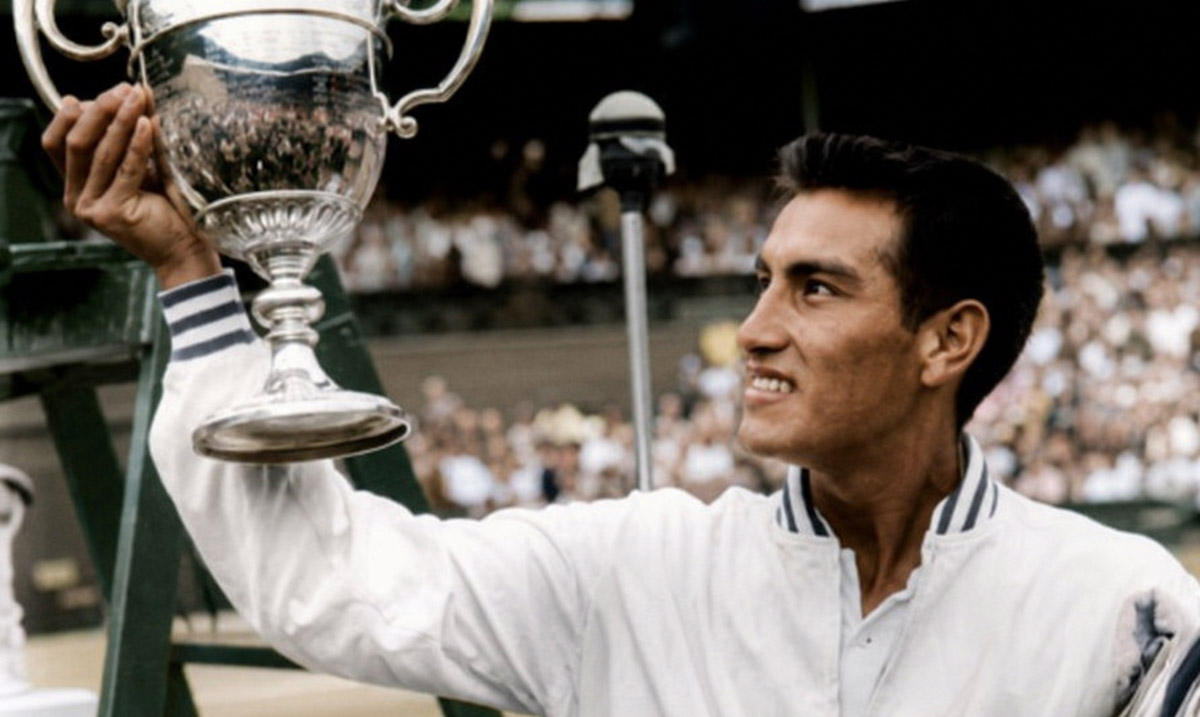
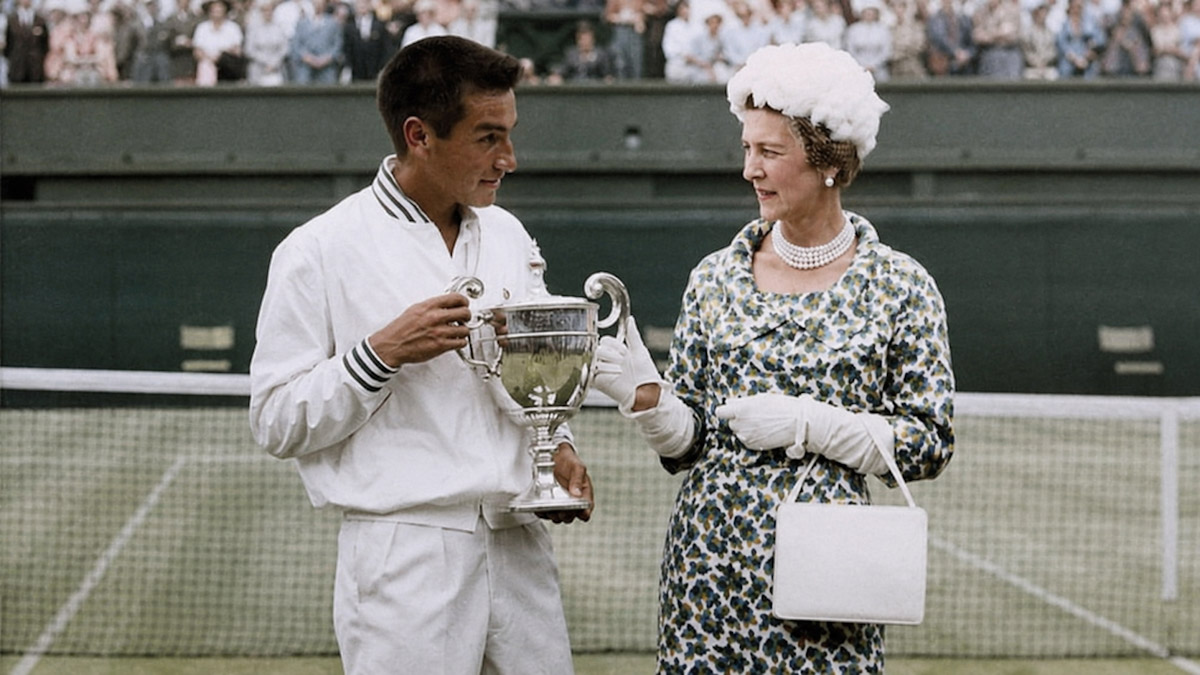
If Brisbane was the announcement, 1959 was the confirmation. Olmedo won the Australian Open over Fraser: 6-1, 6-2, 3-6, 6-3. Then came Wimbledon. The All England Club's official record is unambiguous: Alex Olmedo (PER). First seed. He won his first four rounds without dropping a set, except the third. In the quarterfinals he beat Chile's Luis Ayala in four sets. In the semifinals he dismantled Roy Emerson 6-4, 6-0, 6-4. In the final, a young, unseeded, 20-year-old Australian was waiting — someone few took seriously: Rod Laver. Olmedo swept him in three sets: 6-4, 6-3, 6-4.
Peru had the Wimbledon champion. And the Wimbledon champion remained, in the records of Centre Court at the All England Club, Peruvian.
Life after the court
In 1960 he turned professional. In his first year on tour he won the U.S. Pro Championship, defeating Tony Trabert. But the professional tennis of the era was grueling — indoor courts, canvas surfaces, rivals like Pancho González and Ken Rosewall with groundstrokes that Olmedo's speed could not compensate for indefinitely. He retired in 1965.
What followed is almost a second life. For 27 years he was the director of tennis at the Beverly Hills Hotel, the legendary pink landmark of Los Angeles, where his students included Katharine Hepburn, Robert Duvall, Chevy Chase, and magnates such as Sumner Redstone and Kirk Kerkorian. He was, in every sense, The Chief: the groundskeeper's son from Arequipa who ended up teaching the sport to the elite of American show business.
In 1987 he was inducted into the International Tennis Hall of Fame. He kept competing in veterans' tournaments well into old age, with the same elegance that had always defined him. "He was like a panther," said one of his opponents in those tournaments. "We still need to put weights on him to slow him down."
The movie Hollywood still hasn't made
If a Hollywood producer were looking for a script with every element of the genre — the humble origins, the heroic journey, the national controversy, the triumph over the world's No. 1, the disputed identity between two flags, and the retirement teaching film stars in the same Los Angeles that had received him without English or money — they would not need to invent a thing. It is all here, documented, real.
Olmedo's story has the perfect structure of an American underdog story, with one difference: the protagonist was never fully American. That makes it richer, not harder to tell. The immigrant who saves the adopted country's team, winning the title that country had gone years without claiming, while keeping in his pocket the passport of the country where he was born. And at the end of the story, teaching Katharine Hepburn to hold a racket at the most famous hotel in Beverly Hills.
Hollywood producers would be delighted. The material is unbeatable. The question is why, 65 years later, nobody has called yet.
The groundskeeper's son from Arequipa who arrived without English, won Wimbledon under the Peruvian flag, saved the Davis Cup for the United States, and ended up teaching tennis to Katharine Hepburn. Someone should make that film.
Legacy · Alejandro "The Chief" OlmedoHamburg, May 23, 2026: the heir
As this report is being written, news arrives from Hamburg that seems designed to close the circle. Ignacio Marcel Buse Acurio, 22 years old, Peruvian, has just won the ATP 500 in Hamburg, defeating American Tommy Paul 7-6, 4-6, 6-3 in three hours of battle on the clay of Am Rothenbaum. He entered the tournament through qualifying — the lowest rung from which anyone can reach a final on the ATP Tour — and eliminated top-level opponents one by one: Cobolli, Mensik, Humbert, Kovacevic, and finally Paul.
It is the first Peruvian ATP title since 2007. The first time a Peruvian has won an ATP 500. And Buse won it the way Olmedo won Brisbane: with a Peruvian passport, against an American, in a European city, when no one expected it.
The parallel has one final layer that makes it almost literary: Pablo Arraya, one of the great figures of Peruvian tennis in the 1980s, was in the stands at Am Rothenbaum to watch Buse lift the trophy. The chain had not broken. Olmedo to Arraya, Arraya to Yzaga, Yzaga to Horna, and now Buse — each one carrying the weight and the honour of being the best that a country produces in intervals of decades, but always produces.
Starting point: Entered through qualifying — the lowest possible starting point to reach an ATP 500 final.
Opponents defeated: Cobolli · Mensik · Humbert · Kovacevic · Tommy Paul (6th seed, Houston 2026 champion).
The final: 7-6(6), 4-6, 6-3. Three hours of play. Received medical attention for dizziness after the first five games. Rallied to win the title.
Ranking: Will enter the world top 50 on Monday. A year ago he was ranked No. 177.
History: First Peruvian to win an ATP 500. First Peruvian ATP title since Luis Horna won Viña del Mar in 2007.
Olmedo died on December 9, 2020. He did not see Buse. But the statue installed in Yanahuara in 2024 — 65 years late — is facing the right direction. Forward.
The Peruvian nobody remembers and everyone admires
Alejandro Olmedo was the groundskeeper's son who won Wimbledon. The Peruvian who defeated the world's No. 1 to win the Davis Cup for a country that was not his, with the passport of the country that was. The man they nicknamed "The Chief" for his Inca heritage — who proved, set by set, that the nickname was not ironic but accurate.
No one in the history of Peruvian tennis comes close. And yet he remains, in Peru, a glory too large for the short memory of the country that saw him born — and too Peruvian for the official history of the country that saw him triumph.
Today, a 22-year-old born in Lima has just won in Hamburg the most important ATP title a Peruvian has claimed in decades. He did it from qualifying. He did it against an American. He did it with a Peruvian passport in his pocket.
Olmedo would have smiled. "The Chief" would have recognised the gesture.