Magnitude 7.4 earthquake hits Colombia as new president De la Espriella confronts his first crisis
The strongest quake in a decade struck the Pacific department of Chocó on Aug. 10, days after Abelardo de la Espriella — a hardline newcomer to politics — was sworn in. He has declared a national disaster as the death toll climbs past 200.
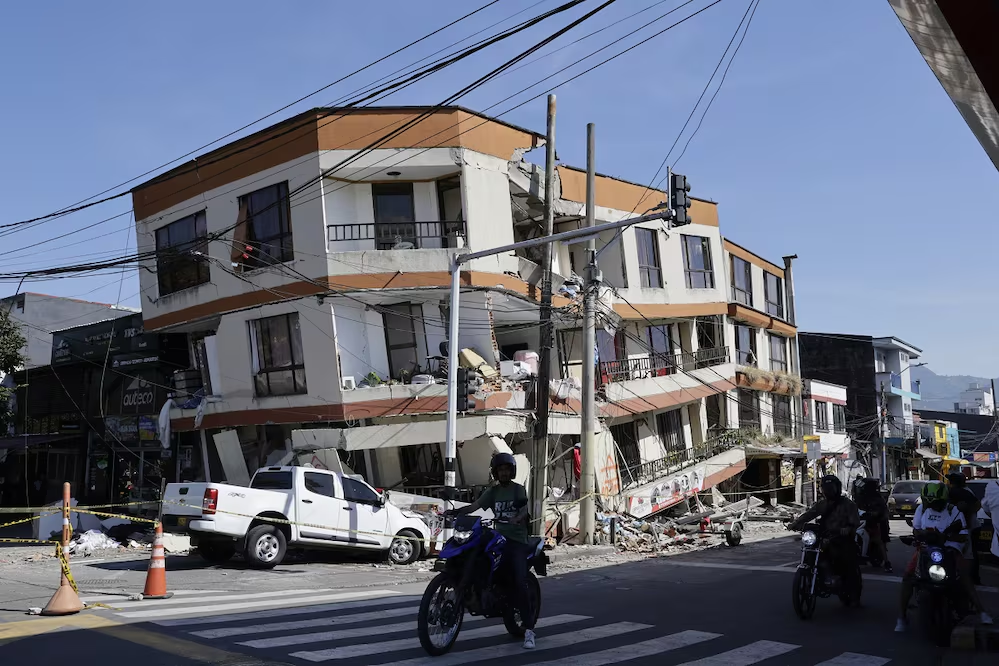
Pereira, Colombia. Photo: EFE
A magnitude 7.4 earthquake struck western Colombia on the morning of Monday, Aug. 10, 2026, its epicenter near the town of San José del Palmar in the Pacific department of Chocó, at a depth of about 82 kilometers (51 miles). The Colombian Geological Service (SGC) recorded it at 7:34 a.m. local time (12:34 GMT) and called it the most powerful quake to hit the country in a decade; its director, Julio Fierro Morales, went further, describing it as the strongest felt in Colombia since 1979. Because it was an intraplate event, it was felt across much of the country and into neighboring Ecuador.
The toll is provisional and has risen steadily. By the evening of Aug. 10 the government counted 132 dead; by the afternoon of Aug. 11 that figure had climbed to at least 224 killed and more than 660 injured, with roughly 165 buildings collapsed. Families had reported more than 3,000 people missing — far above official tallies — and rescue crews, now joined by the army, kept working through the night by flashlight in the hardest-hit cities of Cali and Pereira. Spain's foreign minister said 164 Spanish nationals were unaccounted for, though none were confirmed dead or injured.
The government reported roughly 1,575 homes damaged and 37 destroyed outright. In Manizales, one of the towers of the cathedral came down. In Cali, more than twenty structures collapsed and the Valle University Hospital suffered a partial collapse that forced the evacuation of several medical facilities, some with patients still inside. The airport in Pereira lost part of its roof. Five departmental capitals remained on alert.
The disaster is the opening test of a presidency only three days old. Abelardo de la Espriella — a flamboyant celebrity defense lawyer and businessman who had never held public office — was sworn in on Aug. 7 in Cali, after winning a June runoff against the leftist Iván Cepeda with more than ten million votes. He campaigned on hardline security, a smaller state and dismantling outgoing president Gustavo Petro's "Total Peace" negotiations with armed groups. Some outlets, CNN among them, have labeled him far-right; he casts himself as a law-and-order conservative, and built his public brand on a military salute and the nickname "El Tigre" (The Tiger).
De la Espriella declared a national disaster, a designation that lets the executive adopt exceptional measures and issue decrees to manage the crisis and fund reconstruction. The government set up a main command post in Bogotá and three unified command posts in Armenia, Quindío and Cali to coordinate in real time with governors and mayors. The president said he was personally directing the response and toured the disaster zone — first Quibdó, the Chocó capital near the epicenter, then Cali, with Pereira announced as the next stop; Vice President José Manuel Restrepo traveled to Caldas. Ministers, heavy machinery and aircraft were dispatched from Bogotá and Antioquia, and the injured were airlifted to Medellín. The telecommunications ministry worked with mobile carriers to restore networks and enable free calls, and a portal was opened to report and locate the missing. De la Espriella also promised rent subsidies for displaced families in Chocó. "The State does not bend or waver," he declared, calling for national unity.
There is an irony in the timing that Colombian and regional analysts were quick to note. A president elected to wage war on criminal groups now faces, as his inaugural emergency, a natural catastrophe that demands logistics and institutional coordination rather than force. How his untested administration handles the recovery, the Peruvian daily El Comercio suggested, will shape early public judgment of his government.
Aid came quickly. The United States announced $15.5 million. Messages of support or offers of help came from the European Commission's Ursula von der Leyen, France's Emmanuel Macron and regional governments ideologically aligned with the new president — El Salvador's Nayib Bukele, Ecuador's Daniel Noboa and Chile's José Antonio Kast.
In Cali, Mayor Alejandro Eder imposed an overnight curfew and ordered troops into the streets against the threat of looting, while the public hospital network declared a red alert at 100 percent capacity. As night fell again, the country was still racing to pull survivors from the rubble.