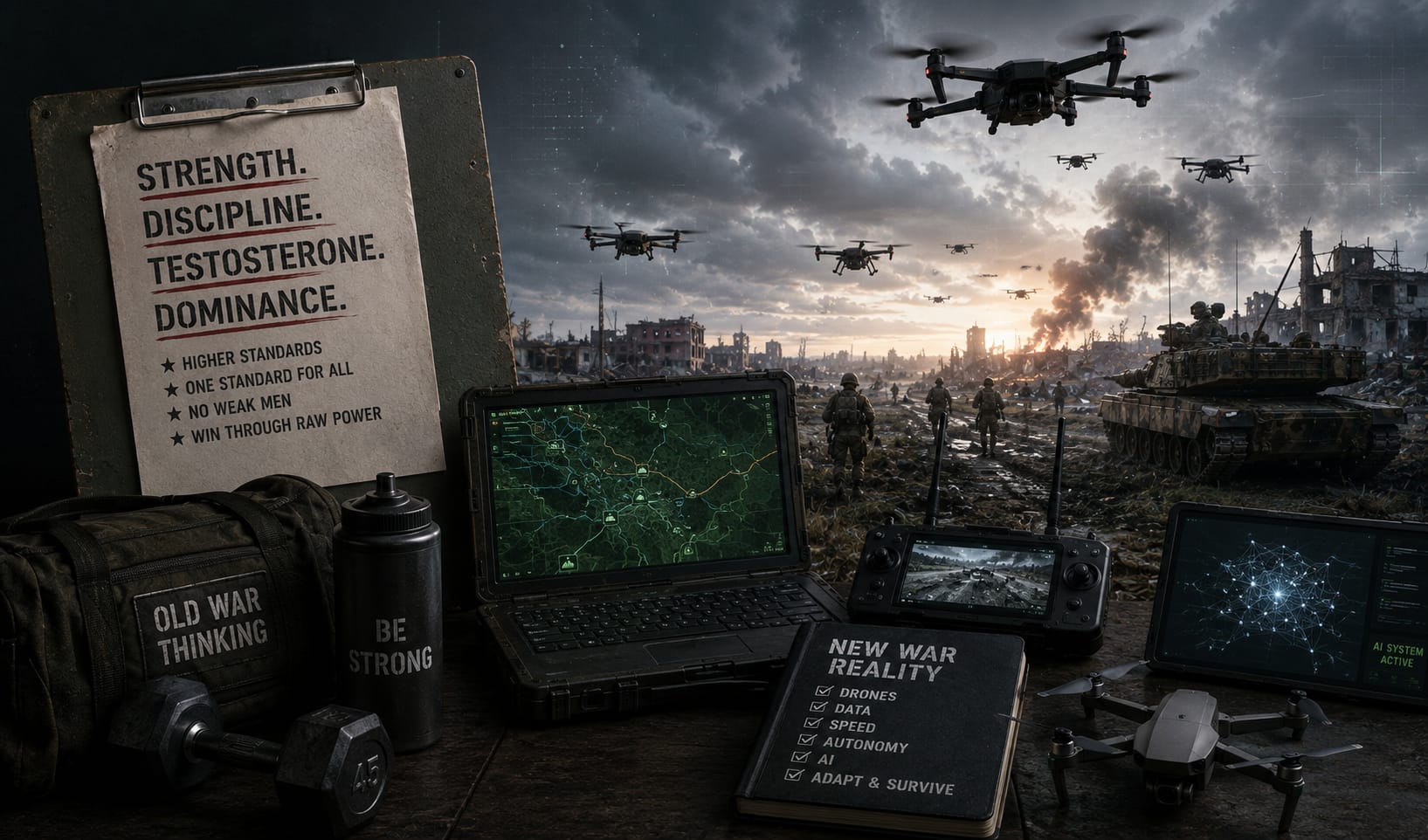
The U.S. secretary of defense wants to check his soldiers’ testosterone. Pete Hegseth unveiled the plan in a video captioned The High-T Department of War: an annual hormone screening for troops over thirty, optional replacement therapy, and, underpinning all of it, a single “male” fitness standard for the entire force — in the name, he said, of keeping it on the cutting edge of lethality. The message could not be plainer: bigger soldiers, harder soldiers, more warriors. It also belongs to another century.
Because while that video was being filmed, the real war was being fought a few thousand miles away, and it looks nothing like the one Hegseth has in mind. On the battlefields of Ukraine, the thing that kills you is almost never the burly infantryman. It’s the drone — a few-hundred-dollar machine flown by remote from a basement or a game controller, that chases a man across open ground and reaches him before he makes the next tree line. Ukrainian frontline commanders reckon these machines now cause between 70 and 80 percent of casualties — up to 95 percent in some sectors — having dethroned artillery as the leading instrument of death. Ukraine built roughly four million of them last year. It wants seven million this year.
From that comes the first lesson of modern war, and it has nothing to do with muscle: there is almost nowhere left to hide. Any cluster of men is a bright dot on somebody’s screen, miles away, and the physical strength testosterone promises matters less and less against the hand flying the aircraft and the mind that designed it. The threat climbs the whole ladder, too. China’s so-called carrier-killer missiles target American battle groups from thousands of miles out, and Ukraine’s sinking of the Russian cruiser Moskva already proved a flagship can go under without the enemy ever coming close. The aircraft carrier isn’t dead — its power lives in the planes it launches, not the hull — but the world in which it was a floating sanctuary is ending.
The Pentagon Already Knows
It would be comforting to assume the brass in Washington simply missed the memo. They didn’t — and saying so is what gives the rest of this argument its teeth. America is already buying the new war: Replicator, launched in 2023 under the previous administration to blunt China’s numerical edge with swarms of cheap drones; the Army rewriting its doctrine and standing up its first drone-pilot school; Hegseth himself signing an order to put unmanned systems in every squad. The 21st-century machine is running, and it was set in motion by the professional military — the apparatus that grinds on regardless of who occupies the White House.
So what is the testosterone about? It isn’t the Pentagon’s answer to drone warfare; that answer already exists. It’s a second war, a cultural one, layered on top and waged by the political leadership on its own account. One male standard, an end to “fat generals,” warnings that weak men won’t make the cut. It is the aesthetic of a battlefield oozing testosterone, laid over a real battlefield that oozes electronics. And that imaginary war carries a very real cost, because it doesn’t merely decorate. It excludes.
Who Gets Left Out
People first. On women, Hegseth has been blunt: he has argued the military shouldn’t put women in combat roles because men are more capable, and has imposed the highest “male” physical standard on everyone — if women can clear it, great; if not, so be it. On transgender troops the administration went further, moving in early 2025 to push them out of the service altogether. Courts have been slowing that down — an appeals panel this year found the policy looked like an effort to harm an unpopular group and blocked the discharge of the service members who had sued — and the fight is now headed for the Supreme Court. But the legal scoreboard is almost beside the point. What the intent reveals is a force willing to shed thousands of trained people for reasons that have nothing to do with how well they do the job, in an era that cannot afford to waste skill.
The same reflex appears — and this is the tell — when the outcast isn’t a soldier but a company. A war of drones and algorithms runs on the civilian technology sector: no software, no autonomy, no edge. And this year the Pentagon collided with one of those companies. Anthropic, whose AI model had become a fixture on classified military networks, refused two uses: weapons that kill without a human decision, and mass surveillance of American citizens. Its chief executive, Dario Amodei, gave a technical reason rather than a moral one — today’s frontier AI, he said, simply isn’t reliable enough to run autonomous weapons. The official response came straight out of the old playbook. The White House ordered federal agencies to stop using the company’s technology, and the Pentagon branded it a national-security supply-chain risk — a label usually reserved for firms from hostile countries. A federal judge froze the move as apparent retaliation; the case is still in the courts.
Sit with that scene, because it is the whole thesis in miniature. A strategy that depends on courting technology companies punishes the first one to set a limit. The instinct — rip out the safeties, demand the throttle with no governor — runs headlong into a war whose value depends precisely on the limit: an unreliable automated weapon isn’t more lethal, it’s more dangerous to the side that fires it.
A Bet on the Wrong Century
Add it up, and these choices form a wager — placed on the wrong side of the century. In a fight where the scarce resource is technical skill, a force that screens its talent by identity and physique narrows the very thing it needs to widen. A military that leans on the tech ecosystem while signaling that principles will cost you drives engineers and firms elsewhere. And a leadership that mistakes total control for capability forgets that this war rewards the opposite: distributed skill, the cheap machine, the human kept inside the decision loop.
There are serious objections, and they deserve a hearing. Civilian control of force is a democratic principle: it should be elected officials, not a private company, who decide how defense technology is used — and the Anthropic case genuinely raises that dilemma. A demanding physical standard can be defended on grounds of effectiveness, not just ideology. But none of that touches the nerve. You can command without blacklisting those who disagree; you can demand fitness without purging by identity; you can want soldiers in good shape without believing testosterone wins drone wars.
The problem isn’t that politics is meddling in war. It always does, and it should. The problem is that it’s meddling with its compass pointed at the wrong century. The drones are already flying. The question is who will be left, twenty years from now, to fly them.

