Wall Street closes August in the green, but with eyes on Warsh's Fed
New York ended August higher—the S&P 500's fifth straight winning month—carried by tech and artificial intelligence. But the script has changed: after betting on cuts, the market now fears Kevin Warsh's Fed may raise rates on September 16, and the oil spike from the Iran conflict has revived inflation. Records and nerves, in equal measure.
Wall Street closed August with a mix that is hard to sustain for long: a market near record highs, with another month in the green, and at the same time a turn that is keeping investors up at night. After betting all year on rate cuts, the market has shifted to fearing the Federal Reserve may raise rates in September. Records and nerves, in equal measure.
What happened these days
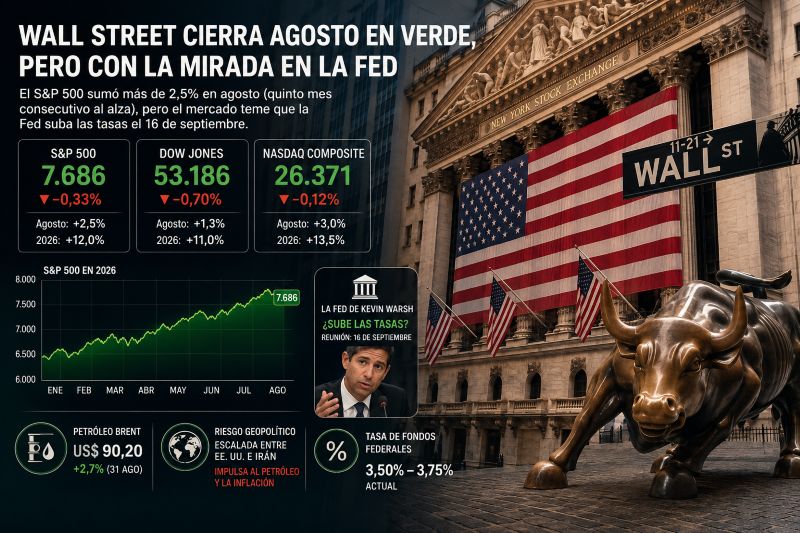
This Monday the 31st, the month's final session, the three big indexes closed lower: the S&P 500 lost 0.33% to 7,686 points, the Dow Jones fell 374 points (0.7%) to 53,186, and the Nasdaq Composite slipped 0.12% to 26,371. The trigger was a fresh exchange of fire between the United States and Iran—the first in nearly a month—which sent oil higher (Brent rose 2.7% and moved back above $90) and revived the specter of inflation. The blow landed hardest on the Dow's cyclical sectors, while the Nasdaq's tech held up better.
Despite that stumble, August ended in the green: the S&P 500 gained more than 2.5% for the month—its fifth straight monthly advance—the Nasdaq rose more than 3% and the Dow about 1.3%. So far in 2026, the S&P 500 is up around 12%, the Dow about 11% and the Nasdaq 13.5%. Behind those numbers sits the same engine: the big technology names and artificial intelligence, with Nvidia rallying last week after raising its revenue guidance.
Why it is moving
The real protagonist is the Fed, and it has a new face. Kevin Warsh took over as chair of the central bank in May, replacing Jerome Powell; he is a well-known inflation hawk who has pared back forward guidance, preferring to lean on the data. In his first Jackson Hole address, on August 28, he sounded more hawkish than expected: he stressed inflation risks and committed to nothing, which raised the odds that on September 16 the Fed will hike rates rather than cut them. It is not an isolated fear: at July's meeting, three members already voted to raise, with the rate now in a 3.50%–3.75% range. The question dividing the market is whether high inflation reflects temporary shocks—tariffs, war—or an economy still running too hot.
The bull case
The optimist leans on the market's own strength. Five straight winning months and a double-digit year are not built on air: corporate earnings keep setting records, and the artificial-intelligence investment cycle—with Nvidia leading—supports tech with real results, not just multiple expansion. The U.S. economy has proved resilient, consumption is holding, and if the coming inflation and jobs data cool, the threat of a hike fades and the market has room to keep climbing. Buying strength while earnings deliver is the bull thesis.
The bear case
The skeptic sees a market that is expensive and dangerously concentrated. Much of the year's gains rest on a handful of tech giants; if one disappoints, the whole index feels it. Onto that fragile ground comes the worst scenario for a market at record highs: a Fed that tightens instead of easing. A rate hike on September 16 would strike precisely at the growth stocks most sensitive to the cost of money. And inflation is no help: the PCE index remains elevated, and the oil spike from the Iran conflict threatens to raise the price of everything, harden the Fed further and strengthen the dollar, all in one move. In a market that priced in cuts, the turn toward hikes is the crack.
What to watch in the coming weeks
Four concrete variables: August's jobs report, due this week, and the inflation data that follow, since they will set the Fed's tone; the September 16 decision—hike or hold?—the most watched of the year; the course of the U.S.–Iran conflict and its effect on oil; and the trajectory of big-tech earnings, which hold the index up. In a market arriving at September at record highs but with the Fed changing its script, any of these could tip the balance.
Figures as of the close of August 31, 2026, drawn from the S&P 500, Dow Jones and Nasdaq indexes, the Federal Reserve and financial press (CNBC, Yahoo Finance, Investing, Bloomberg, Reuters). Index levels and the oil price move daily. RS Valores publishes analysis, not buy or sell recommendations; nothing here is investment advice.