Santiago's stock market: the IPSA near yearly highs, between copper and a new government's promises
The IPSA trades a step from its 52-week high after recovering from last year's trough. Behind the rally sit a real driver—high copper and lithium prices—and a political bet: that the Kast government revives investment. We weigh what sustains it and what could break it.
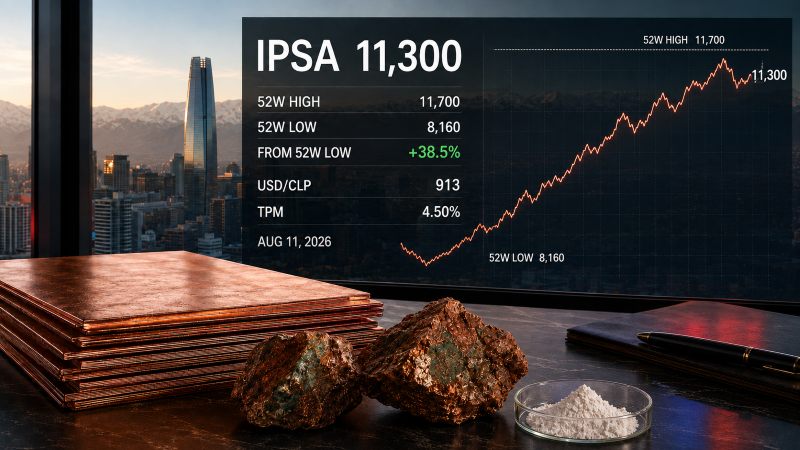
The IPSA, the index that groups the roughly thirty most liquid shares on the Santiago Stock Exchange, was trading around 11,300 points on August 10-11, 2026, just 3-4% below its 52-week high of about 11,700. The number matters less for what it is than for the distance travelled: the same index bottomed near 8,160 points within the past year, making Chile one of the best-performing emerging markets of 2026 so far.
What the index tracks, and what is moving it
The IPSA is a mirror of the Chilean economy, and therefore of copper. Chile's central bank raised its 2026-2028 forecast for the metal this year, citing global demand it links to defense spending, the energy transition and investment in new technologies. Lithium adds to that backdrop: SQM still sets the daily tone in Santiago to a telling degree. On August 7, a single 3.7% jump in that one stock was enough to lift the entire index, a reminder of how heavily the market leans on a handful of names.
The recent twist is that the rally has broadened, with retailers Falabella and Cencosud and the bank BCI joining in. The peso held firm at around 913 to the dollar. Hanging over all of it is one volatile external factor: the conflict between the United States and Iran and the price of oil, which the central bank itself flags as the chief risk to local inflation.
The bull case
Anyone betting on Santiago has arguments. Copper, in the central bank's reading, is not in a passing rebound but in a structural demand cycle. The arrival of José Antonio Kast's government, now in its first year, revived investment expectations; both investment banks and the central bank nudged their growth estimates up as the new administration took office. Inflation, though still above 4%, should return to the 3% target by the second quarter of 2027, and the policy rate, at 4.5%, is tilted downward, promising cheaper financing ahead. A cheap market after years of punishment, with a commodity tailwind and a pro-investment political shift, is the optimist's thesis.
The bear case
The skeptic answers with the real economy. Chile will grow little this year: the central bank projects a range of 1% to 1.75%, and August's expectations survey trimmed that to 1.3%; GDP actually fell 0.5% in the first quarter. The market, in short, has run well ahead of the economy underneath it. Concentration is the second weakness: if one SQM move drags the whole index up, that same leverage cuts the other way the day copper or lithium turns. Add an expectations gap—the government's 4% growth target now looks out of reach, and disappointments get paid for—and the external front, where expensive oil driven by the Middle East conflict pressures inflation, global rates and appetite for emerging-market risk.
What to watch in the coming weeks
Four concrete variables, not forecasts: the copper price and SQM's signals on lithium; upcoming GDP and investment data, which will show whether the recovery the new government promised is materializing or remains an expectation; the path of the policy rate; and events around the Strait of Hormuz and their effect on oil. Much of what the IPSA does between now and year-end will turn on those four.
Figures as of August 10-11, 2026, drawn from the Santiago Stock Exchange, the Central Bank of Chile (June Monetary Policy Report and August 2026 Expectations Survey) and local financial press. Index levels, the exchange rate and the oil price move daily. RS Valores publishes analysis, not buy or sell recommendations; nothing here is investment advice.