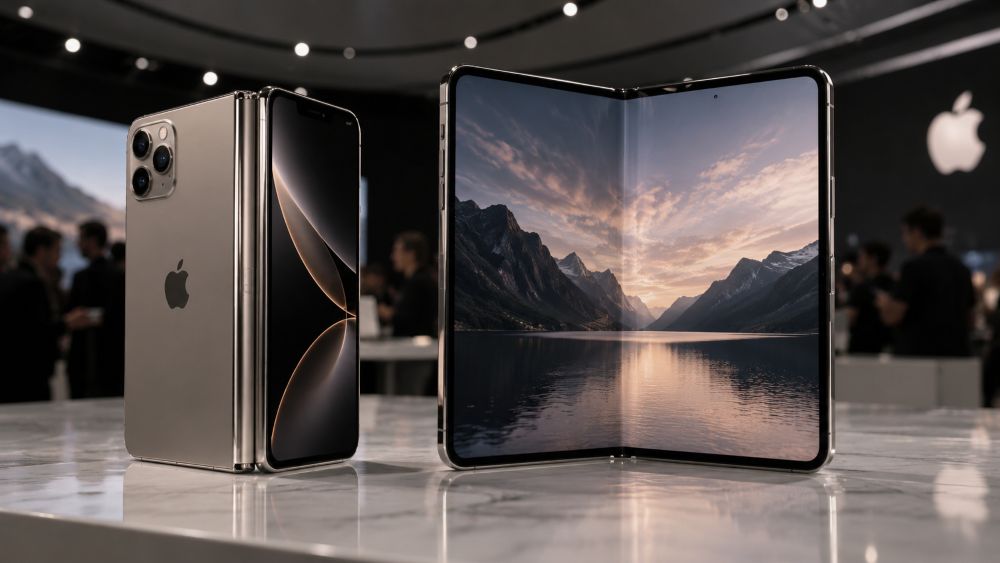
Apple unveiled the iPhone Duo on Wednesday in Cupertino, its first foldable phone, at an event billed as Surprise and Shine that also served as John Ternus's debut as chief executive following Tim Cook's departure earlier this month. The device starts at $1,999 in its 256-gigabyte configuration and reaches around $3,199 in the highest storage versions. It is the most expensive iPhone Apple has ever sold.
That figure is not a secondary detail. It is probably the most consequential decision in the announcement.
The Duo adopts the book-style format already familiar from competitors: closed, it works as a conventional phone with an exterior display of roughly 5.5 inches; open, it unfolds an interior panel of about 7.6 inches, closer to the experience of a small tablet. The chassis is titanium, the processor is the new A20 Pro chip, it carries 12 gigabytes of unified memory, an in-house C2 modem and a dual 48-megapixel rear camera system. It supports the Apple Pencil. It will come in two colors, with deliveries beginning in October.
Apple's central technical argument is the one you would expect from a company arriving seven years after Samsung: the hinge and ultra-thin glass developed to minimize the central crease, the visible flaw that has accompanied foldables since the first Galaxy Fold. Analysts at the event agreed the result is noticeably better than anything available so far.
This is, in essence, the Apple playbook applied once again: not being first, but waiting until a category matures enough to resolve its founding defects and then entering with a polished version. It worked with the MP3 player, the smartphone, the watch and wireless earbuds. The question is whether it works the same way when the entry price is double that of a conventional flagship.
Because at the same event Apple introduced the iPhone 18 Pro and 18 Pro Max, arriving September 18 at $1,199 and $1,299 respectively in their 256-gigabyte versions. The Pro is up a hundred dollars from last year's iPhone 17 Pro. With those numbers, the Duo does not compete against the rest of the lineup: it sits on a separate rung, closer to the price of a laptop than of a phone.
There was also a conspicuous absence. For the first time in years, Apple did not pair its September launch with a conventional base iPhone. The keynote was devoted entirely to the ultra-premium tier, suggesting a reshuffling of the product calendar: September for the expensive, some other point in the year for the mass market. That is a structural change in how the company has organized its launches for more than a decade.
Rounding out the announcement were the Apple Watch Series 12 and Ultra 4, alongside AirPods 5 with improved noise cancellation.
Market context helps explain the price. Foldables have spent years as a profitable but stalled niche: Samsung, Huawei, Honor and Oppo have iterated on the format without making it mainstream. Added to that is a factor that has driven up costs across the industry in recent months, a shortage of memory chips, which pressures the bill of materials on any high-end device. Apple is not setting this price in a vacuum.
For Latin America, the arithmetic is harsher. A $1,999 base price becomes, after taxes, tariffs and local margins, a figure that in several markets in the region comfortably exceeds the equivalent of several average monthly salaries. In Chile, the 256-gigabyte version was announced at around 2.5 million pesos, with higher configurations approaching four million. In practice, the Duo enters the region as an aspirational object rather than a volume product, and its real circulation will depend on financing plans, resale and the gray market, as already happens with the Pro line.
Apple, aware of this, is offering leasing options for the device, a move that says a good deal about how the company itself assesses the elasticity of that price.
The underlying question is not whether the iPhone Duo is a good phone. With those specifications and that level of integration, it almost certainly is. The question is whether Apple can do to foldables what it did to smartwatches and earbuds: take a category that existed, never took off and was full of technical compromises, and turn it into the standard everyone else ends up copying.
The first indicator arrives in October, when deliveries begin. The second, more revealing one, arrives next year, when we learn whether Apple releases a cheaper version. That decision will tell us whether the company sees the foldable format as the future of the iPhone or merely as its most expensive showcase.

