Tony: Anthony Bourdain’s real story and the summer that changed him
Matt Johnson’s film revisits Bourdain’s first kitchen job. His memoir and interviews reveal the real people, the fictional mentors and the longer history behind that coastal summer.
Dominic Sessa’s Anthony Bourdain arrives in Provincetown with literary ambitions, little money and a considerable talent for getting himself into trouble. In Tony, Matt Johnson’s 2026 film, a summer job washing dishes becomes an introduction to a world of knives, seafood, bruised egos and fierce loyalties. The young man hoping to become a novelist begins to find his material on the other side of the restaurant door.
Johnson, the Canadian director of BlackBerry, concentrates on the summer of 1975 rather than the television years that made Bourdain an international figure. Sessa, who broke through in The Holdovers, plays him at nineteen. Emilia Jones is Nancy, the woman he pursues; Leo Woodall plays the reckless cook Sal; and Antonio Banderas supplies the kitchen’s commanding presence as Chef. Stavros Halkias joins the crew as Dimitri.
The film opened in six North American theaters on August 7 before expanding widely on August 21. As of November 29, Box Office Mojo records $15,493,685 in the United States and Canada and $19,266,250 worldwide. Its opening weekend brought in $348,995. IndieWire put the production budget below $15 million, citing a source familiar with the production.
The Critics Choice Association awarded Tony its Seal, while Associated Press critic Mark Kennedy found the story too slight and its new culinary mentor contrived. The film’s reception also reaches into a more personal debate: how to dramatize a man who spent so much of his life turning experience into stories.
Official trailer
English-language trailer published by A24.
The following account discusses characters and events depicted in the film.
The memoir behind the summer
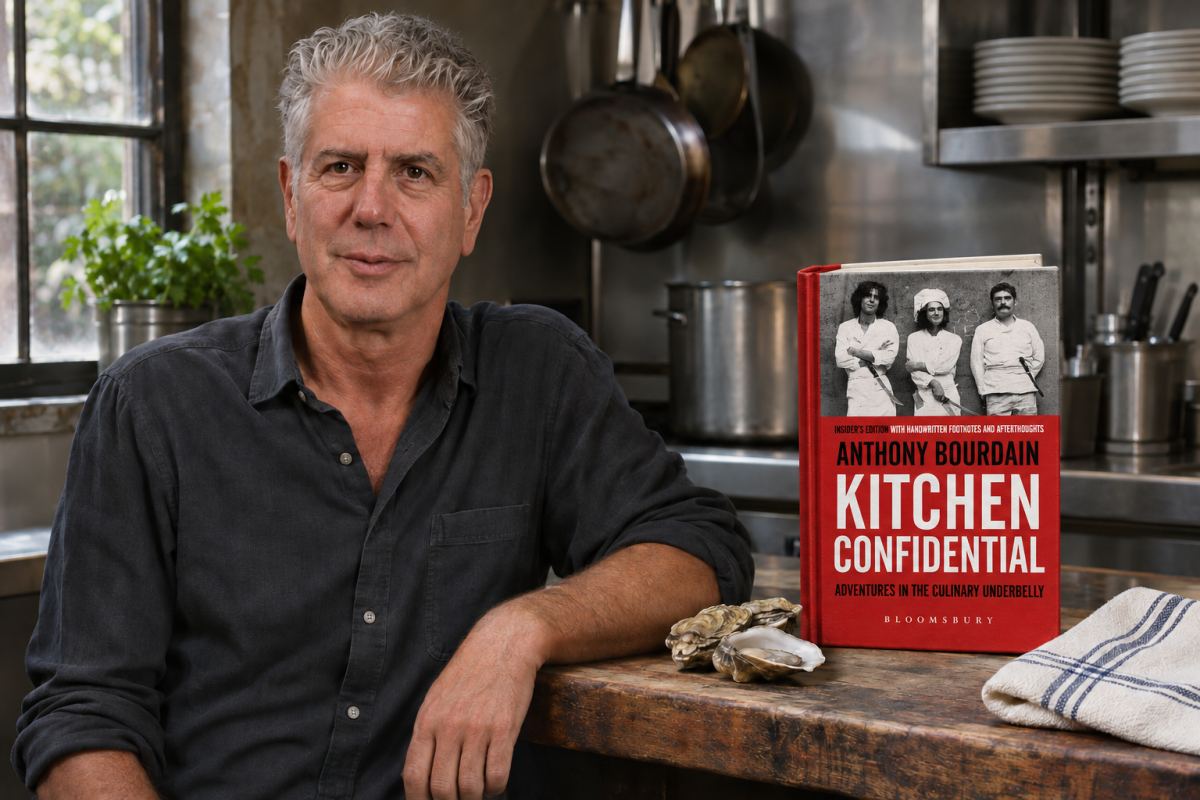
Kitchen Confidential: Adventures in the Culinary Underbelly appeared on May 22, 2000, according to its publisher, Bloomsbury. Bourdain, born on June 25, 1956, was forty-three. He had spent years working in restaurants and had already published fiction. The book brought the language and experience of working cooks to a readership accustomed to seeing food presented from the dining room.
Its early chapters supply the groundwork for Tony: an unhappy student, a shared summer rental, a dishwashing job and the intoxicating authority of the people running the kitchen. The memoir then travels much further, through culinary school and Bourdain’s uneven New York career. Johnson and his fellow screenwriters build their film around one formative stretch, drawing experiences from different moments into the same summer.
The film’s 1975 setting gives those experiences a compact chronology. Bourdain’s own recollections range across several early summers; in his 2014 Massachusetts episode of Parts Unknown, he spoke of arriving in Provincetown in 1972. The coastal years were a recurring part of his life before they became a single season on screen.
A record executive’s son, already curious about food
Bourdain’s father, Pierre, worked in the record business, including at Columbia Records. His mother, Gladys, became a copy editor at The New York Times. Patrick Radden Keefe’s 2017 New Yorker profile describes a family where books, films and food mattered, and a father who introduced his son to unfamiliar eating experiences, including sushi in New York.
Pierre was not a professional chef. In the film, Rich Sommer plays his father, while Banderas’s Chef occupies the role of a demanding mentor. Their influence belongs to different parts of Bourdain’s upbringing and working life.
Food had already surprised him long before Provincetown. In the opening chapter of Kitchen Confidential, he remembers tasting cold vichyssoise aboard the Queen Mary on a childhood trip to France. The temperature, texture and careful service made the soup an event he could still reconstruct decades later. France also supplied the oyster he would remember as another awakening of his appetite.
Those childhood discoveries gave him lasting memories of eating. Provincetown introduced the labor behind the meal: scraping plates, cleaning shellfish, keeping up with orders and earning a place among people who could do the work.
The Flagship and the job he needed
At the tip of Cape Cod, Provincetown offered seasonal employment amid a fishing community, artists, tourists and a longstanding gay culture. In his television return, Bourdain remembered its tolerance and the freedom it offered young people who felt out of place elsewhere. Summer restaurant work financed days at the beach and a shared social life.
The Flagship was a real restaurant. Bourdain called it the Dreadnaught in Kitchen Confidential, where its nautical décor, wooden pilings and fried seafood menu form the setting for his first kitchen job. He describes a roommate finding him a dishwashing opening when the household tired of supporting him.
Nancy Putkoski remembered the same financial pressure in Laurie Woolever’s Bourdain: The Definitive Oral Biography. Tony was staying with people who worked, and a roommate insisted that he contribute. Nancy herself worked at Spiritus Pizza. They had known each other since high school and would marry in 1985; the film reshapes their relationship into a summer courtship.
The work put Bourdain at the lowest rung of a hierarchy he soon wanted to climb. The cooks’ speed, confidence and ability to feed a crowded dining room impressed him. Their abrasive humor and conspicuous appetites also appealed to a young man eager to escape the expectations surrounding him.
Chef, Sal and the men behind the characters
Bourdain’s memoir names the chef at that early restaurant Bobby. Banderas’s Chef gathers several influences into one screen presence. Johnson told Entertainment Weekly that he drew heavily on Bigfoot, the demanding New York boss Bourdain described in his memoir. That influence has been moved into the Provincetown story.
Sal also borrows from beyond that summer. Johnson identified the troubled New York baker known in the book as Adam Real-Last-Name-Unknown as an inspiration. Woodall told British GQ that he approached Sal as a danger-seeking kitchen pirate rather than an imitation of one person. The oyster-shucking cook is a fictionalized character, with a dramatic biography of his own.
Dimitri has a more direct connection to the historical kitchen. Woolever identifies him as Alex Getmanov, who worked with Bourdain in Provincetown and New York. Getmanov recalled a novice with little practical knowledge and a confidence that irritated the crew. The two later ran a small catering operation together. Their friendship extended beyond the film’s compressed apprenticeship.
One kitchen humiliation also survives through competing memories. Bourdain wrote about burning himself on a pan and watching a veteran handle it barehanded. Johnson told Entertainment Weekly that the cook remembered using a towel. The director kept Bourdain’s version for the screen.
Drugs were already part of his youth
Bourdain was using drugs before he began working in professional kitchens. In Kitchen Confidential, he describes drinking and smoking marijuana during his disaffected student years. Woolever’s interviews with school and college friends likewise place drugs in his life before he had settled on cooking.
Provincetown intensified that environment. Bourdain recalled marijuana, cocaine and LSD alongside the beach days and restaurant shifts. His account of leaving town in Parts Unknown joins culinary experience to a deepening involvement with recreational drugs. The promise of a vocation and the possibility of self-destruction developed together.
He dated his first purchase of heroin to 1980, when he was twenty-four, in the same CNN episode. Recalling the coastal years, he explicitly placed that first bag some time ahead of him. The drug culture around the young Tony and Sal’s screen behavior belong in that longer chronology; the television testimony places Bourdain’s own entry into heroin later.
His later accounts of New York work describe addiction taking hold amid exhausting shifts and a social circle that used heavily. Returning to Massachusetts in 2014, he discussed the opioid crisis with people living through it. The older narrator brought his experience to those conversations, with the damage and the losses now plainly visible.
Seafood, a cookbook and a shared table
Another lasting influence came through Howard Mitcham’s Provincetown Seafood Cookbook, first published in 1975. Bourdain admired its combination of cooking, local knowledge, stories and illustrations. He contributed the introduction to the 2018 reissue, returning late in his life to a book associated with his beginnings.
The publisher’s description gives a sense of that world: Portuguese seafood traditions, Cape Cod fishermen, folklore and recipes rooted in place. GQ’s interview with the film’s food stylist, Christine Tobin, explains that Mitcham’s cookbook also supplied the recipe behind the screen clambake. Preparing food for a gathering becomes a way of showing what the young cook is beginning to value.
The Culinary Institute of America records the practical next step. After working as a dishwasher and moving onto a cooking station, Bourdain sought the training to keep pace with experienced cooks. He graduated from the institute in 1978. More than two decades in professional kitchens followed, including Les Halles, before the memoir transformed his prospects.
The coastal summer gave him work, friendships, humiliations and subjects worth describing. His literary ambitions survived the move into cooking. Years later, they would give an audience to people and places usually encountered only through a finished plate.
A life still larger than its origin story
In Bon Appétit, Woolever praised Sessa’s ability to evoke Bourdain while questioning the film’s sunny resolution. His brother Chris expressed resistance to the very idea of a comforting biopic. Their responses carry the weight of knowing the person whose youth has become a movie.
The apprentice who emerged from Provincetown still faced years of unstable work and addiction. Cooking gave Bourdain a profession; writing eventually gave him a public voice. Tony brings the audience to the threshold of that working life, with the memoir and his own television accounts opening onto its much longer, more difficult course.
Where to watch Tony
Availability checked November 29, 2026. In the United States, Tony is available with an HBO Max subscription, following its November 20 streaming premiere. A24 also offers digital rental and purchase through its app.