The Uprising: history and fiction in England’s Peasants’ Revolt of 1381
Andrew Garfield plays an invented farmer in Paul Greengrass’s film about England’s 1381 revolt. Its cast, box office and Robin Hood ending lead back to a rebellion whose promises of freedom were soon revoked.
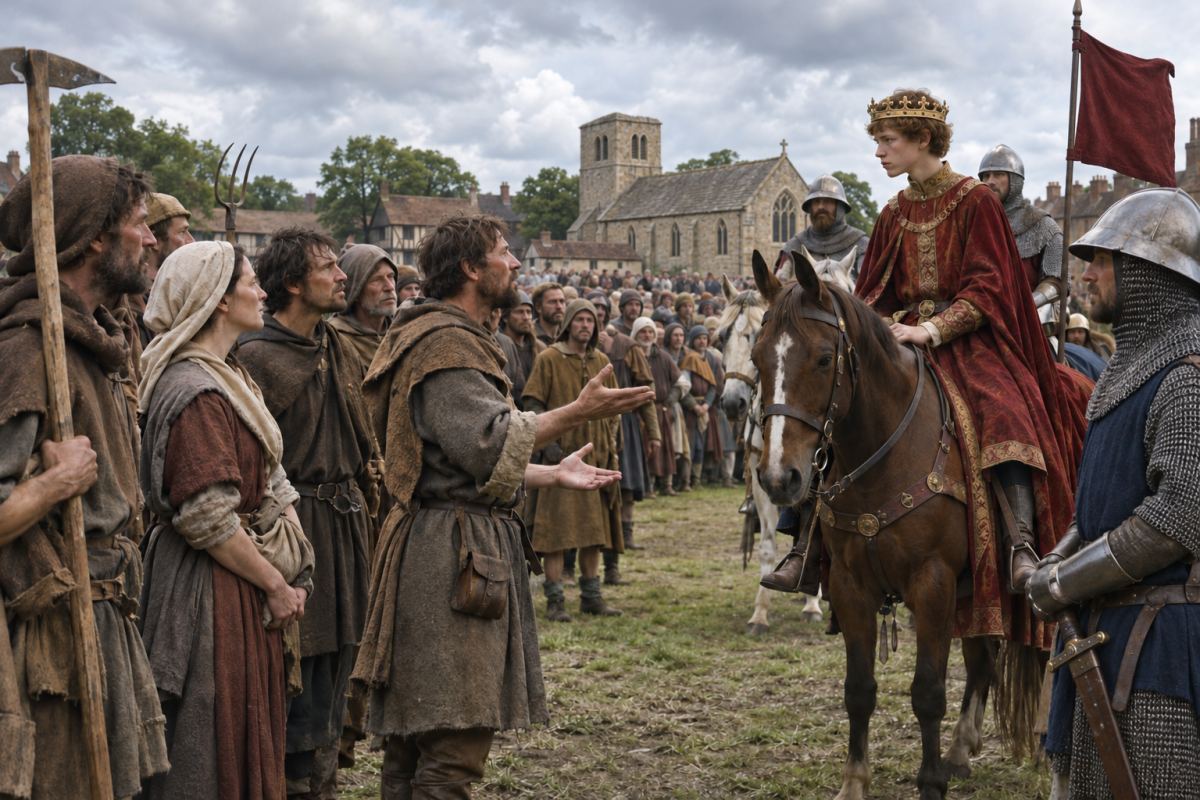
Andrew Garfield begins The Uprising at the bottom of medieval England’s social order, working the land while officials demand money his village can scarcely find. The farmer’s confrontation with the collectors carries him towards London and a meeting with a teenage king. Paul Greengrass turns the journey into an action film about a rebellion that briefly brought royal government to its knees in June 1381.
Released widely in the United States on September 11, 2026, the film reunites the director’s interest in people facing overwhelming institutions with the physical urgency familiar from his Bourne films. This time the material comes from the Peasants’ Revolt: a real uprising whose grievances, leaders and violent suppression survive in medieval chronicles and legal records.
Its theatrical audience proved small. Box Office Mojo records $6,513,180 in the United States and Canada and $10,468,074 worldwide as of November 28. The North American opening brought in $3,311,085. The Numbers records an opening in 2,068 theaters and a sharp contraction to 223 theaters by the third weekend.
Box Office Mojo’s territory breakdown includes $2,005,440 from the United Kingdom. In North America, the second weekend earned roughly $1.2 million, down 64% from the opening, according to The Numbers.
A farmer invented for a historical cast
Garfield’s character is identified by his occupation, the Ploughman. Around him stand people with names in the historical record: Jamie Bell plays the radical priest John Ball; Cosmo Jarvis is Wat Tyler, the Kentish rebel leader; and Woody Norman plays the fourteen-year-old Richard II.
Katherine Waterston portrays the king’s mother, Joan of Kent. Stephen Dillane plays Simon Sudbury, Archbishop of Canterbury and royal chancellor; Tom Hollander is treasurer Robert Hales; and Jonny Lee Miller plays London’s mayor, William Walworth. Thomasin McKenzie’s Alyce, a follower of Ball, belongs to the film’s invented characters.
Greengrass explained in an interview published by Focus Features that he wanted an ordinary farmer at the center rather than a biography of Tyler or Ball. Historian Dan Jones, author of Summer of Blood, advised on the screenplay. With Jason Blum and Greengrass among the producers, the team filmed village scenes at Bad Windsheim and used buildings in Nuremberg for locations representing medieval England. Visual effects extended those settings into the London of the story.
Official trailer
Original English-language trailer, published by Focus Features.
The following account discusses the film’s ending and the fates of the historical rebel leaders.
The anger that survived the Black Death
The revolt grew in a country transformed by mass death. Plague reached England in 1348, and the devastating mortality of 1348–49 left landowners competing for a much smaller workforce. Survivors could demand higher wages and seek better conditions. Lords and royal government tried to hold labor costs down, including through the Statute of Labourers of 1351.
For people bound to a manor, work also meant services owed to a lord and restrictions on movement. These obligations became a central target of the rising. Other participants were free tenants, prosperous farmers, craftspeople, townspeople and former soldiers. The research project The People of 1381 describes a movement crossing several social groups, with grievances extending well beyond the poorest agricultural workers.
Taxation sharpened the conflict. War with France drained royal resources, while successive poll taxes in 1377, 1379 and 1380 demanded further payments. Attempts to enforce the last levy in the spring of 1381 brought officials into communities already resisting collection. In Essex, confrontations with the authorities helped turn refusal into organized revolt.
The film gives that outbreak a recognizable individual face. Garfield’s bereaved farmer and his personal path through the rebellion are a dramatic construction. Tyler was a separate historical leader, played by Jarvis. Little is known about him before 1381, leaving substantial gaps in the life of the man who came to lead the Kentish rebels.
John Ball gave the revolt a religious language of equality. His preaching challenged the privileges of secular and ecclesiastical lords through the biblical story of Adam and Eve. Historian James Crossley’s study of Ball explains how these ideas imagined a transformed Christian society. The priest’s radicalism belonged to the religious arguments of his own century.
London, June 1381
Rebels from Essex and Kent converged on London. Local supporters helped the rising penetrate the capital, where insurgents opened prisons, burned administrative records and attacked properties associated with royal officials and great lords. Documents recording debts and obligations became targets alongside the people enforcing them.
On June 13, John of Gaunt’s Savoy Palace was destroyed. Gaunt, Richard II’s uncle, embodied much of the hostility towards the governing elite. The following day, while the king met rebels at Mile End, insurgents entered the Tower of London. Sudbury and Hales were seized and beheaded.
Historic Royal Palaces identifies Joanna Ferrour among the leaders accused of participating in the assault on the Tower. Allegations recorded after the rebellion attributed a direct role in the ministers’ deaths to her. That evidence gives a historical foundation to the presence of women in the uprising, although McKenzie’s Alyce and her personal story were created for the film.
The violence also reached people outside the governing circle. Flemish residents were singled out and killed. London Museum documents these attacks alongside those on ministers and lawyers. The capital’s upheaval contained targeted political destruction, personal revenge and murderous hostility towards foreigners.
Many rebels still appealed to Richard as a just king who might free them from oppressive advisers. Historic Royal Palaces notes their declared loyalty to the fourteen-year-old monarch. At Mile End, Richard offered concessions, including charters of freedom. For a short time, people who had confronted royal power could believe they had secured release from bondage.
What the film changes at Smithfield
The decisive encounter came on June 15 at Smithfield. Tyler approached the royal party for further negotiations. The Anonimalle Chronicle, available in translation through Fordham University’s Medieval Sourcebook, recounts demands for an end to serfdom and a confrontation involving Walworth and members of the king’s household.
Its account places Walworth at the center of the attack on Tyler and describes another royal attendant inflicting wounds. As Tyler fell, Richard rode towards his followers, presented himself as their leader and drew them away from Smithfield.
Walworth subsequently had the injured Tyler brought back from nearby St Bartholomew’s Hospital and executed. The descriptions of gestures, insults and responsibility in these accounts reflect the perspectives of the chroniclers. Royal authority recovered, the freedom charters were revoked, and judicial and military repression followed in the regions affected by the revolt.
The film also compresses John Ball’s fate. As HistoryExtra’s comparison of the film and the historical record explains, it places his death amid the violence at Smithfield. Ball actually survived the June confrontation. He was captured later, tried at St Albans and executed in July 1381. His death belonged to the repression that followed the dispersal of the rebels.
Where Robin Hood enters
The closing movement carries Garfield’s fictional farmer towards the outlaw world associated with Robin Hood. Focus’s promotional description explicitly links the uprising to the legend. This is the film’s largest leap from documented events into an imagined origin story.
Robin Hood has no established historical identity connecting him to a farmer who survived the rising of 1381. References to his stories were already circulating around the time of William Langland’s Piers Plowman, conventionally dated to about 1377. The legend developed through later ballads, performances and retellings. The familiar setting under Richard the Lionheart belongs to a different reign from Richard II’s.
Scholars have explored connections between the social imagination of the revolt and the later outlaw stories. Crossley’s study Early Robin Hood Stories discusses their shared visions of fellowship and a better social order. Such literary relationships leave room for Greengrass’s interpretation, but they supply no documentary biography for the Ploughman.
That turn attracted criticism. Associated Press praised Garfield’s commitment but found the Robin Hood connection disruptive, awarding the film two and a half stars out of four. Sight and Sound emphasized the tension between its urgent visual style and the difficulty of conveying the rebellion’s political and religious arguments.
The historical rising ended with broken promises, executions and a restored monarchy. Serfdom endured beyond 1381, weakening over subsequent generations through wider economic and social changes. Greengrass gives his surviving farmer a path into legend. The people recorded in the courts and chronicles left a more fragmented inheritance: names, demands and evidence of a moment when England’s rulers were forced to negotiate with those who worked beneath them.