Mao was a dictator. China is a dictatorship, even as LaLiga apologizes over Mbappé’s remark
A comment about a meme led Chinese state television to suspend LaLiga broadcasts and prompted apologies from Kylian Mbappé, the league and Real Madrid. The response does not alter the historical record of Mao’s repression or the authoritarian nature of China’s political system today.
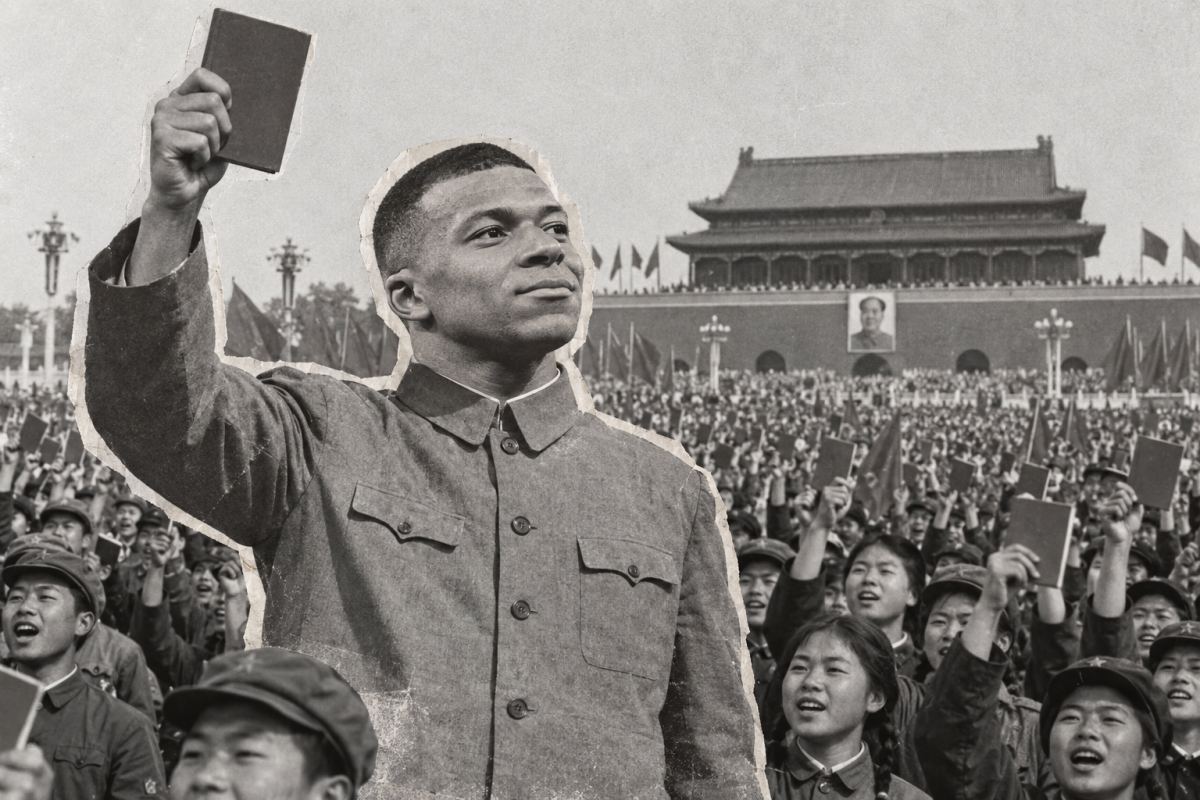
Kylian Mbappé referred to a “Chinese dictator” while describing a meme that put his face on Mao Zedong’s body. He did not name the former leader in the clip that circulated online, but the image made the reference clear. Chinese state television suspended LaLiga broadcasts and advertisements featuring the footballer. Mbappé apologized, followed by the Spanish league and Real Madrid. An offhand answer about an internet joke had become a dispute between Spanish football and one of its major markets.
The apologies leave a historical question unanswered: was it wrong to call Mao a dictator? The record says no. He ruled through a one-party system, oversaw political repression and pursued policies that contributed to millions of deaths. He also launched the Cultural Revolution, during which young people mobilized in his name persecuted and killed fellow Chinese citizens. A footballer’s remark may have offended some people; that does not make those events untrue.
How a meme became a broadcasting dispute
The controversy began with a video in which Mbappé was asked to name his favorite meme. He described one that depicted him as a “Chinese dictator.” Fans had shared the comparison as a joke about the influence they believe he wields at the clubs where he plays. It was not a considered statement about Chinese history. That context explains what he actually said without obscuring the figure depicted in the meme.
According to the EFE news agency and Spain’s public broadcaster RTVE, China Media Group, which oversees CCTV, suspended the relevant LaLiga broadcasts and removed advertisements featuring Mbappé. Several Chinese companies ended commercial agreements with him. The Chinese Football Association protested to Real Madrid and sought public apologies. On October 28, the state media group acknowledged receiving a letter from the club but did not announce an end to the suspension. There is no basis yet to say the broadcasting dispute has been resolved.
Mbappé apologized for causing hurt and expressed respect for Chinese people and their history. LaLiga said it regretted the offense to Chinese fans, stressed that the comments were personal and announced a protocol on communication and cultural awareness. Real Madrid apologized as well. None of those public statements shows that LaLiga personally ordered Mbappé to retract his words.
Political executions and famine under Mao
Mao led the People’s Republic of China from its founding in 1949 until his death in 1976, exercising decisive authority over both the Communist Party and the state. The Campaign to Suppress Counterrevolutionaries, carried out from 1950 to 1953, illustrates how that power was used. Research published in the Journal of Chinese History documents execution quotas tied to population figures and cites a record of 753,275 people executed by the end of the campaign. Those were victims of a particular campaign of political repression, not an estimate of every death during Mao’s rule.
The famine associated with the Great Leap Forward was a different catastrophe. The program imposed agricultural communes, unattainable production targets and grain procurement policies that left communities without enough food. Economists James Kai-Sing Kung and Justin Yifu Lin cite estimates of 16.5 million to 30 million excess deaths during the famine of the late 1950s and early 1960s. The range varies with the demographic method used. It does not count direct executions or assign the same degree of individual responsibility for every death. It does show the devastating scale of the policies and the political system that failed to correct them in time.
These figures should not be combined as though they came from a single ledger. Keeping them separate makes the historical responsibility clearer. One set concerns deliberate violence against people designated political enemies. The other concerns policies imposed from the top that helped cause mass mortality. Both belong in an account of Mao’s rule.
A revolution launched from above
Mao launched the Cultural Revolution in 1966 and called on young people to confront supposed ideological enemies. Red Guards attacked teachers, intellectuals, officials and neighbors. Researcher Youqin Wang documented attacks on teachers at all 96 schools she studied and recorded 27 educators killed by students. Those figures describe the schools in her research, not a nationwide total. They establish that the violence had identifiable victims and cannot be reduced to images of rallies and little red books.
Even a historical resolution adopted by the Chinese Communist Party in 2021 acknowledges that Mao “launched and led” the Cultural Revolution and that it inflicted grave losses and a decade of domestic turmoil. The party document assigns responsibility to other leaders as well, but it does not erase Mao’s initial decision or the gravity of what followed. Independent researchers have also reconstructed persecution and deaths that contemporary propaganda concealed.
China today and the limits of the debate
China today is not the country it was in the 1960s. Its economy, society and place in the world have changed profoundly. Its political system, however, still offers no competitive national election through which citizens can choose their government. International IDEA says China holds no national elections and gives it a score of zero for representation. Freedom House classifies it as “Not Free.” Describing the present system as a dictatorship is a political judgment grounded in the Communist Party’s concentration of power, the absence of electoral alternation and restrictions on civil liberties. It is not something Mbappé said in the video.
A club may seek to protect its relationship with Chinese supporters, and a player may regret causing unintended offense. The decision to pull broadcasts and commercial agreements over an informal remark also warrants scrutiny. EFE found that many internet users in China could not readily locate the clip behind the apologies: official outlets avoided repeating the word “dictator,” while politically sensitive references circulated under restrictions.
LaLiga and Real Madrid can decide how to respond to a commercial crisis. Historical claims require evidence. Mao was a dictator who oversaw repressive campaigns and made decisions that contributed to one of the 20th century’s worst famines. China today remains an authoritarian one-party state. Stating those facts precisely respects the Chinese victims who, for decades, could not speak freely about what happened to them.