Is America on Putin’s side or freedom’s?
Trump called Putin “my friend” in Shenzhen. The Russian leader’s record of war, repression and driving people from their homelands raises a question about what the president of the United States stands for.
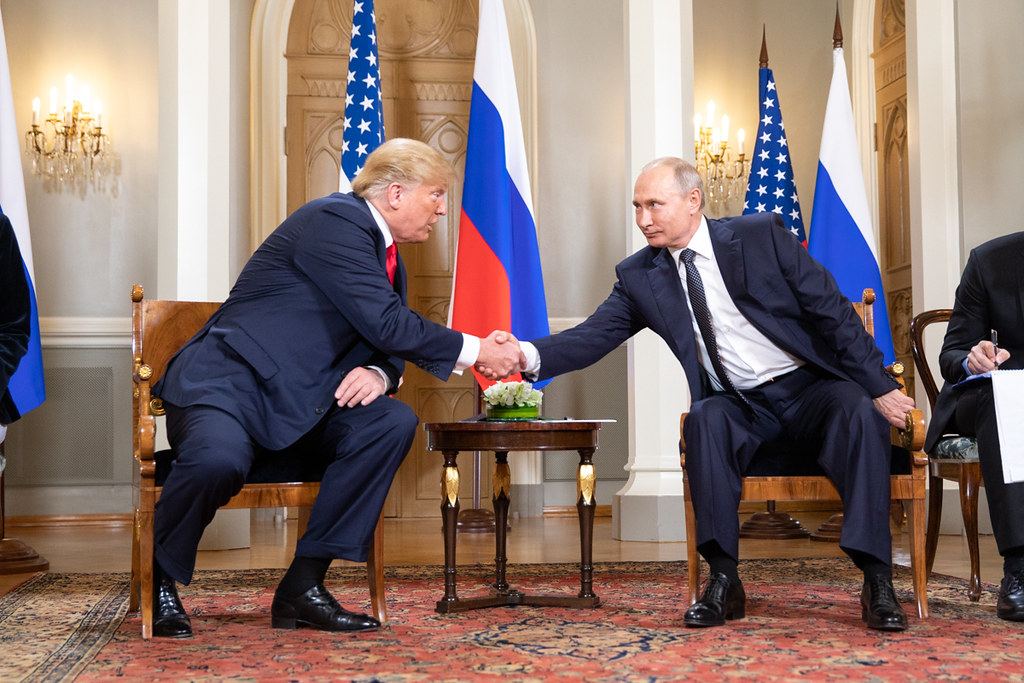
Donald Trump called Vladimir Putin “my friend” on November 19 in Shenzhen, China, before talks with him and Xi Jinping. He did so in front of the cameras while Russia continues the war Putin launched against Ukraine. Trump was speaking as the representative of the United States. Ukrainians who have spent years burying their relatives have every right to ask what that friendship means, and what place they have in the American president’s decisions.
Calling Putin a friend expresses a closeness that should trouble anyone who believes in democracy. His record tells us how he understands power, how much he respects the lives of his own citizens and how much he values other people’s freedom. Trump knows that record. By publicly celebrating their friendship, he gives recognition to the leader responsible for it.
I believe in democracy because everyone should be able to choose how to live. No president, party or religious authority can take ownership of that right. We elect leaders to exercise limited power and answer to the people. When a ruler imprisons his opponents, persecutes dissenters and decides to invade a neighboring country, defending freedom means standing with those who suffer the consequences.
Putin’s record of disregard for human life stretches back well before the full-scale invasion of Ukraine. In Chechnya, Russian aircraft bombed Katyr-Yurt on February 4, 2000, when he was acting president. In 2005, the European Court of Human Rights found Russia responsible for the deaths of Zara Isayeva’s son and three nieces. It found that the operation had been planned and carried out without the care required to protect civilians.
The August 2008 war in Georgia provides another example. Putin was prime minister at the time, while Dmitry Medvedev held the presidency. In its 2021 judgment, the European court held Russia responsible for killings of civilians, ill-treatment, looting and the burning of homes after the ceasefire, in territories under its effective control. It also found that displaced Georgians had been prevented from returning home.
In Syria, Putin intervened militarily in 2015 to keep Bashar al-Assad in power, after four years of war. A UN commission of inquiry found reasonable grounds to attribute 2019 attacks on a market in Maarat al-Numan and a displacement camp near Haas to Russian aircraft. It characterized those actions as war crimes involving indiscriminate attacks on civilian areas. Families who had tried to find refuge from the violence were there, too.
In Ukraine, the illegal annexation of Crimea in 2014 preceded the full-scale invasion of February 2022. Putin turned his claim to decide the neighboring country’s future into a war that continues to destroy homes and lives. Ukrainians have the right to choose their leaders, their alliances and how they live. Their right deserves the same respect that any American citizen demands for their own freedom.
The scene in Shenzhen looks particularly dangerous from countries whose fate other powers presume to negotiate. Europe knows the cost of such bargains. In August 1939, Hitler and Stalin agreed to a nonaggression pact and secretly defined their spheres of influence. Germany invaded Poland on September 1, and the Soviet Union invaded from the east on September 17. The Poles were subjected to decisions made about their country without their consent.
The pact did not protect the Soviet people either. On June 22, 1941, Hitler invaded the Soviet Union. The security Stalin had sought through his agreement with Germany ended in a devastating war for his own people. That warning remains relevant when great powers claim the right to dispose of other nations. Ukrainians must decide their own future, regardless of whatever advantage Trump, Putin or Xi might see in reaching an understanding among themselves.
We should also remember the support given to governments that drove millions into exile. In 2011, Russia and China vetoed a draft UN Security Council resolution condemning the Syrian government’s repression. In 2019, they blocked another calling for free presidential elections in Venezuela. Putin backed Assad and Nicolás Maduro while their citizens endured persecution, violence and deteriorating living conditions.
Millions of Syrians and Venezuelans sought protection or an opportunity outside their countries. Those exoduses have left families separated and people deprived of their homes, careers and the chance to grow old near their loved ones. The governments that protected those regimes bear a political responsibility that should follow them into international summits. Trump should consider those consequences before presenting his closeness to Putin as a source of satisfaction.
His own foreign policy demands results. The confrontation with Iran has shown how difficult it is to turn American military superiority into lasting security. On November 17, the United States again struck an Iranian missile installation on Qeshm, while threats to its forces and regional shipping persisted. In my view, a great power weakens its standing when its interventions drag on and its allies remain exposed. Rapprochement with Moscow and Beijing adds to the unease of those who depend on American commitments.
Admiration for Putin also extends into domestic politics. In February 2022, Steve Bannon, Trump’s former strategist, praised the absence of LGBT Pride flags in Russia on his program. In 2023, Russia’s Supreme Court declared the so-called “international LGBT movement” extremist. UN experts warned of the consequences for LGBT people’s rights and safety. What freedom are people defending when they celebrate a government that persecutes others for their identity?
Religious freedom protects believers and nonbelievers alike. The rights of women and sexual minorities must be protected from the fanaticism of whoever holds office. A democracy also needs an education that allows people to learn science, read and debate ideas. Florida law allows parents to restrict which books their own children can check out from school libraries. That power deserves scrutiny in light of children’s right to learn and respect for the choices of other families.
The United States reaches its 250th anniversary with rights won through struggles against slavery, segregation and exclusion. Defending that legacy requires respect for those who were able to challenge power. A president who admires a repressive ruler compromises the example his country can offer the world.
Russian families also have the right to demand answers. Mediazona and Meduza estimated that about 352,000 male Russian citizens aged 18 to 59 died in the war between the start of the full-scale invasion and the end of 2025. Their estimate draws on inheritance records and other sources, including court files. Territorial ambition has consumed hundreds of thousands of lives. Among them were young men who should have had education, work, family and a future ahead of them.
The question Shenzhen leaves us with goes far beyond a personal friendship: Is America on Putin’s side or freedom’s? You cannot call yourself a believer in democracy, say you believe in freedom and then call Putin your friend. He bears political responsibility for invasions and bombing campaigns that have killed civilians in Syria and Ukraine. He shielded dictatorships that drove mass exoduses from Venezuela and Syria. He has sent hundreds of thousands of Russians to their deaths and keeps sending young men to the front, where their future ends in a trench.
Whose side are you on, Mr. Trump?