Argentina's stock market enters August 2026 with two stories unfolding at different speeds. On one side, the decline in country risk from the critical levels of the past, the return of corporate financing and a new wave of investment are supporting expectations. On the other, currency volatility, sovereign debt and market concentration are reminders that the recovery still depends on a small number of companies and, above all, on energy.
The S&P Merval remains particularly sensitive to YPF, banks, electricity companies and gas transporters. Looking only at the headline index can therefore obscure important differences: while Vaca Muerta is going through an expansion cycle, businesses exposed to domestic consumption still face an uneven economy and demand that is not recovering at the same pace.
YPF returns to the center of the market
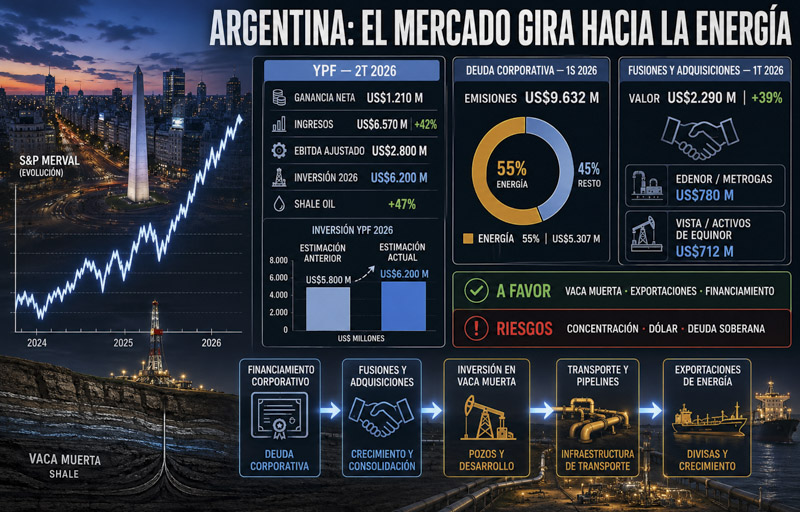
The week's most important corporate news came from YPF. The oil producer reported second-quarter net profit of $1.21 billion, compared with only $58 million in the same period of 2025. Revenue increased 42% to $6.57 billion, while adjusted EBITDA reached a quarterly record of $2.80 billion.
Shale oil production grew 47% year on year to an average of 213,000 barrels per day, and the company aims to reach 250,000 barrels by year-end. Following those results, YPF raised its 2026 investment forecast from $5.8 billion to $6.2 billion and increased its annual EBITDA projection from $6 billion to $8 billion.
The figures explain why YPF has so much influence over market expectations. Vaca Muerta represents more than oil production: it is also a potential source of exports, international reserves and fiscal revenue. That connection turns each operational result into a signal for Argentine assets as a whole.
The Metrogas sale redraws the energy map
The second major transaction is YPF's sale of its 70% stake in Metrogas to Edenor for $780 million. The deal places the country's largest electricity distributor and a gas company serving roughly 2.5 million customers under the same business group.
The transaction still requires regulatory approval and raises questions about market concentration. For YPF, however, it is part of a clear strategy: disposing of assets it does not regard as central and directing more capital toward unconventional production in Vaca Muerta.
For Edenor, the purchase represents an extraordinary increase in scale, but it also means assuming Metrogas's regulatory, financial and operating risks. Future profitability will depend heavily on tariff reviews and the continuity of the regulatory framework.
Vista and Central Puerto are also buying growth
Corporate activity extends beyond YPF. Vista Energy completed the acquisition of Equinor interests in Bandurria Sur and Bajo del Toro, two Vaca Muerta areas. The assets ultimately incorporated were valued at $712 million.
Vista produced 156,000 barrels of oil equivalent per day in the second quarter, 32% more than a year earlier. Revenue rose 89% to $1.15 billion and net profit reached $322 million. The company also exported 72% of the volume it sold, partly reducing its dependence on the domestic market.
Central Puerto, traditionally focused on power generation, also entered the oil business by acquiring Patagonia Energy, holder of concessions in Aguada del Chivato and Aguada Bocarey. The purchase introduces a new thesis for the company: reducing its exclusive dependence on electricity and participating directly in hydrocarbon development.
These are not isolated transactions. Mergers and acquisitions in Argentina totaled $2.29 billion during the first quarter of 2026, a 39% year-on-year increase, even as the number of transactions fell 23% to 57. There were fewer deals, but they were larger. Energy, oil and gas, technology and real estate attracted most of the interest.
Companies return to the debt market
Another favorable signal comes from the corporate bond market. Argentine companies issued $9.632 billion during the first half of 2026, 8% more than in the same period of 2025.
Energy companies captured 55% of that financing, or $5.307 billion. YPF issued $833 million; Pampa Energía, $700 million; Edenor, $640 million; Vista, $617 million; and Pluspetrol, $500 million.
The increase in issuance shows that some Argentine companies can once again raise dollars for long-term projects. It also reveals obvious concentration: access to credit has not recovered uniformly, but favors companies with export-linked revenue and the capacity to generate dollars.
The bull case
The optimistic argument is that Argentina is gradually rebuilding a functioning capital market. Country risk approached 400 basis points during July, companies returned to the debt market and large acquisitions show that investors are assigning real value to local assets.
Energy offers the strongest thesis. Vaca Muerta is increasing production, reducing costs and generating exports. YPF and Vista are reporting stronger results, while transport, processing and export infrastructure require further investment.
If Argentina can accumulate reserves, maintain fiscal discipline and broaden access to credit, the market could become less dependent on political expectations and begin relying more heavily on verifiable corporate earnings.
The bear case
The skeptic sees a narrow and concentrated market. Much of the enthusiasm depends on oil, gas and a handful of companies. A fall in crude prices, regulatory problems or infrastructure delays could simultaneously affect several of the index's most important stocks.
Sovereign risks also remain. Although country risk has declined from earlier levels, Argentina still pays a high premium and must demonstrate that it can refinance maturities without endangering its reserves.
The recovery is not uniform either. Energy and export companies are advancing faster than consumption, domestically oriented industry and smaller businesses. A rising Merval does not necessarily mean that the entire Argentine economy is growing at the same pace.
What to watch in the coming weeks
Five variables will shape the market: oil prices; production trends in Vaca Muerta; the financial exchange rate; sovereign bonds and country risk; and quarterly results from banks, energy producers and regulated utilities.
Investors should also watch the regulatory review of Edenor's acquisition of Metrogas, the progress of infrastructure projects and YPF's ability to turn its $6.2 billion investment plan into higher production and exports.
Argentina's stock market is attracting capital again, but it does not yet offer a broad-based recovery. Its 2026 story is more specific: large energy companies producing more, buying assets, issuing debt and investing within an economy whose stabilization still needs to be consolidated.
Corporate information updated through August 13, 2026, based on company disclosures, Reuters, capital-market reports and financial press. Share prices, bond prices, exchange rates and country risk change daily. RS Valores publishes analysis, not buy or sell recommendations; nothing here constitutes investment advice.

