Rubio met Fujimori in Lima while China answered with open doors
The Peruvian leg of the U.S. tour was also fought in newspaper columns and over a visa policy. Beijing had twelve years of accumulated advantage
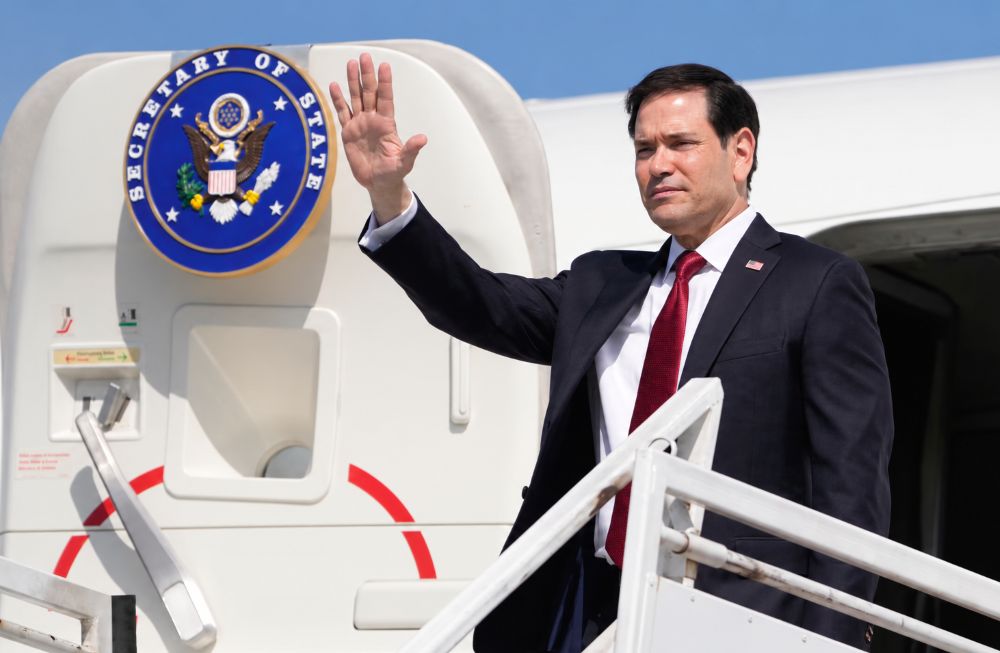
U.S. Secretary of State Marco Rubio closed a three-day South American tour in Lima on Thursday, after earlier stops in Colombia and Ecuador. According to the schedule released by the State Department, his day in the Peruvian capital began at 9:20 with a closed-press meeting with staff and families of the U.S. embassy, continued at 10:10 with Peruvian Foreign Minister Carlos Espa and at 11:00 with President Keiko Fujimori, followed at 11:35 by a joint press availability, and ended at 12:40 with remarks to the American Chamber of Commerce of Peru.
Peru's presidency had announced the Government Palace meeting for 10:15, with the full cabinet attending. The discrepancy between the two schedules was never publicly clarified.
On the official agenda were security, the fight against organized crime, defense cooperation, bilateral trade, investment promotion and preparedness for the El Nino phenomenon. It is Rubio's first visit to Peru since Fujimori was sworn in on July 28, and it comes days after the country formally joined the Escudo de las Americas, the hemispheric counternarcotics security coalition promoted by the Trump administration.
But the conversation that actually defined the Peruvian stop did not happen at the palace. It happened on a newspaper page and on an X account.
Before landing, Rubio published a column in El Comercio arguing that projects backed by the Chinese Communist Party bypass Peru's legal frameworks and threaten transparency and data security. The piece framed the choice in terms of models: investment with rules versus investment without them.
China's embassy in Lima responded on three separate fronts, and the choice of those fronts reveals precisely how Beijing understands the dispute.
The first was sovereignty. "The Western Hemisphere is nobody's backyard," the diplomatic mission wrote, a formulation aimed less at Washington than at Latin American public sensitivity toward the Monroe Doctrine.
The second circulated most widely, and is the most revealing: visas. The embassy noted that China unilaterally applies a visa waiver for all Peruvians holding ordinary passports, allowing stays of up to 30 days for business, tourism, family visits, exchanges or transit. "China opens its doors and welcomes the Peruvian people with open arms," the message concluded, with an explicit jab at the immigration controls of "a certain country" that did not need naming.
The fact itself is not new. The waiver began as a trial measure in June 2025, under the China-CELAC forum, also covering Argentina, Brazil, Chile and Uruguay, and Beijing extended it through midnight on December 31, 2026. What was new was the timing chosen to recall it: the same Tuesday Rubio took off from Miami toward Barranquilla.
The asymmetry that message exploits is real and instantly legible to any Peruvian. A tourist or business visa for the United States means a long form, a nonrefundable fee, a consular appointment that can take months, and an interview with an uncertain outcome. For China, a passport suffices. It is a difference felt in daily life long before anyone registers it as foreign policy, and Beijing has been using it as its cheapest and most effective argument for some time.
The third front was commercial. China noted that it has been Peru's largest trading partner for twelve consecutive years, that the Andean country is the region's third-largest exporter to its market, and that the Updating Protocol of the China-Peru Free Trade Agreement should enter into force shortly.
Behind all of it sits Chancay, which neither side needed to mention. The megaport is built, operating and under Chinese control. Rubio did not come to Lima to reverse that, because it is not reversible in a day of meetings or in a single term. He came, at best, to try to prevent a second Chancay, and to offer an alternative in financing and investment that has so far not materialized into concrete figures.
That is the structural weakness of the U.S. position on this stop. Washington offers security cooperation, which Peru needs and values, and promises solid trade agreements "in the near future," as Rubio himself said before departing. China offers a port that already works, a treaty being updated, twelve years of commercial primacy and an open border for Peruvian passports. One is a promise; the other is concrete infrastructure on the Huaral coast.
The Peruvian question, like that of much of the region, is not really a choice between blocs. It is that each power offers something the other does not replace. The United States brings military cooperation, intelligence, surveillance technology and access to a market with known rules. China brings bulk purchases of minerals, infrastructure and financing without political conditionality. Governments that try to keep only one half end up paying the cost of the other.
Fujimori's government, six weeks into its term, inherits that equation intact, with a port already inaugurated inside it. Its room for maneuver lies less in choosing than in managing two relationships that watch each other closely.
What is worth watching in the coming weeks is not the communiques from this visit but three concrete things: whether the FTA Updating Protocol with China actually enters into force and on what terms, what U.S. investment commitments appear with figures and deadlines attached, and what operational obligations Peru assumes within the Escudo de las Americas. Those three answers will say considerably more than any photograph at Government Palace.