

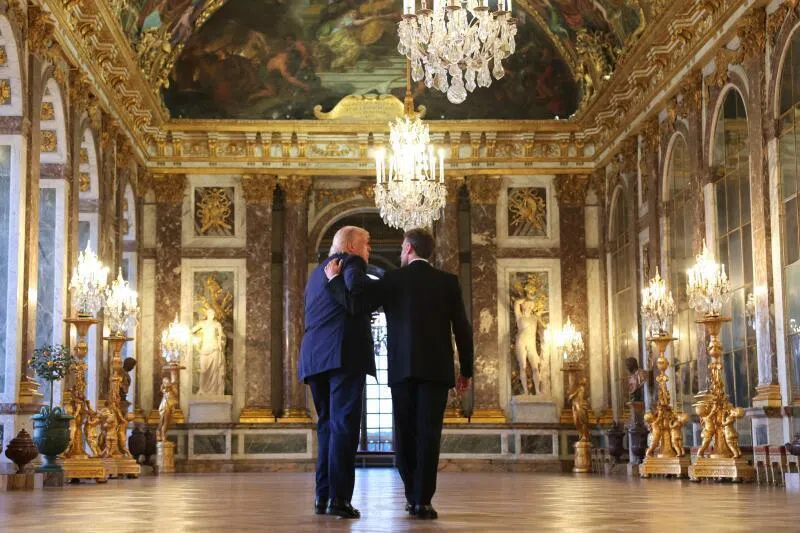
Photo by AFP
“It is signed, yes. I signed it at Versailles.” With that sentence, spoken to reporters on the night of last Wednesday, June 17, as he left a dinner with Emmanuel Macron, Donald Trump announced the end of the war he himself had launched in late February against the Islamic Republic of Iran. The image—the U.S. president initialing the document beneath the palace’s gilded chandeliers, Macron’s applause, Secretary Marco Rubio receiving the file—was designed for social media. What no one told him is that over that same hall looms a tragic past.
Because Versailles is no neutral backdrop. In its Hall of Mirrors the German Empire was proclaimed in 1871, after defeating France in a war that France had declared on the Kingdom of Prussia—a humiliation for the French. For the first time Paris was taken by German forces, and it would lose Alsace and Lorraine; and in that same hall, in 1919, the victorious powers forced Germany to sign the peace meant to conclude the First World War and to chasten the aggressor power. That peace was never truly concluded: twenty years later the continent was ablaze again, in a war far bloodier than the first. To choose that setting to seal an agreement with Tehran is an irony so dense that it is hard to believe no one in the White House weighed its historical force.
For a century it has been repeated that what led to the Second World War was the Versailles armistice and the economic burden it imposed on Germany, condemning Germans to a long era of scarcity and galloping inflation. The Weimar Republic was never able to bring Germany back to the economic standing it had enjoyed at the start of the First World War.
The armistice was one of the favorite cards of Hitler’s National Socialism, used to exalt German nationalism against the disgrace inflicted by the democracies, France and the United Kingdom. It is true that the rhetoric against the shame of signing the Treaty of Versailles propelled the Nazis onto the public stage—but that is not the whole truth.
The armistice of November 1918 was signed before a single Allied soldier had set foot on German soil. The Kaiser’s troops returned home in formation, and the nationalist right and the military caste built upon that image the Dolchstoßlegende, the “stab-in-the-back legend”: the army had been undefeated in the field and betrayed by the politicians, the socialists and the Jews of the home front. France recovered Alsace and Lorraine—the territory that had been seized from it in 1871—but Germany kept intact the myth that it had never been defeated. On that lie was built the revanchism that carried Hitler to power.
That, and no other, is the parallel that ought to keep Washington awake. Because what the Versailles memorandum leaves standing is precisely that: the narrative of an Iranian victory. The leadership of the theocracy that governs Tehran emerges victorious from the Hall of Mirrors even though its forces were decimated, its military program battered and much of its command eliminated—just like the German army of 1918. It emerges victorious because its strategy worked: putting world trade in check by closing the Strait of Hormuz and threatening the petro-monarchies was enough to seat the planet’s greatest power at the negotiating table. President Masoud Pezeshkian did not have to invent anything when he spoke of “a message from a powerful Iran.” It was handed to him, signed.
It is worth sticking to the verifiable before projecting. The document is a fourteen-point memorandum of understanding, reached after months of negotiation mediated by Pakistan, and it entered into force immediately; Trump signed it physically and Tehran subscribed to it electronically. It orders the immediate and permanent cessation of military operations on every front, including Lebanon. It opens a sixty-day window to negotiate a definitive agreement on the nuclear program and the lifting of sanctions.
In operational terms: Iran reopens the Strait of Hormuz and guarantees the transit of commercial vessels; the United States lifts its naval blockade within thirty days. Iran reaffirms that it will not build nuclear weapons and agrees to dilute its enriched material under IAEA supervision, although its ballistic-missile program is explicitly left outside the pact. And, as the centerpiece, a fund of 300 billion dollars is committed for the country’s reconstruction, fed by the unfreezing of Iranian assets. There is, in the public text, no clear accountability mechanism over that money.
Here lies the historical fracture. In 1919, the defeated paid. Reparations flowed from Germany to the victors. At Versailles 2026, the supposed victor puts 300 billion dollars on the table for the adversary, asking for no accounting. Without drawing red lines, such as the financing of terrorist groups.
And it is not comparable to America’s earlier withdrawals. Neither in Vietnam nor in Afghanistan did Washington ever acknowledge a defeat. The 1973 Paris Accords were sold as “peace with honor”; Saigon fell two years later, but the paper never said the United States had lost. The 2020 Doha Agreement—signed, it is worth recalling, by Trump himself—was sealed with the Taliban, not with the Afghan government, which was left off the table, and it was presented as a counterterrorism pact; Kabul fell in August 2021, and today Afghanistan is a theocracy so extreme that, beside it, the ayatollahs’ almost passes for liberal.
Versailles is different. Here there is no discreet extraction from someone else’s quagmire: it was the United States and Israel who launched the offensive, and it is the United States, over Israel’s defiance, that halts it and, on top of that, commits to ending the economic asphyxiation the regime suffered before hostilities began—fresh money for its coffers.
Trump’s miscalculation is straight out of a modern-history textbook. A dictatorship governed by religious fanatics does not surrender, however many dead each Israeli and American incursion may cause, nor for the destruction of its infrastructure; it measures everything in survival, in its own survival. A dictator answers to no one; the lives of his citizens do not weigh on his decisions. It is the same indifference to human life that keeps Moscow waging a war that claims, every week, the lives of thousands of Russian soldiers—cannon fodder, they call them—on a front that has not moved in four years.
A regime that does not depend on votes for its survival does not fear the threat of being wiped off the map; as long as its bunkers can hold, it will not be moved by its enemies’ bombs falling on its people. Until a few months ago, Tehran was attacking its own citizens when they protested en masse demanding economic improvements; the death of compatriots at the hands of the “little and the great Satan” serves to lecture them on the external evil and the good the regime claims to embody.
We must not forget that this whole maelstrom of violence in the Middle East begins in a massacre: the killing of more than a thousand Israelis in the attack of October 7, 2023, carried out by Hamas with the participation of Palestinian Islamic Jihad, both financed by Tehran. The uncomfortable question is whether the Versailles agreement does not return the board, with fresh money, to its starting point.
To understand the rush to sign a memorandum of understanding that opens peace negotiations, one has to look at the U.S. calendar. The midterm elections are held in November, and a president who started a war needs to display its end as a trophy before the voters judge him.
There is a serious argument in favor of the pact. The alternative to negotiating could have been worse: a regional war, a global energy crisis, or the so often failed fantasy of changing a regime using the weapons and the lives of American soldiers.
The real test of the agreement will not be the ceremony, nor the headlines, nor the markets’ immediate reaction. It will be what Iran does with the time, the money and the narrative forged in this deal—that of a victorious country, without a single battle won. If it uses that margin to rearm its allies, harden its internal apparatus and rebuild its capacity for regional pressure, Versailles will have bought short-term calm in exchange for future instability.
The main threat is perhaps not a nuclear bomb dropped on Israel, an extreme and politically suicidal scenario. The more probable danger lies in another form of war: drones, missiles, fast boats, militias, indirect attacks and constant pressure on energy routes. Not a single explosion, but a web of small, persistent strikes that are hard to attribute. A war without formal declaration and without a visible end.
Israel, for its part, will face a question that no tactical victory can fully resolve: how long can a society live in a state of permanent mobilization? Military superiority allows survival. It does not necessarily allow rest. And without rest, even the most resilient societies begin to pay internal costs: fatigue, emigration, political fracture, psychological exhaustion and a recession.
That is why Versailles weighs more heavily today than ever. Because of the history lesson it offers, one that someone in the Trump administration ought to read. In 1919, the victors believed they had ended a war because they had signed a document. They did not understand that the vanquished had preserved a narrative capable of setting the future ablaze.
Trump signed at Versailles as if history had reserved a gilded hall for him to consecrate his triumph. Perhaps the agreement will work. May it work. But if Iran emerges from this crisis convinced that resisting is equivalent to winning, and if Washington mistakes a pause for a solution, the peace of Versailles may end up looking less like a closure than like a mirror.
And Versailles, it bears recalling, has reflected before the illusion of a finished war.