

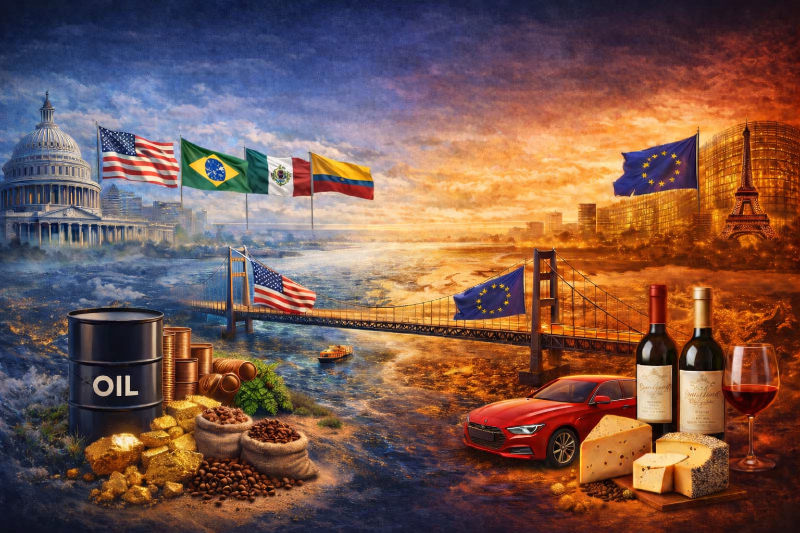
For half a millennium, the Atlantic Ocean was not a barrier, but the circulatory system of global power. Today, that center of gravity is shifting seismically toward the South China Sea, leaving Western democracies with an existential dilemma: either they integrate into an unprecedented economic structure—a Customs Union encompassing the United Kingdom, the European Union, and the Americas, from Alaska to Patagonia—or they accept their fate as an archipelago of museums and middle powers in an inevitably Asian century.
This proposal, which to skeptics sounds like bureaucratic utopia and to strategists like a lifeline, would entail the creation of the most powerful economic bloc in human history. A single market harmonizing tariffs, phytosanitary standards, and capital flows for more than 1.5 billion people. Yet the question lingering in the air is: Why, if the economic logic is overwhelming and the cultural roots are identical, does the project continue to die in diplomatic drafts?
To understand the potential of this union, one must look beyond simple trade balances. America — from the ice fields of Canada to the Argentine pampas — is not merely Europe’s neighbor; it is its most ambitious historical, legal, and philosophical extension.
“America is the favored daughter of the European Enlightenment, an experiment that ultimately surpassed the metropolis in scale and resources,” says Jean-Pierre Chevalier, senior analyst at the Paris Institute for Geopolitical Studies. The legal architecture of Latin America, rooted in Roman law and the Napoleonic Code, combined with Canada’s parliamentary system and American liberal democracy, creates a foundation of institutional trust that simply does not exist in the West’s relations with emerging Eastern powers.
This “shared heritage” is the most valuable strategic asset of our time. In a world where Chinese state capitalism offers cold efficiency in exchange for social control, the union of the Americas and Europe would represent a united front in defense of individual liberty and open markets. America provides the youthful demographics, resilient creativity, and natural resources that an aging, energy-dependent Europe needs to survive. In return, Europe offers capital, technological sophistication, and a regulatory framework capable of stabilizing American economies, freeing them from chronic cycles of inflation and volatility.
The urgency of this integration does not arise from nostalgia but from cold arithmetic. Asia already accounts for more than 50% of global GDP in purchasing power parity terms and is home to the most populous nations on the planet. The Regional Comprehensive Economic Partnership (RCEP), led by Beijing, has already consolidated the largest free trade zone in the world in the Pacific, setting the rules of the game for the 21st century.
Faced with this colossus, the United Kingdom finds itself at a particular crossroads. After its traumatic divorce from the European Union, the concept of “Global Britain” has struggled to find a solid anchor. A Transatlantic Customs Union would offer London the opportunity to reinsert itself at the heart of global trade without the political constraints of Brussels that motivated Brexit, acting as the natural financial pivot between the two hemispheres.
If the benefits are so evident, what force restrains this Leviathan? The answer lies in a triad of resistance: agriculture, sovereignty, and productive asymmetry.
The Green Wall of Protectionism: This is the “black hole” of any negotiation. Farmers in France, Poland, and Ireland view with absolute alarm the competitiveness of Mercosur’s giants. An Argentine steak or a ton of Brazilian grain is produced at a fraction of the European cost. Without a massive compensation fund or draconian harmonization of environmental standards, European domestic politics will continue to block any real opening.
The Regulatory Labyrinth: Europe regulates based on the “precautionary principle” (ban until proven safe), while the United States and Canada typically operate under “scientific evidence” (permit until proven harmful). Reconciling these two philosophies in critical sectors such as biotechnology, data privacy, and artificial intelligence is a Herculean task requiring a level of political will that currently seems absent.
The Shadow of Instability: For a customs union to function, basic macroeconomic convergence is required. The disparity between the stability of the euro and the volatility of the Argentine peso or the weakness of certain Andean currencies creates a financial contagion risk that Northern central banks are unwilling to assume without guarantees of deep structural reforms in the South.
Imagine, for a moment, the scale of this bloc. A biotechnology firm in Medellín could sell its patents in Berlin without regulatory friction. Lithium from South America’s “triangle” (Chile, Argentina, Bolivia) would directly power the German and French automotive industries, eliminating current dependence on Chinese refineries. Oil from Alberta’s sands and Brazil’s offshore fields would ensure that the Old Continent is never again hostage to energy supplies from authoritarian regimes in Eurasia.
This bloc would not only neutralize Asia’s scale advantage but would reclaim “standard-setting power.” If the Americas and Europe agree on a standard for green finance or algorithmic ethics, the rest of the world will have to adapt in order to access the most lucrative market on the planet. It would, in essence, turn the market into the West’s most sophisticated geopolitical weapon.
The concept of nearshoring — relocating supply chains to nearby and allied countries — finds its fullest expression in this union. Instead of European companies seeking cheap labor in Vietnam or Thailand, integration would allow production to shift to Mexico, Colombia, or Peru. This would not only reduce the carbon footprint of maritime transport but also strengthen American middle classes, ease migratory pressures, and create a belt of prosperity protecting the Atlantic’s flanks.
The 21st century will not belong to individual nations but to continental blocs with cultural coherence. Europe and America are united by the DNA of their institutions, their languages, and their unwavering faith in human dignity and democracy. Yet they remain separated by anachronistic bureaucracy and short-term electoral fears.
The creation of a Transatlantic Customs Union is not an optional economic choice; it is a decision of civilizational survival. The bridge between the continents has already been built by history, migration, and shared values. All that remains is for today’s leaders to have the audacity to cross it before the world’s center of gravity definitively shifts to the other side of the Pacific, leaving the Atlantic as an ocean of lost opportunities.