

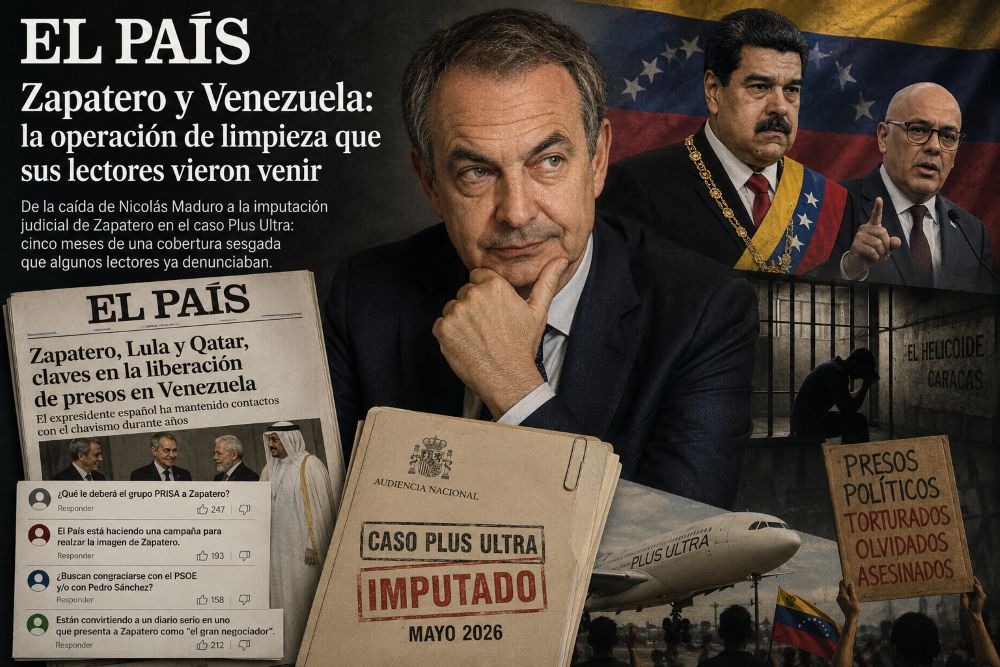
Before the Plus Ultra case placed José Luis Rodríguez Zapatero at the center of a judicial scandal, a section of El País readers had already detected something odd in the paper’s coverage of Venezuela. They did not do so in political op-eds or specialized reports, but in the comments on the articles themselves.
“What does the PRISA group owe Zapatero?” one reader asked in the comments of an article about Zapatero. Another accused the paper of taking part in a campaign to “burnish Zapatero’s image.” A third wondered whether PRISA’s owners were seeking to “ingratiate themselves with the PSOE” and/or with Pedro Sánchez. In another comment, a user summed up the suspicion bluntly: El País was turning a paper that had once been serious into a medium obliged to present Zapatero as “the great negotiator” of the Venezuelan cause.
The irritation of El País’s readership stemmed from the campaign the paper seemed to be waging to portray Zapatero’s negotiating role as the indispensable piece of the process underway in Venezuela. Article after article circled the same idea: El País was not simply reporting on Zapatero’s role in Venezuela; it was helping to construct a benevolent version of that role.
During the five months between the military capture of Nicolás Maduro by U.S. special forces, on January 3, 2026, and the former Spanish prime minister’s judicial indictment by the National Court in May of that year, the PRISA Group–owned paper published a series of pieces that form a homogeneous editorial line regarding the former Spanish head of government.
The pattern was recognizable: attributing to Zapatero merits that belonged, at least to a greater degree, to other actors; presenting his closeness to Delcy and Jorge Rodríguez as diplomatic virtue rather than political problem; diminishing the voice of the Venezuelan opposition; and, finally, shifting the focus from the victims of Chavismo toward the supposed nobility of the mediator.
The problem was no small one. In Venezuela there were not only freed political prisoners. There were also political prisoners tortured, sick, abandoned and dead in Chavista jails. To turn that tragedy into a story of successful diplomacy implied something graver than editorial bias: it meant erasing the victims from the center of the narrative.
Five days after U.S. commandos entered Caracas, eliminated the presidential guard and took Nicolás Maduro into custody, El País published the report “Zapatero, Lula and Qatar, keys to the release of prisoners in Venezuela,” bylined by Juan Diego Quesada and Naiara Galarraga Gortázar.
The headline established a political hierarchy from the outset. Instead of placing the U.S. operation, opposition pressure or the collapse of Maduro’s power in the foreground, the paper cast Zapatero, Lula and the government of Qatar as the protagonists.
The piece itself acknowledged, in its body, the decisive fact: the capture of Maduro in Caracas by U.S. special forces. Yet the account ended up attributing to Zapatero, Lula and Qatar a “leading role” in the release of prisoners.
That bias was not innocent. If the fall of the regime was the principal cause of the new scenario, Zapatero appeared as a secondary actor. If, on the other hand, the focus was placed on mediation, the former prime minister could be presented as a key figure in the Venezuelan opening.
The central source backing that role was Jorge Rodríguez, president of the Chavista National Assembly and, until a few days earlier, one of Nicolás Maduro’s chief political operators. That is, a figure of the apparatus that for years had sustained the repressive system which filled the jails with political prisoners.
The Venezuelan opposition, by contrast, was subjected to a false equidistance. The report noted that María Corina Machado criticized Zapatero and that the two held “opposing positions”: she in favor of pressure against Chavismo; he a defender of dialogue. The framing reduced a problem of democratic legitimacy to a difference of methods.
It was not merely a matter of style. The article did not give the necessary weight to the electoral fraud denounced by the opposition, to the role of the tally sheets gathered by Edmundo González, nor to the criticisms accumulated against Zapatero for having endorsed for years an interlocution that many in the opposition considered functional to Chavismo.
Two days later, El País published “The family of Rocío San Miguel highlights the dialogue and diplomacy that brought about her release,” bylined by Juan Diego Quesada.
Rocío San Miguel—lawyer, activist and Spanish-Venezuelan citizen—had spent two years in El Helicoide, one of the most symbolic centers of Chavista repression. Her detention had been denounced by human rights organizations as arbitrary and tied to an accusation without guarantees.
The report included an essential fact: San Miguel was under a ban on speaking publicly. No one could speak on her behalf, attribute opinions to her, or interpret her personal, legal or health situation. Even so, the family statement that anchored the piece thanked the Venezuelan government, the Spanish government and Zapatero.
That gratitude deserved a far more critical reading. What political value does a statement produced in a context of a Chavista judicial ban hold? Can it be read as a free declaration when the victim remains subject to restrictions? What does it mean to thank the very state apparatus that held her prisoner for two years?
El País did not make those questions the axis of its coverage. It preferred to insert the case into the general narrative of useful diplomacy.
The underlying problem is that the emphasis on the releases concealed a graver reality: not all political prisoners came out of the Chavista jails alive. For years, opponents, soldiers, activists and citizens detained for political reasons died in the regime’s custody, in penitentiary or intelligence centers marked by reports of torture, isolation, lack of medical care and cruel treatment.
Turning the release of some prisoners into a diplomatic victory for Zapatero, without recalling those who died awaiting justice, concealed a reality difficult for the paper itself to acknowledge, and instead foregrounded it as a story of successful management.
On January 15, barely a week after the first piece, El País ran the column “A Nobel for Zapatero” in its opinion section. To this day many wonder whether its author, Daniel Gascón, wrote a sarcastic article or was genuinely calling for the Nobel to be given to the former Spanish prime minister for his contribution to peace in Venezuela.
The leap was significant. Zapatero no longer appeared merely as a discreet mediator or a necessary interlocutor. The column elevated him to the symbolic terrain of international recognition. The proposal was especially striking because the 2025 Nobel Peace Prize had gone to María Corina Machado, one of the voices that for years had most harshly questioned the former Spanish prime minister’s role in Venezuela.
The column—whether Gascón was compelled to write praise of Zapatero and found in irony the best way to escape that unethical and immoral mission—thus fit into a clear editorial sequence: first, Zapatero as the key to the releases; then, Zapatero as humanitarian mediator; finally, Zapatero as a figure deserving moral canonization.
By then, the Venezuelan opposition’s criticisms were nothing new. Nor were the suspicions about the former prime minister’s relations with Chavismo. But the paper chose another angle: that of the patient, misunderstood and useful man.
On February 9, El País published “Zapatero’s 40 hours in Venezuela,” a chronicle of his visit to Caracas after Delcy Rodríguez assumed office as interim president of the regime that succeeded Maduro.
The text reproduced the former prime minister’s statements defending that the time had come for part of the work he had done over the years to be known. It also recorded his claim to have “great confidence” in Delcy Rodríguez.
The phrase was extraordinary. Delcy Rodríguez was not a marginal figure. She had been vice president of Maduro’s regime, a central piece of Chavismo and an internationally sanctioned leader. That a former Spanish prime minister should boast of personal confidence in her deserved severe scrutiny.
Yet the report treated that closeness as diplomatic capital. What for many Venezuelans was an alarm signal appeared, in the chronicle, as proof of access, influence and managerial capacity.
The piece also included a revealing fact: five months earlier, Zapatero had traveled secretly to Caracas to negotiate the release of political prisoners and had returned to Madrid “empty-handed.” That earlier failure was key to understanding the real limits of his mediation. If the releases came after Maduro’s fall, and not during the prior secret efforts, the centrality attributed to the former prime minister was debatable.
But the paper did not develop that contradiction. The failure was absorbed into the epic of the persistent mediator.
On March 17, El País published “Zapatero returns to Caracas to accompany the application of the amnesty law.”
The verb in the headline was telling. Zapatero was not going to supervise, verify or oversee. He was going to “accompany.” And to accompany, in that context, meant standing alongside the Chavista power charged with administering the amnesty.
The choice was no small matter. An amnesty law managed by the same political apparatus that had jailed, persecuted and silenced opponents demanded especially critical coverage. One had to ask who was left out, what conditions were imposed, what responsibilities were erased, what victims remained without justice and what became of the prisoners who did not survive.
The problem is that reconciliation, when formulated without truth or accountability, can become an alibi. In Venezuela there were freed political prisoners, yes. But there were also deaths in custody, destroyed families, the tortured, the exiled and years of persecution. Coverage that speaks of peace without placing that reality at the center ends up softening the nature of the regime that produced the tragedy.
The most explicit moment of the sequence came on April 12, with the interview “Jorge Rodríguez: ‘The most important thing now in Venezuela is the economy,’” bylined by Javier Lafuente and María Martín.
The interviewee was not a neutral actor. Jorge Rodríguez was Delcy Rodríguez’s brother, president of the Chavista National Assembly and one of the chief political operators of Maduro’s regime. His testimony about Zapatero had to be read, therefore, with special caution.
In the interview, Rodríguez declared that Spain had in Zapatero an “extraordinary and plenipotentiary ambassador in friendship with Venezuela.” He added that one day everything Zapatero had done for the country’s peace—and, above all, for the opposition sectors—would be known.
The phrase was politically explosive. That one of the central faces of Chavismo should describe a former Spanish prime minister in such terms could not be treated as simple praise. It should have opened a question: what does it mean for a former democratic head of government to be celebrated that way by the apparatus of a regime accused of jailing, torturing and persecuting opponents?
The interview, however, did not sufficiently problematize that legitimization. Nor did it incorporate a robust counterpart from the Venezuelan opposition. There was no serious confrontation with the denunciations of those who saw in Zapatero not a mediator, but an uncomfortable ally of Chavismo.
The result was a piece that allowed one of the regime’s figures to partially launder himself and, at the same time, reinforced the image of Zapatero as an indispensable bridge.
On March 23, El País published “Zapatero distances himself from the consultancy under investigation in the Plus Ultra case: ‘I didn’t know who the clients were,’” bylined by Irene Dorta and Manuel Viejo.
The headline already contained a problem: “distances himself” presented as fact what was in reality Zapatero’s own version. The body of the text contained important data: the former prime minister had been paid 463,000 euros between 2020 and 2025 by the consultancy Análisis Relevante, under investigation for money laundering; his partner Julio Martínez Martínez had been arrested; and Zapatero claimed to be unaware of relevant details of that company’s business.
But, once again, the treatment was indulgent toward his explanations. The report also recorded an especially significant statement: Zapatero said he was a “personal friend” of Delcy and Jorge Rodríguez, and claimed to know very well what they had done and how they had supported him.
That confession deserved fuller development. This was not a distant diplomatic relationship, but personal friendship with two central figures of Chavismo. And yet no strong voice from the Venezuelan opposition appeared in the piece responding to those words. Nor was there a sufficient reminder of the political responsibilities of the apparatus to which the Rodríguez siblings belonged.
The contradiction was evident: the former prime minister defended his closeness to those who represented the regime that jailed opponents, while the paper avoided turning that closeness into the central problem.
When the judicial indictment was already a fact, El País published the column “Of the Fallen Tree.”
The rhetorical move was transparent: shifting the focus from the accused toward those who criticized him. The text suggested that many opined on Zapatero driven by sectarianism, a desire for condemnation, or an inability to nuance. Criticism of the former prime minister was thus partially delegitimized before even getting to the substance of the case file.
The operation was familiar: presenting the investigated party as the victim of a crowd eager to see him fall.
But that approach omitted something essential. The criticisms against Zapatero did not begin with the Plus Ultra case. In Venezuela they had been voiced for years. They came from opposition leaders, exiles, relatives of political prisoners, victims of repression and citizens who considered that the former prime minister’s mediation had served to give international oxygen to Chavismo.
When the judicial scandal broke, El País changed its tone. It began to cover at greater length the investigation’s data, the figures in the police report, the payments, the companies, the accounts and the connections in the case. Where before there had been diplomatic narrative, there began to be judicial information.
The turn was notable. But it came late.
A review of the coverage allows three main features to be identified.
First, the systematic attribution to Zapatero of a central role in processes that depended on a much broader balance of forces. The releases of political prisoners occurred after Maduro’s fall, international pressure and the weakening of the Chavista apparatus. To present them primarily as the fruit of the mediation of Zapatero, Lula and Qatar implied a debatable causal hierarchy.
Second, the normalization of the former prime minister’s closeness to Delcy and Jorge Rodríguez. That relationship was presented as a diplomatic tool, not as a bond that demanded difficult questions. But in foreign policy, and all the more so when facing a repressive regime, closeness to the perpetrators cannot be treated solely as privileged access.
Third, the insufficient centrality of the victims. The coverage spoke of freed prisoners, of reconciliation and of amnesty, but it did not place with equal force the prisoners who died, the tortured, the sick left without care, the silenced relatives and those who spent years in Chavista jails while patience was demanded in the name of dialogue.
That third point is the gravest. Because the debate is not only whether Zapatero was useful or not. The question is whether the journalistic narrative ended up using the prisoners’ suffering as a backdrop to rehabilitate a Spanish politician.
It is not possible to assert, on the basis of the published texts alone, that there existed a formal instruction from the editorship of El País or the PRISA Group to protect Zapatero. Such an accusation would require internal documents, direct testimony or evidence that is not part of the available public material.
Nor can it be asserted that all the journalists involved acted with the intention of covering anything up. Editorial bias does not always arise from an explicit order. Sometimes it is expressed in the selection of sources, in the headlines, in the verbs chosen, in the questions that are not asked and in the hierarchy assigned to facts.
What can be asserted is that El País’s coverage between January and May 2026 showed a notable homogeneity of approach: Zapatero appeared again and again as mediator, facilitator, man of peace or victim of unjust criticism, while the objections of the Venezuelan opposition and the memory of the victims were left in the background.
The impartiality that arrived after the indictment does not erase the preceding months. That El País began to cover the Plus Ultra case in detail once the judicial file already placed Zapatero at the center of the scandal does not eliminate the prior problem: for weeks, the paper contributed to building a favorable image of the former prime minister in Venezuela.
And it did so in an especially delicate context. This was not an ordinary diplomatic dispute. It was a country where there were political prisoners, torture, deaths in custody, mass exile and institutional destruction. In that setting, presenting Zapatero as the architect of peace without severely examining his closeness to Chavismo was an editorial decision of enormous weight.
Readers perceived it. They wrote it in the comments. They asked what PRISA owed Zapatero, why it insisted on crediting him, and why the paper seemed bent on cleaning up his image.
Perhaps they did not have all the data. But they had detected the framing.
The Zapatero case forces a question that goes beyond the former prime minister: what happens when a newspaper of record decides to turn into a respectable mediator a figure questioned for years by the victims and opponents of a dictatorship?
The answer lies in the sequence itself. First, the kindly narrative. Then, the readers’ irritation. Finally, the judicial scandal.
We do not know whether PRISA wanted to save Zapatero. What we do know is that, for months, El País published coverage that, in practice, helped to present him in the most favorable light possible.
The question is not only why the paper spoke so much about Zapatero. The question is why it spoke about him without placing at the center those who mattered most: the freed prisoners, the sick prisoners, the tortured, the exiled, the silenced families and the political prisoners who died in Chavista jails while the diplomacy of silence asked for patience.
That self-criticism, at El País, has not yet arrived.