

The United States has the sovereign right to control its borders and deport those who are in its territory without legal status. That principle is not in dispute. What should be discussed, as a matter of urgency, is the way in which the State exercises that right and the institutional cost it is willing to pay to do so.
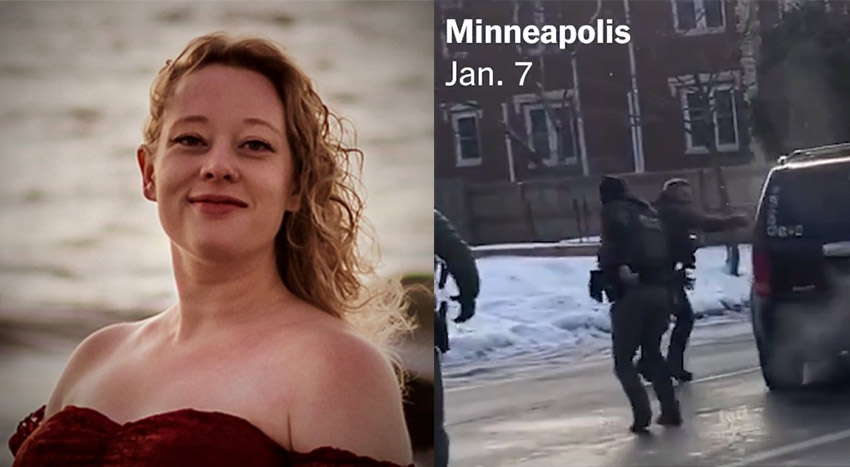
This is not about a particular administration. Under Democratic and Republican administrations, Immigration and Customs Enforcement (ICE) deported hundreds of thousands of people. That is part of the country's modern history. The difference today is not the declared objective, but the method and the internal climate that is being built around immigration and that yesterday caused the death of an American citizen: Renee Nicole Good, who was intervened and surrounded by ICE agents, despite the fact that her profile did not correspond to the racial stereotype that today, in the United States, turns a person into an object of intervention.
It is claimed that the immigration operations are aimed at "dangerous criminals", members of organizations such as the Mara Salvatrucha (MS-13) or the Tren de Aragua. But the operational modality shows otherwise: raids on workplaces, farms, factories, restaurants and hotels. Does Homeland Security Secretary Kristi Noem really believe that a criminal from these transnational gangs is going to be found harvesting tomatoes, cleaning a bakery or working on an assembly line?
Organized crime is not fought with spectacles or with operations of hundreds of agents taking over streets and shopping malls. It is fought with intelligence, financial investigation and focused police work. Public threats and "hunting" rhetoric do not weaken criminals; on the contrary, they push them to hide better, tighten their security and operate more clandestinely. ICE is not going to find a criminal boss in a taqueria, even less so when those criminals know that the agency can be everywhere.
The reality is that if today the United States has close to 10 million undocumented workers, it is because for decades they were functional and essential to its economy. They arrived under Republican and Democratic administrations: under Bush Sr. and Jr., under Clinton, under Obama and also during the first Trump administration. Today they are treated as latent threats, but yesterday they were needed to mow our neighborhood lawns, clean our mansion pools or walk our pets.
In this hunt for immigrants, we are all suspects. Today we must prove at any moment whether we were born in the United States or carry a green card; otherwise, we may end up in jail or be deported.
Herein lies the root problem: the weakening of due process. When a state force acts under the logic of "stop first and check later," the burden of proof is reversed. It is no longer the government who must justify an intervention, but the individual who must prove, on the spot, that he or she legally belongs to the country. Such role reversal is dangerous in any democracy.
The United States does not have a tradition of intimidating internal controls. It is not Russia, where arbitrary police interception is a daily occurrence. It is not Iran, where the citizen is accustomed to being surrounded, interrogated and detained without explanation. In 250 years of democratic history, this country has not systematically used its federal forces against its own civilian population as a method of internal political control. Therefore, when it happens, the psychological impact is devastating.
The case of Renee Nicole Good, a 37-year-old U.S. citizen, mother and daughter, marks a turning point. She died during an operation linked to federal agents. The videos show a woman surrounded by armed men; it is reasonable to believe that she was scared and trying to evade the situation from her vehicle. There is no clear evidence that she attempted to run over an agent; what is seen is that the officer had time to aim and fire three shots at her.
That fact, regardless of what the investigation determines, breaks a fundamental tradition: law enforcement exists to protect citizens, not to kill them. When a citizen dies in a context of federal intervention without having committed any crime, the problem ceases to be individual and becomes institutional.
Some will say it was an "isolated incident". History shows that isolated incidents do not exist when they are repeated in the same pattern: aggressive operations, agents who do not clearly identify themselves, confusion between administrative orders and judicial orders, and an official narrative that justifies the use of force before clarifying the facts.
Are ICE agents under pressure to meet detention quotas? If so, we are dealing with officers under a high level of job stress. At the end of the day, they are employees responding to superior orders. Can they act under pressure? Are they being trained to see enemies instead of citizens?
History teaches us that a democracy begins to expire when the police and armed forces cease to be beholden to the citizen and the institution they represent, and become obedient only to political power. Let's be clear: the hunt for immigrants is a political slogan repeated since the 2024 presidential campaign. Adequate rules of engagement are no longer followed, as in other administrations. Street spectacles are performed to show that an electoral promise is being fulfilled: expel all undocumented immigrants.
As has happened in authoritarian regimes, there is a risk of creating a security corps that, in a manner dangerous to democracy, does not hesitate to shoot at a citizen who, out of fear or contempt, did not allow herself to be intervened.
The United States does not need a climate of internal war to apply its immigration law. This path only deepens the division and can provoke an irreversible distancing between the citizens and the police forces that should protect them.