

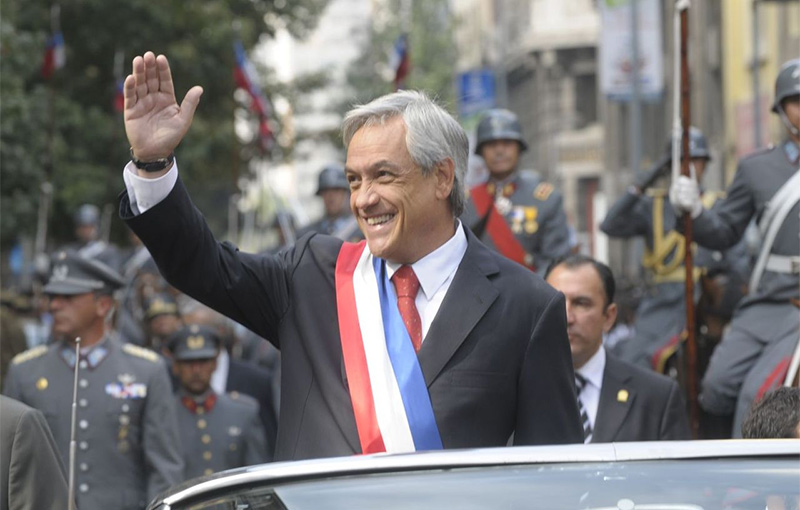
Two years after the tragic plane crash at Lake Ranco, the figure of Sebastián Piñera continues to generate debate, analysis, and sharply contrasting readings. A successful businessman, pragmatic politician, and two-time President of the Republic, Piñera embodied—like few others—the tensions of Chile’s contemporary right: between the economic liberalism inherited from the military regime and the need for democratic legitimacy in post-dictatorship Chile.
On February 6, 2024, Piñera died when the Robinson R44 helicopter he was piloting capsized over the waters of Lake Ranco, in the Ilihue area. His death not only shocked the country; it also triggered a necessary exercise in historical reassessment of a career defined by economic power, political ambition, and an always ambiguous relationship with Chile’s political center.
Born on December 1, 1949, Miguel Juan Sebastián Piñera Echenique was the third child of José Piñera Carvallo and Magdalena Echenique Rozas. His father, a prominent member of the Christian Democratic Party, served as ambassador during the government of Eduardo Frei Montalva and was among the party’s founders. That environment shaped Piñera early on, giving him a cultural and emotional closeness to the political center.
Yet the family story was also marked by deep contradictions. While his father represented the ethos of republican public service, the Piñera family supported the institutional breakdown of 1973. Sebastián himself was in Boston on September 11 of that year, beginning his PhD in Economics at Harvard University. There he trained under figures such as Kenneth Arrow, consolidating a liberal outlook that, over time, he would regard as incompatible with what he saw as the Christian Democrats’ immobility.
A little-known episode—yet key to understanding Piñera’s complexity—took place on August 27, 1980. That night, Eduardo Frei Montalva led a massive rally at the Teatro Caupolicán to oppose the Constitution promoted by the dictatorship. In the audience, seated in the front row, were José Piñera Carvallo and his son Sebastián.
The gesture reveals a persistent duality: while Piñera benefited from the economic model established under the regime, he maintained visible ties to the democratic opposition. Eight years later, he would declare that he voted “No” in the 1988 plebiscite—a credential that allowed him to craft his image as a right-wing figure compatible with liberal democracy.
Piñera’s fortune—estimated at $2.7 billion by Forbes in 2017—was the result of strategic business decisions. After completing his doctorate, an economic advisory job in Bolivia enabled him to amass the initial capital to found his first company, the construction firm Toltén.
The decisive leap came later:
Banco de Talca: general manager between 1979 and 1980. In 1982 he faced legal proceedings for fraud and violations of the Banking Law, remaining a fugitive for 24 days before the Supreme Court granted a writ of protection.
Bancard: in the 1980s he drove the mass adoption of Visa and MasterCard credit cards in Chile.
LAN Chile, Chilevisión, and Colo-Colo: he accumulated strategic stakes across key sectors, consolidating broad-based economic power.
This growth—built in the dictatorship’s final years—fed decades of criticism over conflicts of interest that would shadow his political career.
With the return to democracy, Piñera emerged as one of the central figures of Renovación Nacional. He served as senator for Santiago Oriente (1990–1998) and was part of the so-called “Patrulla Juvenil,” alongside Andrés Allamand and Evelyn Matthei, aiming to distance the right from hardline Pinochetism.
After two failed presidential bids in 2005, he won in 2009 against Eduardo Frei Ruiz-Tagle, becoming the first right-wing president democratically elected since 1958. In 2017, he secured re-election.
His first term (2010–2014) was defined by crisis management: the 27F earthquake and the rescue of the 33 miners projected an image of efficiency and technocratic leadership.
His second term (2018–2022) was far more turbulent. Despite the success of the COVID-19 vaccination campaign, he faced the 2019 Social Outburst, the country’s largest political crisis since the return to democracy. The Agreement for Peace and the constitutional process it set in motion marked an institutional turning point.
During visits to Peru, President Piñera would often mention—proudly—a fact that historians and genealogists have documented with precision: his descent from Inca royalty. Through his maternal branch, the Echenique family, the former president traced his family tree to the emperor Huayna Cápac.
The connection is established through the princess (ñusta) Leonor Yupanqui, daughter of the emperor, who joined the conquistador Juan Ortiz de Zárate. Many Chilean families descend from them, including the Echeniques. Although President Piñera referred to it with humor, Alan García once quipped that with such imperial ancestry, the Piñera Echeniques could just as well lay claim to Cusco.
The president died as he governed: in command. His state funeral sealed a figure impossible to reduce to a single reading. An audacious businessman, a managerial president, and a controversial politician, his legacy reflects the tensions of a Chile in permanent transition. Two years after his death, Piñera remains the uncomfortable mirror of a right that sought to reconcile power, democracy, and markets in a country still debating its own historical direction.