

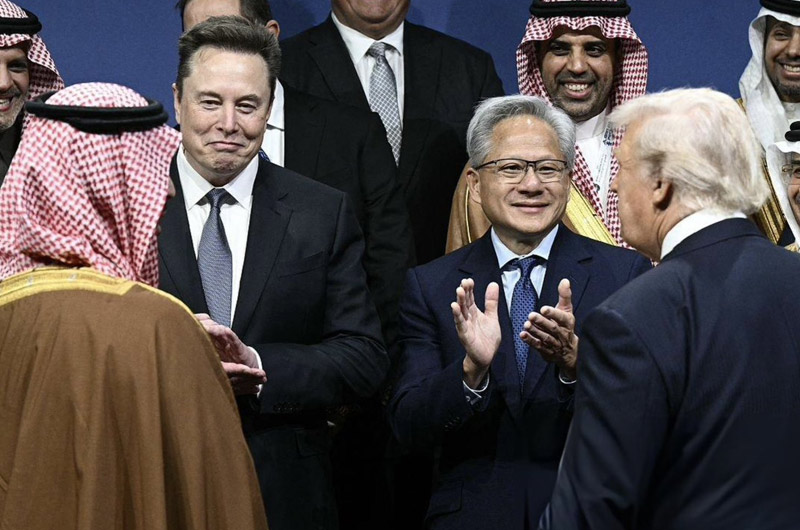
In a setting designed to send a geopolitical message, the Minister of Communications and Information Technology of the Kingdom of Saudi Arabia opened a conversation with two of the most influential figures in global technology: Elon Musk, CEO of Tesla, SpaceX, and xAI, and Jensen Huang, founder and CEO of Nvidia.
The meeting aimed not only to discuss innovation but to announce a new phase in the relationship between Saudi Arabia and the United States, marked by a strategic transition from an economy powered by fossil fuels to one driven by artificial intelligence, robotics, and data centers.
Riyadh wants to position itself as the physical engine of global AI, relying on American technological talent and leadership.
From the beginning, the minister described this moment as “the greatest alliance in the history of Saudi Arabia and the United States.” First it was oil fueling the industry of the 20th century; now it will be capital, energy, and land fueling the “intelligence age.”
The central concept was AI factories. According to Jensen Huang, generative AI marks a historic shift: previously, systems retrieved information that already existed. Now software is generated in real time, adapted to the context, the user, and the problem. Every response is unique.
This requires AI factories distributed around the world, capable of training massive models and generating personalized outputs. Saudi Arabia aims to become one of these global hubs, evolving from data refineries to full-scale intelligence factories.
Musk explained that his goal is not to disrupt existing industries but to create entirely new ones. He pointed out that before SpaceX, reusable rockets did not exist, and that Tesla emerged at a time when there were no appealing and accessible electric vehicles.
Right now, he said, there are no truly useful humanoid robots. His prediction is that Tesla will build the first functional humanoid robots, capable of working both in homes and in factories.
According to Musk, this industry will be larger than the smartphone market, because everyone will want one—perhaps more than one. In the long term, he believes the combination of AI and robotics will create an economy in which work becomes optional, and money gradually loses relevance.
Huang agreed that AI will profoundly reshape work but emphasized that in the short and medium term, jobs will not disappear—they will transform.
He cited radiology as an example. For years it was predicted that radiologists would be replaced by AI, but the opposite has happened. Medical image analysis has become more efficient, and more radiologists are being hired because they can treat more patients and more complex cases.
For Huang, AI will make people more productive but also busier, because they will have more ideas and more projects they can pursue with enhanced tools.
The minister outlined Saudi Arabia’s ambition: to become the country with the largest physical infrastructure for AI, offering energy, capital, and land to build massive data centers.
During the conversation, several key projects were announced. xAI and Saudi Arabia will build a 500-megawatt data center, beginning with an initial 50-megawatt phase, using Nvidia hardware.
Humane, supported by Nvidia and AWS, will launch operations in the Kingdom with the goal of reaching one gigawatt of capacity.
Nvidia will use Omniverse to create industrial digital twins, where robots can learn in simulated environments before operating in the real world. Work will also advance on supercomputing for quantum simulation, an area requiring enormous computational power.
One of the final questions was straightforward: “Is AI in space possible?” Musk replied that not only is it possible, but inevitable.
He argued that an advanced civilization must harness far more of the Sun’s energy. Earth receives only a tiny fraction of it, so any system aiming for extremely high levels of computation will need to expand into space through solar-powered satellites with embedded chips.
Musk stated that within five years, AI computing in space could be cheaper than on Earth, thanks to constant sunlight, radiative cooling, and the absence of heavy support structures for solar panels.
The final question was whether the world is experiencing an AI bubble. Huang rejected the idea, arguing that current growth is driven by three structural changes.
The first is the end of Moore’s law and the slowing performance of CPUs. The second is the global migration toward accelerated computing, where GPUs now dominate the world’s top supercomputers. The third is the shift from traditional recommendation systems to generative and agentic AI, which not only suggests content but also interacts and takes action.
For Huang, demand for computing power is not speculative—it is a direct consequence of how modern computation works.
The minister concluded the meeting by describing this stage as an evolution of 92 years of cooperation between Saudi Arabia and the United States. The historical equation is shifting: from fossil energy to digital energy, and now to energy for intelligence.
Riyadh wants to be the physical engine powering global AI, while companies like Tesla, xAI, and Nvidia lead technological design. It is an alliance that seeks to transform the oil of the 20th century into the terawatts of computation of the 21st century.