

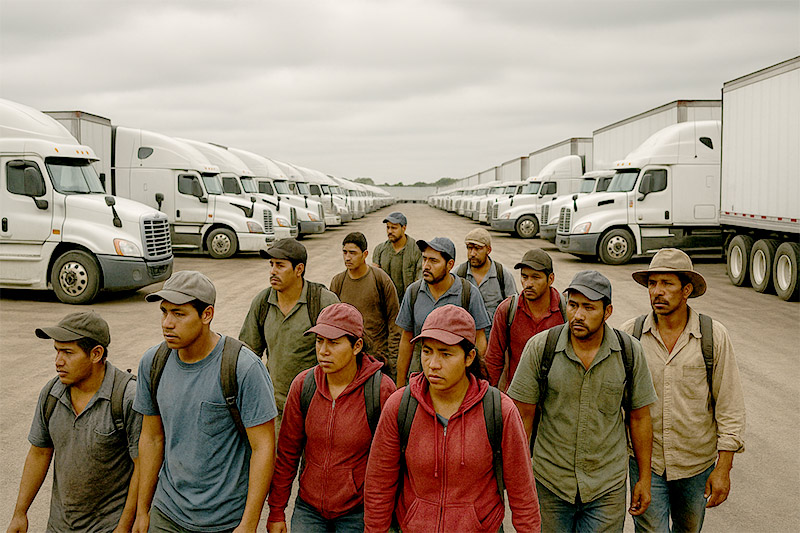
At a distribution center on the outskirts of Phoenix, three hundred trucks sit parked in perfect rows under the desert sun. They aren’t missing fuel, parts, or cargo. What they’re missing are drivers.
That motionless image has become the most visible symbol of an economic crisis quietly accelerating beneath the surface: the head-on collision between the new protectionist trade policy and the administration’s aggressive immigration strategy.
While Wall Street cheers deregulation and corporate tax cuts, logistics managers, farmers, and small businesses confront a far harsher reality. The U.S. supply chain—already strained by global tariffs of 10% to 20%—is now breaking from within due to a factor few economic models measured accurately: fear.
The promise to “close the border” and the escalation of workplace raids in industrial hubs have had an immediate impact on the labor force.
According to the American Trucking Associations, the industry already faced a shortage of 80,000 drivers before 2025. Today, with the threat of mass deportations and a climate of constant surveillance, that shortage has surged and expanded across the entire logistics ecosystem.
Fear as an economic force:
Thousands of undocumented workers or mixed-status workers—the backbone of warehousing, packing, and last-mile delivery—have stopped showing up for work. Others have shifted into informal jobs or moved to states with fewer enforcement operations.
What political rhetoric frames as “cracking down on illegal immigration,” logistics operators experience as something far simpler: unstaffed shifts, unmanned routes, and warehouses running below capacity.
The ports of Los Angeles and Long Beach are reporting record import volumes as companies rush to bring in goods before tariff hikes take effect in January. But that surge in cargo is now sitting idle on the docks.
In practice, the U.S. is importing more—only to pay more for goods that arrive late or never reach store shelves.
If logistics is near collapse, agriculture is already deep in crisis.
In California’s Central Valley and across Florida’s farmland, producers describe acres of fruit and vegetables left unharvested. The agricultural labor force—historically made up largely of immigrant workers—has evaporated under intensified immigration enforcement in rural areas.
Robert Guenther, an executive in the fresh-produce industry, put it bluntly: “It doesn’t matter how many tariffs we impose to protect American farmers if there’s no one to harvest the crops. Food is rotting in the fields while grocery store prices climb.”
American consumers now face a true “inflation pinch” heading into the holiday season and early 2026:
1. External costs: Imported products are more expensive because of rising tariffs.
2. Internal costs: Domestic goods—especially food and labor-intensive services—are pricier because:
* labor shortages force businesses to raise wages to unsustainable levels, and
* many producers cut output due to an inability to operate normally.
The result: the political promise to “protect the American worker” leaves the American consumer with emptier shelves and higher bills.
The economic theory behind the new tariff wave was simple: make imports more expensive to encourage *reshoring*—the return of factories and jobs to U.S. soil.
On paper, it sounded like patriotic reindustrialization. In practice, supply-chain experts point to a fundamental flaw: you can’t rebuild an industrial base without workers.
In Arizona and Ohio, the construction of new semiconductor and battery plants—the crown jewels of the new industrial policy—has slowed significantly. Builders cite the lack of qualified tradespeople and essential labor, another sector heavily supported by immigrant workers.
Breaking the cycle:
- Companies cannot hire the personnel they need to operate at full capacity.
- Investment projects are delayed or scaled down.
- Productivity fails to grow at the promised pace—yet costs continue rising.
Goldman Sachs estimates that a sharp, sustained reduction in immigration could shave 0.5 percentage points off projected GDP growth for 2026—a meaningful blow to an economy already on uncertain footing.
Behind this crisis lies more than trade and immigration policy. It reflects a vision of executive power that uses “national security” as a master key for reshaping the economy.
After 9/11, Dick Cheney’s vice presidency became a laboratory for expanding presidential authority under the banner of the “war on terror,” with measures that widened executive discretion and weakened internal checks.
Today, with different language and different targets, the logic feels unsettlingly familiar:
The result: decisions crafted at the political center—often without deep debate about their economic impact—are now affecting something as mundane as the price of milk or winter produce availability.
As 2025 draws to a close, the American supply chain is no longer a story about ships in China or chip factories in Taiwan. The crisis is, above all, domestic.
The “War on the Migrant” has ceased to be a campaign slogan and has become a line item in the balance sheets of trucking companies, retailers, and agricultural producers. For the average consumer, it will mean:
In a globalized economy, breaking even the smallest, lowest-paid link in the labor chain comes with a cost that—sooner or later—everyone ends up paying.