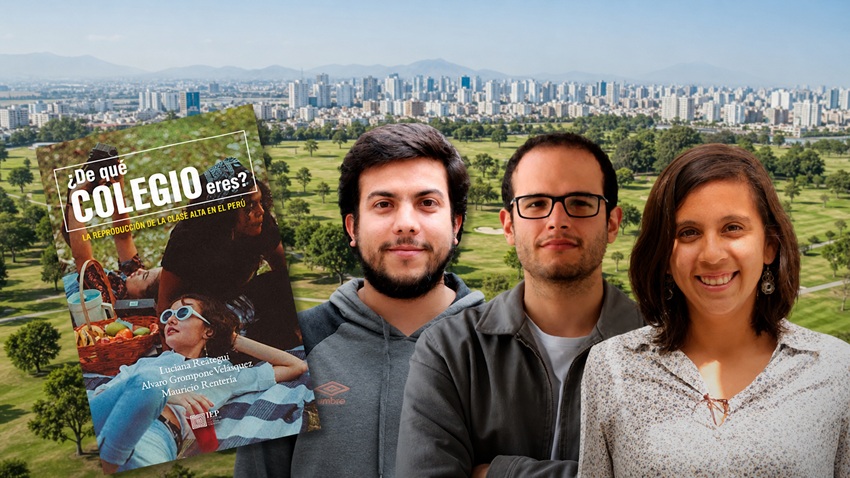
The key question that opens this text is: Is success truly the result of individual merit, or is it a consequence of privilege? The book What School Did You Go To? The Reproduction of the Upper Class in Peru, by Álvaro Grompone Velásquez, Luciana Reátegui, and Mauricio Rentería, challenges one of the most deeply rooted ideas in Lima society: that effort alone is enough to succeed.
Based on an analysis of the educational and professional trajectories of Lima’s elite, this study reveals a strong concentration of opportunities from an early age. One of its most striking findings shows that nearly 60% of leadership positions in major companies are held by graduates of elite private schools. Even more revealing is that around 65% of these profiles come from a group of ten elite schools in Lima, demonstrating that access to power is highly concentrated and far from equitably distributed.
Among the most prominent schools are Colegio Santa María Marianistas, Colegio Markham, Colegio Roosevelt, and Colegio San Silvestre. These institutions not only provide a high-quality education; they also serve as key spaces for socialization, where networks of contacts are built and accompany students throughout their lives.
The book shows that these networks are activated even before graduates enter the labor market. Approximately 70% of students from these schools gain admission to highly selective universities such as the Pontifical Catholic University of Peru, the University of Lima, and Universidad del Pacífico.
This pathway is not accidental: it is supported by academic preparation, language proficiency, specialized counseling, and, above all, a family environment that facilitates these routes.
At the international level, the study notes that around 30% of these students continue their studies abroad, especially in the United States and Europe, further strengthening their social and cultural capital. International education not only enhances their academic credentials; the networking they develop also allows them to access global networks that later become competitive advantages in the Peruvian labor market.
However, this privilege and these networks are not limited to the educational sphere. The book indicates that more than 55% of the profiles analyzed are members of exclusive social clubs such as Club Nacional or Lima Golf Club. These spaces function as extensions of school and university networks, where the same social circles interact and where friendships are consolidated—relationships that facilitate professional advancement, access to corporate boards, and positions of influence.
Another key finding is the low representation of non-privileged sectors in these positions. Fewer than 10% of those occupying senior management roles come from public schools, which reflects how the highest levels of the economic structure operate within restricted circles and exclusive spaces in Lima. This makes clear that, although meritocratic discourse remains dominant, starting conditions continue to be decisive.
The authors emphasize that nearly 75% of interviewees acknowledged having advanced professionally through personal contacts, reinforcing the idea that social networks play a central role in the reproduction of privilege. In many cases, opportunities to join boards or assume leadership positions are neither publicly announced nor openly competed for; instead, candidates are sought within closed circles.
In this context, the question often asked among members of the upper class when meeting someone—“What school did you go to?”—takes on a much deeper meaning. It is not merely a matter of curiosity, but rather a mechanism of social classification that quickly identifies a person’s background, networks, mutual acquaintances, and opportunities. It is an implicit code that organizes social interaction in Lima and, in many cases, determines access to—or exclusion from—certain spaces.
The authors also underline how these dynamics are reinforced by cultural factors. Belonging to certain schools does not only provide contacts; it also grants codes of behavior, ways of speaking, cultural references, and a sense of self-confidence that becomes crucial in competitive environments. This “symbolic capital” turns into an invisible yet powerful advantage.
In addition, the book shows that these networks tend to be highly closed and exclusive. In other words, social, professional, and even family relationships are built within the same circles, reinforcing homogeneity and making it difficult to open up to other sectors. This phenomenon contributes to the intergenerational reproduction of privilege, in which opportunities are inherited just as much as economic resources.
In terms of inequality, the impact is significant. When opportunities are concentrated within a small group, the talent of other sectors is left underused. This not only limits individual trajectories, but also affects the country’s development as a whole by restricting the diversity of perspectives in decision-making spaces.
The study in question does not deny the importance of individual effort, but it does question its ability to operate under equal conditions. While some people begin with access to quality education, consolidated networks, closed social spaces, and family support, others face structural barriers that hinder their progress. In this sense, meritocracy appears more as an ideal than as an applied reality.
In a city like Lima, where social fragmentation is evident at multiple levels—educational, urban, and economic—these conclusions are especially significant. The concentration of opportunities is not an isolated phenomenon, but part of a broader structure that systematically reproduces inequalities.
The final reflection posed by the book is as uncomfortable as it is necessary. If success does not depend solely on merit, then those who have had access to these privileged circuits bear an additional responsibility. It is not only a matter of recognizing privilege, but of acting accordingly.
Opening networks, democratizing opportunities, questioning exclusionary practices, and promoting more diverse spaces are some of the challenges that emerge from this study. Rather than reproducing the same closed circles, the invitation is to transform them into platforms for inclusion.
Because, in the end, the question is no longer only “What school did you go to?” but what we do with that answer—and what we do with the privileges obtained at different levels. In a Lima where opportunities remain shaped by one’s origins, the real challenge is to turn privileges into bridges rather than barriers.