For years, the economy in Peru was seen as something exclusive to specialists: complex figures, technical indicators, and debates far removed from everyday life. Today, in a context of political polarization, economic slowdown, and growing institutional distrust, that view is no longer sustainable. Economic data are no longer abstract: they are public policy decisions that directly impact employment, income, private investment, access to services, and quality of life.
That is the main contribution of Los 10 números que todo peruano debe conocer, by Roberto Chang and María Cecilia Villegas. The book does not seek to train economists but rather informed citizens. Its objective is to simplify economics, bring it closer to the public, and demonstrate that understanding numbers allows people to evaluate public policies, demand results, and actively participate in the country’s development.
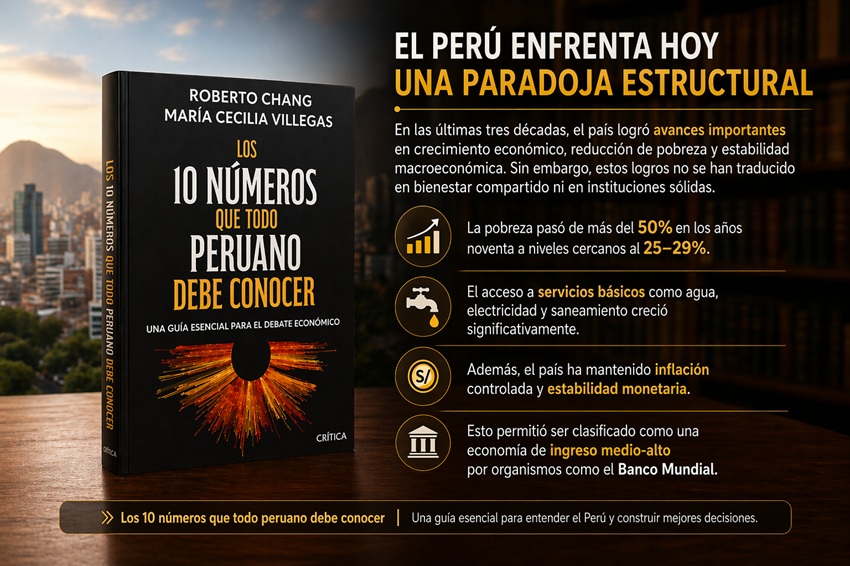
Peru faces today a structural paradox. Over the last three decades, the country has achieved significant progress in economic growth, poverty reduction, and macroeconomic stability. Poverty fell from more than 50% in the 1990s to levels close to 25–29%. Access to basic services such as water, electricity, and sanitation increased significantly. In addition, the country has maintained controlled inflation and monetary stability, which allowed it to be classified as an upper-middle-income economy by organizations such as the World Bank.
However, these macroeconomic advances are not reflected in citizens’ daily lives. Problems persist in health, education, infrastructure, and security. The perception among citizens is clear: the State does not respond to the level of development achieved. This disconnect between economic growth and social well-being explains much of the current frustration.
One of the main factors explaining this gap is informality. In Peru, around 70% of the working population is employed under informal conditions. This figure is significantly higher than in countries in the region such as Chile (30%) or Colombia (50%). Informality not only implies a lack of labor rights but also low productivity, limited access to the financial system, and scarce innovation. From a macroeconomic perspective, it reduces tax collection and limits the State’s ability to make quality investments. Therefore, informality is not just a labor issue but one of the main obstacles to Peru’s economic development.
Economic growth is another key element. Between 2005 and 2013, Peru grew at rates above 6% annually, driven by the boom in mineral prices and increased private investment. This period allowed for a rapid reduction in poverty and improvements in social indicators. However, in recent years, Peru’s economic growth has slowed to levels of 2–3%.
Although these figures may seem acceptable in developed economies, they are insufficient for a country with structural gaps. More importantly, the problem is not only how much Peru grows but how it grows. The economy continues to depend largely on mining and other primary sectors, without significant productive diversification. This limits value-added generation, reduces economic resilience, and perpetuates inequality. Thus, growth fails to translate into sustainable development.
Although poverty declined for years, the recent increase highlights the vulnerability of large segments of the population. There is a significant proportion of Peruvians who are not poor but are one “economic” or health shock away from becoming so. This highlights the need to strengthen social protection and promote inclusive and sustainable growth.
Tax collection is another critical indicator. In Peru, it represents approximately 16% of Gross Domestic Product, well below the OECD average (more than 30%) and also lower than several Latin American countries (around 20%). This level of collection limits the State’s capacity to finance public policies, but the problem is not only one of revenue. Low public spending execution, inefficiency in resource allocation, and the high number of unfinished projects reflect a lack of management.
In this scenario, private investment plays a central role. It represents between 18% and 20% of GDP and is the main driver of economic growth. However, its dynamism depends on political stability, legal certainty, and confidence. In recent years, political instability — with multiple presidents — regulatory uncertainty, and social conflicts have affected investment. Without investment, there is no sustained growth or generation of formal employment.
One of the most relevant findings of the analysis is low budget execution. It is estimated that up to one-sixth of the public budget is not executed. This reveals that Peru’s problem is not only a lack of resources but the inability to convert them into concrete results. Better public spending management could have a direct impact on poverty reduction, closing gaps, and improving public services.
The institutional contrast is evident. While entities such as the Central Reserve Bank of Peru have managed to maintain monetary stability and economic credibility for decades, other sectors of the State face problems of efficiency, continuity, and governance. This shows that Peru does have technical capacity, but fails to replicate it uniformly across the public sector.
Overcoming these challenges requires a comprehensive strategy. First, it is essential to promote formalization through increased productivity, access to credit, and adoption of technology. Second, it is necessary to strengthen the State’s capacity to implement public policies, incorporating meritocracy, results evaluation, and transparency. Third, a stable environment must be ensured to promote private investment and sustain long-term economic growth.
The analysis of these indicators leads to a clear conclusion: Peru does not face a shortage of resources but rather a problem of execution, institutional quality, and decision-making. Development depends not only on economic growth but on the ability to transform that growth into well-being for the population.
In this context, the role of the citizen becomes central. Understanding economics is no longer optional. It is a key tool to demand better policies, identify what works, and reject what does not produce results. Development is not built through discourse but through consistent decisions, evidence, and active participation.
Peru has the conditions to take a leap toward development. It has macroeconomic stability, natural resources, and accumulated experience. But that leap will not happen by inertia. It requires raising the level of public debate, prioritizing evidence over narrative, and assuming that real change occurs when data are transformed into sustained decisions and collective action.