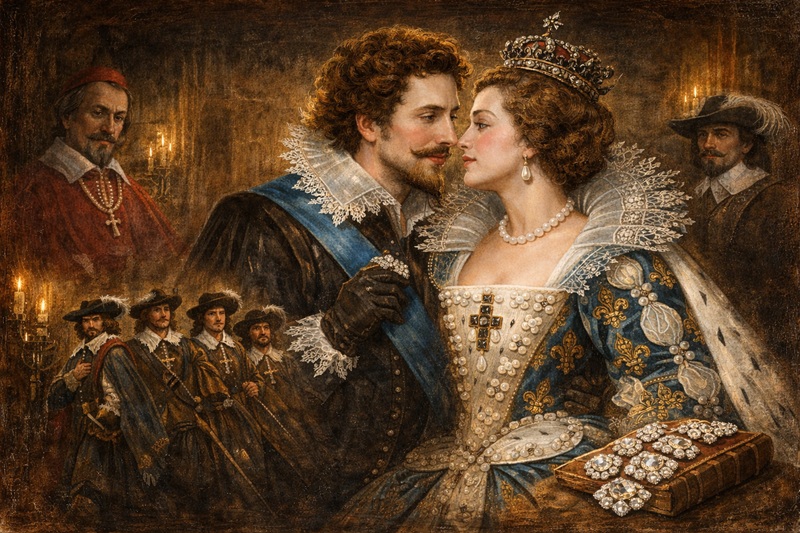
In 1844, Alexandre Dumas published The Three Musketeers and immortalized a story of love, espionage, and stolen jewels set in the court of Louis XIII. What few readers know is that beneath the fiction lies a perfectly documented diplomatic scandal: the encounter between George Villiers, first Duke of Buckingham, and Anne of Austria, Queen consort of France. An episode that nearly triggered a war, and one that historians still debate today.
George Villiers: The Royal Favourite Who Rose Too High
To understand the scandal, one must first understand the man. George Villiers was born in 1592 in Brooksby, Leicestershire, into a family of minor English gentry. His rise was, by any historical measure, extraordinary. Within just a few years, he went from an unknown young man to the most powerful figure in England after the king himself.
The secret of his success was the personal attention he inspired in James I of England, who named him Duke of Buckingham in 1623 and showered him with titles, wealth, and power. The exact nature of that relationship has been debated by historians for centuries: some documents and letters suggest it was intimate in character. James I referred to him publicly as his dearest favourite, comparing his affection to the love Christ bore for the apostle John. After the king's death, Villiers maintained his influence under Charles I, becoming the de facto chief minister of the English crown.
He was a Baroque man in the fullest sense: excessive, magnetic, and deeply ambitious. His presence at any European court caused a stir, and he used the impact of his own persona as a political instrument, with calculated deliberation.
Anne of Austria: A Queen Alone in a Foreign Court
On the other side of this story stands Anne of Austria (1601–1666), daughter of Philip III of Spain and wife of Louis XIII of France since 1615. Her position was deeply paradoxical: queen of one of the most powerful kingdoms in the world, yet without real power, surrounded by Cardinal Richelieu's spies, and married to a monarch who treated her with glacial indifference.
To make matters worse, in the early years of her marriage, the Duke of Luynes — Louis XIII's favourite — ordered all of Anne's trusted Spanish ladies-in-waiting removed from court and compelled her to adopt French customs, language, and even dress. Anne was thus doubly foreign: a stranger in her own palace and in her own marriage. This structural loneliness is essential to understanding why Buckingham's behaviour in 1625 caused such scandal, and such enduring speculation.
The Amiens Incident: When Reality Surpasses Fiction
In May 1625, Buckingham travelled to Paris on an official mission: to escort Henrietta Maria of France to England, where she was to marry Charles I. It was during this stay that his gaze fell upon the Queen consort.
The best-documented episode took place in the gardens of a residence in Amiens. Taking advantage of a lapse in protocol, Buckingham managed to find himself alone with Anne of Austria. What happened next remains disputed: diplomatic dispatches of the time confirm that the queen cried out, her ladies-in-waiting came running, and Buckingham was reprimanded. Historian Desmond Seward suggests the duke may have attempted something beyond a verbal declaration. Louis XIII was so affronted that he abandoned any serious prospect of an alliance with England from that point forward.
What history records with greater certainty is the political
consequence: Buckingham was effectively expelled from France, and his obsession with returning by any means — including funding Huguenot rebels at La Rochelle in 1627 — entangled what may have been a personal impulse with the geopolitics of his era. Whether there was genuine feeling involved, or simply a calculated provocation aimed at Cardinal Richelieu, remains an open question.
The Mystery of the Diamond Studs: What Does History Actually Say?
The most famous element of The Three Musketeers — the twelve diamond studs that Anne gives to Buckingham and that D'Artagnan must recover before Richelieu exposes the queen's indiscretion — does, in fact, have a historical basis. But as is so often the case, reality is more complicated than fiction.
The earliest account of the jewels comes from the memoirs of François de La Rochefoucauld, the seventeenth-century French writer and moralist, who records that Anne of Austria gave Buckingham a set of diamond studs. However, an equally documented alternative version holds that the jewels were originally an official gift from Louis XIII to his wife, and that Anne passed them on to Buckingham as a token of affection.
According to La Rochefoucauld, the person who stole the jewels was no anonymous agent, but Lucy Hay, Countess of Carlisle — a real woman of considerable influence at the English court — driven by jealousy. Lucy had been Buckingham's mistress before the duke turned his attention toward the Queen of France, and in this version she acted out of personal spite. Dumas took this historical figure and transformed her into the Milady de Winter of his novel.
It is worth noting that the most rigorous historians point out that the story of the stolen diamonds does not appear in any official archival document of the period. It circulates only in literary memoirs and third-party accounts written years after the fact. It may well be true; it may equally be a piece of court gossip magnified over time. What is verifiable is that in June 1625, Louis XIII presented Buckingham with a diamond necklace valued at 200,000 francs as an official diplomatic gift, duly recorded in the court registers. Whether Anne also gave him jewels in secret is something no document has been able to confirm or definitively refute.
From History to Legend: What Dumas Transformed
Alexandre Dumas was a storyteller of genius, not a historian. He took the raw materials the seventeenth century offered him — La Rochefoucauld's memoirs, period chronicles, diplomatic accounts — and fashioned them into an adventure novel that is still read nearly two hundred years after its publication.
In his version, Buckingham is a romantic knight willing to bring a kingdom to a standstill for the love of a queen. In the documented historical record, he was an ambitious politician whose conduct toward Anne of Austria was, at best, reckless, and according to some sources, frankly aggressive. Dumas stripped away the moral complexity, sublimated the possible violence into chivalric courtship, and turned geopolitics into adventure.
What is remarkable is that even stripped of its fictional layers, the historical episode retains all its power. A lonely queen, a favourite without limits, a cardinal who watched everything, an indifferent king, and a set of jewels that may never have been stolen at all: these are the materials from which great stories are built, with or without musketeers.
George Villiers was assassinated in August 1628 by John Felton, a disaffected army officer with personal grievances. He died without ever seeing Anne of Austria again. The queen lived to see her son, Louis XIV, become the most powerful monarch in Europe. Richelieu died in 1642, with no diamond scandal having brought down the French crown.
What survived was the story: first as court rumour, then as literary memoir, finally as an adventure novel. The fact that we still ask today what exactly happened in that garden in Amiens in May 1625 is proof that some scandals are simply too good to die — even when the evidence is ambiguous. Dumas knew that. It is precisely why he wrote the novel.

