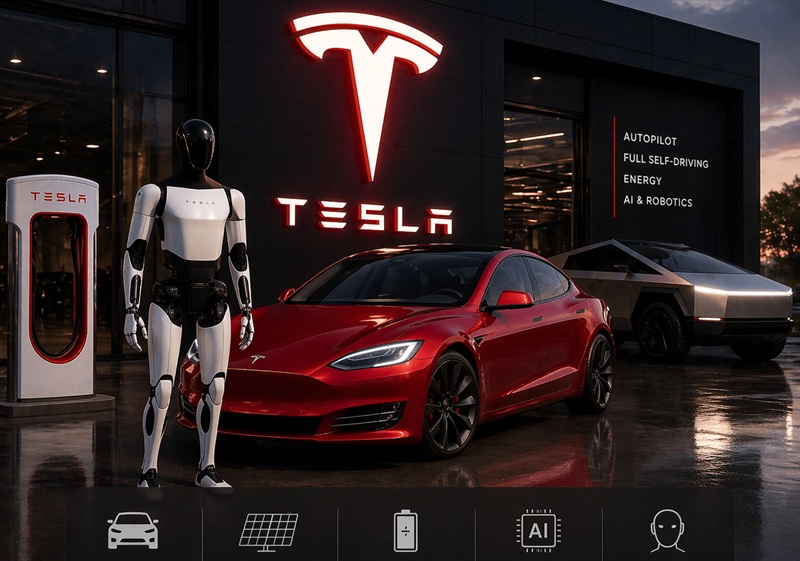
The quarterly report Tesla (TSLA) delivered to markets on Wednesday made one thing clear: the company no longer competes in the same league as Ford, Toyota or Volkswagen. With revenue of $22.38 billion in the first quarter, up 16% year-over-year, the Texas-based manufacturer still sells cars, but its narrative —and its stock market valuation— rests increasingly on a different promise: becoming the great platform for artificial intelligence applied to transportation, energy and robotics.
The message could not be more explicit. This year, Tesla will end production of the Model S and Model X at its Fremont, California plant to repurpose that factory for the assembly line of Optimus, its humanoid robot. It is the clearest industrial signal of a strategic pivot that has been quietly taking shape for months and is now accelerating, backed by a figure that is hard to ignore.
Chief Financial Officer Vaibhav Taneja confirmed that capital expenditure for 2026 will exceed $25 billion, five billion above the guidance offered last quarter and nearly triple the $8.6 billion invested in 2025. It will be, by far, the biggest spending year in Tesla's history.
Part of those resources already has a destination: six new production lines spanning vehicles, batteries, energy storage and robotics. But the real figure could be even higher. Barclays warns that the Terafab project —a semiconductor megaplant developed alongside SpaceX, Intel and Super Micro Computer— could involve billions more in additional costs if fully executed.
The immediate consequence is a deterioration in free cash flow. Market consensus projects negative free cash flow of roughly $6.2 billion in 2026, funded by the company's own war chest, which now exceeds $44.7 billion in cash and short-term investments. Tesla has the cushion to invest. The question is whether it will also have the patience of the market.
The investment thesis Elon Musk has been preaching for months rests on three business lines that today contribute little to the balance sheet but that, according to the company, will define its next decade.
Robotaxi. The driverless ride-hailing service is already operating commercially in Austin, and in the first half of 2026 will expand to Dallas, Houston, Phoenix, Miami, Orlando, Tampa and Las Vegas. Tesla says paid robotaxi miles nearly doubled sequentially, although absolute numbers remain modest. ARK Invest analyst Tasha Keeney has argued that more than 60% of Tesla's projected enterprise value could hinge on this division alone.
FSD (Full Self-Driving) software. Supervised autonomous driving is today the spearhead of software monetization. Active subscriptions reached 1.28 million, up 51% year-over-year. Each one represents a high-margin recurring revenue stream, radically different from the traditional logic of a one-time vehicle sale.
Optimus. The humanoid robot is the most distant bet and also the most audacious. With no material contribution to the income statement, its viability will depend on scaling production from the converted Fremont plant. Until then, Optimus is more a narrative asset than a financial one.
Morningstar analyst Seth Goldstein estimates that the real impact of robotaxis and robots will only begin to show meaningfully on Tesla's results around 2028. Tesla is therefore asking for two years of blind faith.
While the spotlight follows the autonomous vehicle and Optimus, the energy segment is quietly consolidating as the hidden jewel of Tesla's portfolio. In 2025, the energy division billed $13.2 billion, up 31% from the previous year, and remains the most profitable segment in the group, with gross margins near 30% —roughly double those of the automotive business.
Energy storage deployments reached 46.7 GWh in 2025, a 49% year-over-year increase, and the Megapack backlog already exceeds $50 billion, a figure that a decade ago would have seemed unthinkable for a line Tesla considered secondary.
The new generation of the product, Megapack 3, will enter production this year at the Houston Megafactory, targeting an annual capacity of 50 GWh. For some analysts, Tesla Energy could even overtake the automotive business in growth pace before 2028, effectively becoming the stable core of the model while the AI projects mature.
Tesla's stock has fallen nearly 20% so far in 2026, and the reaction to the earnings report was volatile: shares initially rose about 4% in extended trading but gave back the gains when the company announced that this year's spending will be $5 billion above prior guidance.
The market does not dispute the narrative; it disputes its price tag. Automotive revenue remains under pressure from Chinese competition and the global price war, margins are far from 2022 levels, and every additional dollar of capex delays the moment when the new businesses will justify the current valuation —trading at a forward multiple near 55 times earnings, closer to a tech company than an automaker.
Morgan Stanley summed it up in a single word: "critical." The robotaxi rollout has to scale fast to sustain the market capitalization.
Tesla's transformation faces several open fronts at once. Autonomous vehicle regulation advances unevenly across states and could slow the robotaxi expansion. Competition in artificial intelligence no longer comes only from Detroit or Shenzhen, but from Waymo, Nvidia and the major compute providers. Humanoid robot adoption, in both industrial and domestic environments, remains commercially unvalidated territory. And, above all, the narrative rests on a single man: Elon Musk.
To this a structural risk must be added. Tesla is deliberately compressing the margins of the business that is paying the bills today —car sales— to finance businesses that will not generate meaningful returns until at least 2028. A two-year slippage in that timeline could force a brutal multiple recalibration.
The Tesla case transcends the automotive industry. It is a live experiment on how an industrial company tries to metamorphose into a technology platform, shifting its revenue base from a single, low-margin sale toward recurring software services, autonomous fleets and automation.
If the bet works, Tesla will not only redefine its own valuation: it will redefine the rules of what it means to be a company in the post-digital economy, where value no longer lies in what is manufactured but in the intelligence embedded in it. If it fails, the price of the ambition —$25 billion this year, likely more next year— will mark one of the most resounding market corrections of the decade.
For now, the first-quarter numbers only confirm the paradox: a solid but strained present, a promising but uncertain future.

